

AB-620 sample exam questions
15 exam-style questions for Microsoft AB-620: AI Agent Builder in Copilot Studio, with answers and explanations. Take them as a timed practice exam first if you want a score out of 1000.
- A company uses an agent in Copilot Studio that produces structured responses using a reusable instruction template. The responses follow the required tone and format. During a compliance review, the team discovers that the responses were generated using a model that is not on the approved list.
The company requires that the reusable instruction template continues to be used and the model used for prompt-driven responses meets governance requirements.
The solution must ensure that prompt-driven responses are generated using an approved model.
You need to configure the solution that meets the requirements.
Which two actions should you perform? Each correct answer presents part of the solution.
NOTE: Each correct selection is worth one point.- ASelect an approved model from the Microsoft Foundry model catalog in the configuration that is used for prompt-driven response generation.
- BConfigure Azure AI Search as the grounding source so the approved model requirement is enforced during response generation.
- CEnsure the reusable instruction template is the one applied to the agent that generates the structured response.
- DPublish the agent so that the model used by prompt-driven responses is updated automatically.
- EEnable citations so generated responses can be traced and comply with governance requirements.
- FAdd a line to the instruction template that requires the agent to use only approved models when generating responses.
Show answer
Correct answer: A, C
WhyThe prompt-driven response uses a custom prompt, so you pick an approved model from the Foundry model catalog in that prompt's settings and keep the same reusable template applied. Publishing does not change models, Azure AI Search and citations do not enforce model choice, and instruction text cannot control which model runs.
- A
- Note: This question is part of a series of questions that present the same scenario. Each question in the series contains a unique solution that might meet the stated goals. Some question sets might have more than one correct solution, while others might not have a correct solution.
After you answer a question in this section, you will NOT be able to return to it. As a result, these questions will not appear on the review screen.
An agent uses a flow that calls an external service which can occasionally fail or time out.
When a failure occurs, the agent must meet the following requirements:
• Must not terminate silently.
• Must send a notification containing the error details.
You need to configure the agent flow so that failures are handled in a controlled and predictable way.
Solution: Terminate the flow immediately on error.
Does the solution meet the goal?- AYes
- BNo
Show answer
Correct answer: B
WhyTerminating immediately on error is exactly the silent failure the scenario forbids. It sends no notification and gives no error details. A Configure run after scope with a notification action is needed instead.
- A
- A company requires an agent in Copilot Studio to answer questions using content stored in a third-party knowledge base system and reuse that content for knowledge grounding.
The agent must ground answers using indexed enterprise knowledge from a non-Microsoft system.
You need to choose the correct integration approach.
What should you use?- ACall the third-party API from a topic for each question.
- BAdd a Copilot Studio tool as a real-time knowledge source.
- CAdd a Copilot Studio tool and call it from a topic.
- DAdd a Copilot connector knowledge source for authorized content.
Show answer
Correct answer: D
WhyA Copilot connector indexes the third-party content into Microsoft Graph, so the agent can use it as an authorized knowledge source for grounding. Calling an API from a topic or adding a tool is transactional and per-call, not indexed knowledge grounding.
- A
- A tenant administrator configures a Copilot connector that indexes content from an external knowledge system into Microsoft Graph.
A builder is building an agent that must:
• Use the indexed enterprise knowledge during answer generation.
• Avoid duplicating or manually uploading the same content.
• Avoid invoking the system as a transactional tool.
You need to configure the agent so that responses are grounded in the authorized knowledge sources.
What should you do?- AAdd the configured enterprise knowledge source to the agent’s knowledge.
- BCreate a new custom connector inside the agent configuration.
- CAdd the connector as a tool and invoke it from a topic.
- DUpload documents from the external system directly into the agent’s file knowledge store.
Show answer
Correct answer: A
WhyThe connector already indexes the content into Microsoft Graph, so you simply add that enterprise knowledge source to the agent's knowledge. Creating a custom connector, using a tool from a topic, or uploading files would duplicate content or treat the system as transactional.
- A
- DRAG DROP
A solution containing an agent in Copilot Studio is deployed to multiple environments that require different configuration values.
Configuration values must vary by environment without modifying the solution contents.
Configuration values must meet the following requirements:
• Allow values to be set during import.
• Exclude values from the agent definition.
• Run a dedicated agent instance for each individual environment.
You need to associate each requirement with the configuration approach.
What should you configure for each requirement? To answer, move the appropriate configurations to the correct requirements. You may use each configuration once, more than once, or not at all. You may need to move the split bar between panes or scroll to view content.
NOTE: Each correct selection is worth one point.

Move each item to the matching row:
- Use channel-specific settings.
- Define environment variables in the solution.
- Publish distinct agent versions for each environment.
- Hardcode the configuration values in the agent configuration.
- Allow values to be set during import.
- Exclude values from the agent definition.
- Run a dedicated agent instance for each individual environment.
Show answer
- Allow values to be set during import. Define environment variables in the solution.
- Exclude values from the agent definition. Define environment variables in the solution.
- Run a dedicated agent instance for each individual environment. Publish distinct agent versions for each environment.
WhyEnvironment variables are solution components whose values are supplied at import and stored outside the agent definition. Publishing in each environment gives it its own running agent instance. Hardcoded values would require changing the solution for every environment, which the scenario forbids.
- A company is building an agent in Copilot Studio.
The agent must meet the following requirements:
Responses must be grounded in approved internal content.
The agent must be able to retrieve information from configured data sources in a topic.
You need to configure the agent so that topic responses are grounded from custom data sources.
What should you configure?- AEnable analytics to review which topics users trigger most often.
- BAdd a custom prompt that tells the agent to answer only from company data.
- CConfigure knowledge sources in a generative answers node.
- DAdd SharePoint as a knowledge source only at the agent level.
- EIncrease the response length limit to improve answer completeness.
Show answer
Correct answer: C
WhyA generative answers node in a topic can be configured with specific knowledge sources, so topic responses are grounded in approved custom data. Prompt wording does not enforce grounding, agent-level SharePoint does not scope the node, and analytics or length limits are irrelevant.
- A
- DRAG DROP
A company is integrating an agent in Copilot Studio into a custom application by using the Microsoft 365 Agents SDK.
The company has the following requirements for the application:
The deployment workflow must follow a dependency driven sequence.
The agent must be published before configuration values are retrieved.
End-to-end validation must occur before production deployment.
You need to plan the deployment workflow to integrate the agent.
In which order should you perform the actions? To answer, move all actions from the list of actions to the answer area and arrange them in the correct order.
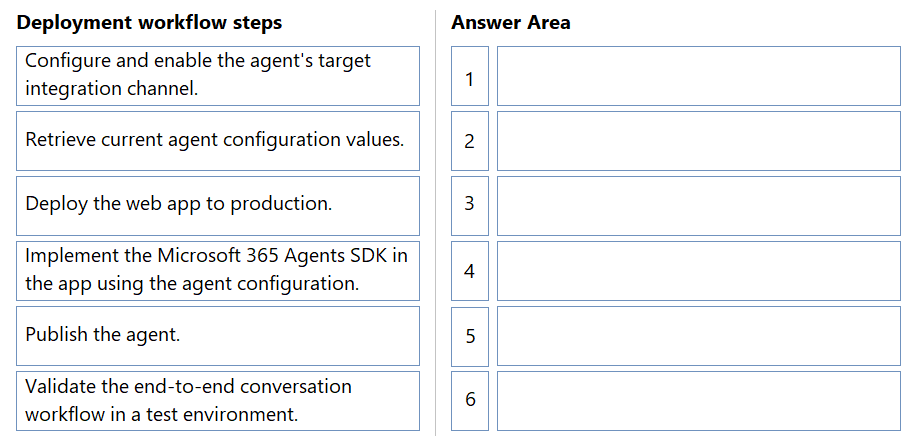
Arrange 6 of these in the correct order:
- Configure and enable the agent's target integration channel.
- Retrieve current agent configuration values.
- Deploy the web app to production.
- Implement the Microsoft 365 Agents SDK in the app using the agent configuration.
- Publish the agent.
- Validate the end-to-end conversation workflow in a test environment.
Show answer
- Configure and enable the agent's target integration channel.
- Publish the agent.
- Retrieve current agent configuration values.
- Implement the Microsoft 365 Agents SDK in the app using the agent configuration.
- Validate the end-to-end conversation workflow in a test environment.
- Deploy the web app to production.
WhyThe channel is enabled and the agent published so that its current settings are available. Those values, such as the environment ID and schema name, configure the Agents SDK client in the app. End-to-end testing then precedes the production deployment.
- A company uses an agent in Copilot Studio that produces structured responses using a reusable instruction template. The responses follow the required tone and format. During a compliance review, the team discovers that the responses were generated using a model that is not on the approved list.
The company requires that the reusable instruction template continues to be used and the model used for prompt-driven responses meets governance requirements.
The solution must ensure that prompt-driven responses are generated using an approved model.
You need to configure the solution that meets the requirements.
Which two actions should you perform? Each correct answer presents part of the solution.
NOTE: Each correct selection is worth one point.- APublish the agent so that the model used by prompt-driven responses is updated automatically.
- BEnable citations so generated responses can be traced and comply with governance requirements.
- CAdd a line to the instruction template that requires the agent to use only approved models when generating responses.
- DConfigure Azure AI Search as the grounding source so the approved model requirement is enforced during response generation.
- EEnsure the reusable instruction template is the one applied to the agent that generates the structured response.
Show answer
Correct answer: C, E
WhyApplying the reusable instruction template to the prompt that generates the structured response is required. The other community pick is weak: instruction text cannot force a model, since the model is chosen in the prompt's model setting. Publishing, citations and Azure AI Search do not enforce model approval.
- A
- DRAG DROP
A company is extending agents in Copilot Studio with both external capabilities and enterprise content access. Some user requests require grounded answers, while other requests require executing actions.
To meet the business needs, the agent must meet the following requirements:
Ground answers using results from enterprise data.
Invoke callable functions exposed through a standardized tool interface.
Write an update to a system by using an authenticated action during the conversation.
You need to integrate the correct approach to meet the requirements.
What should you integrate for each requirement? To answer, move the appropriate integrations to the correct requirements. You may use each integration once, more than once, or not at all. You may need to move the split bar between panes or scroll to view content.
NOTE: Each correct selection is worth one point.

Move each item to the matching row:
- Connect to an MCP server and add its tools to the agent.
- Add Dataverse tables as a structured data knowledge source.
- Add a Power Platform connector tool and call it from a topic.
- Add a Copilot connector knowledge source for indexed content.
- Ground answers using results from enterprise data.
- Invoke callable functions exposed through a standardized tool interface.
- Write an update to a system by using an authenticated action during the conversation.
Show answer
- Ground answers using results from enterprise data. Add a Copilot connector knowledge source for indexed content.
- Invoke callable functions exposed through a standardized tool interface. Connect to an MCP server and add its tools to the agent.
- Write an update to a system by using an authenticated action during the conversation. Add a Power Platform connector tool and call it from a topic.
WhyA Copilot connector knowledge source grounds answers in indexed enterprise content. Model Context Protocol is the standard interface for exposing callable tools, so an MCP server fits the second requirement. Writes need an action, so an authenticated connector tool called from a topic performs the update.
- A company is configuring generative answers for an agent in Copilot Studio agent.
The agent must use Azure AI Search to retrieve enterprise content, and all responses must be generated by a Microsoft Foundry model.
The agent sometimes generates answers that are not grounded in Azure AI Search content. The company requires that the agent only generate responses when relevant indexed content is retrieved.
You need to configure the agent so that its generative answer behavior meets the organization's requirements.
What should you do?- AUse Azure AI Search as a tailback source and enable answer expansion.
- BUpload documents into the agent and disable fallback responses.
- CRequire grounding for generative answers and use Azure AI Search as the retrieval source.
- DEnable citations and configure a public model endpoint.
- EEnable conversational boosting and select a Foundry-approved model.
Show answer
Correct answer: C
WhyRequiring grounding makes the agent answer only when relevant content is retrieved from the Azure AI Search source, preventing ungrounded replies. Answer expansion, disabling fallback, citations, a public endpoint, or conversational boosting do not restrict generation to retrieved content.
- A
- Note: This question is part of a series of questions that present the same scenario. Each question in the series contains a unique solution that might meet the stated goals. Some question sets might have more than one correct solution, while others might not have a correct solution.
After you answer a question in this section, you will NOT be able to return to it. As a result, these questions will not appear on the review screen.
A company is configuring an agent in Copilot Studio that uses a generative answers node inside multiple topics.
The company requires responses to meet the following requirements:
Must use an executive summary format.
Must apply only within a specific topic.
Must continue using configured knowledge sources.
Must comply with connector security controls.
You need to configure a custom prompt to meet the formatting requirements.
Solution: Configure the custom prompt tool at the topic level so that other topics are not affected.
Does the solution meet the goal?- AYes
- BNo
Show answer
Correct answer: B
WhyA custom prompt tool is a standalone prompt action and does not use the node's configured knowledge sources, so it does not meet the knowledge requirement. The topic-scoped formatting should be set on the generative answers node's own custom instructions instead.
- A
- DRAG DROP
A company builds agents in Copilot Studio in a development environment.
The agents are packaged inside a solution and deployed by using Power Platform Pipelines to test and production environments.
The company has the following requirements that must be met:
Production deployments are limited to a defined set of users who are responsible for that stage.
The same solution is reused across all environments without editing its components.
The production environment always receives a locked-down version of the solution.
You need to configure the pipeline and solution behavior to meet the requirements.
What should you configure? To answer, move the appropriate configurations to the correct requirements. You may use each configuration once, more than once, or not at all. You may need to move the split bar between panes or scroll to view content.
NOTE: Each correct selection is worth one point.

Move each item to the matching row:
- Deploy the solution as managed.
- Deploy the solution as unmanaged.
- Use environment variables in the solution.
- Configure stage access for the production stage.
- Limit users who can deploy to production.
- Reuse the same solution across environments without modifying its components.
- Ensure production receives a locked-down version of the solution.
Show answer
- Limit users who can deploy to production. Configure stage access for the production stage.
- Reuse the same solution across environments without modifying its components. Use environment variables in the solution.
- Ensure production receives a locked-down version of the solution. Deploy the solution as managed.
WhyPipeline stage access restricts who may deploy to a given stage. Environment variables hold per-environment values outside the components, so the same solution can be reused unchanged. Managed solutions cannot be edited directly in the target environment, which provides the locked-down production version.
- HOTSPOT
A team deploys Copilot Studio solutions by using Power Platform Pipelines.
You must configure a deployment strategy that meets the following requirements:
Ensure that the solutions deploy in dev, test, and production environments in order.
Identify missing connection references or environment variables before the deployment process begins.
Manage all pipeline stages and security from a single, unified location for all linked environments.
You need to configure the pipeline to meet the requirements.
What should you configure for each requirement? To answer, select the appropriate options in the answer area.
NOTE: Each correct selection is worth one point.
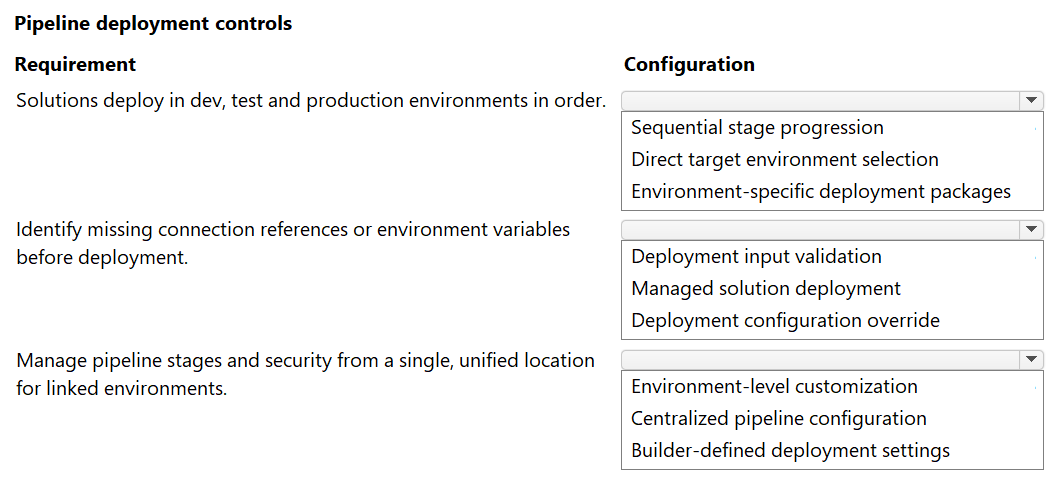
Solutions deploy in dev, test and production environments in order. Sequential stage progression / Direct target environment selection / Environment-specific deployment packages Identify missing connection references or environment variables before deployment. Deployment input validation / Managed solution deployment / Deployment configuration override Manage pipeline stages and security from a single, unified location for linked environments. Environment-level customization / Centralized pipeline configuration / Builder-defined deployment settings Show answer
- Solutions deploy in dev, test and production environments in order. Sequential stage progression
- Identify missing connection references or environment variables before deployment. Deployment input validation
- Manage pipeline stages and security from a single, unified location for linked environments. Centralized pipeline configuration
WhyPipeline stages run sequentially, so a solution moves from dev through test to production in order. Pre-deployment validation flags missing connection references and environment variables. The pipelines host centralizes stage definitions and security for all linked environments in one place.
- Note: This question is part of a series of questions that present the same scenario. Each question in the series contains a unique solution that might meet the stated goals. Some question sets might have more than one correct solution, while others might not have a correct solution.
After you answer a question in this section, you will NOT be able to return to it. As a result, these questions will not appear on the review screen.
A team is implementing ALM for agents in Copilot Studio across multiple environments.
The team requires a consistent way to manage and transport agent assets.
You need to recommend a solution that supports creation and use of ALM scenarios for agents in Copilot Studio.
Solution: To export, import, and manage agents between environments, you need to create and use a custom solution.
Does the solution meet the goal?- AYes
- BNo
Show answer
Correct answer: A
WhySolutions are the supported ALM container in Power Platform. Putting the agent in a custom solution lets you export, import, and version it consistently across Dev, Test and Prod, so this meets the goal.
- A
- Note: This question is part of a series of questions that present the same scenario. Each question in the series contains a unique solution that might meet the stated goals. Some question sets might have more than one correct solution, while others might not have a correct solution.
After you answer a question in this section, you will NOT be able to return to it. As a result, these questions will not appear on the review screen.
A team is implementing ALM for agents in Copilot Studio across multiple environments.
The team requires a consistent way to manage and transport agent assets.
You need to recommend a solution that supports creation and use of ALM scenarios for agents in Copilot Studio.
Solution: Builders can change environment variable values directly in Copilot Studio to complete ALM configuration without administrative tools.
Does the solution meet the goal?- AYes
- BNo
Show answer
Correct answer: B
WhyChanging environment variable values in Copilot Studio is only a configuration piece. It does not package or transport agent assets between environments, which requires solutions and pipelines or admin tools, so it does not meet the goal.
- A