

AI-103 sample exam questions
15 exam-style questions for Microsoft AI-103: Azure AI Apps and Agents Developer, with answers and explanations. Take them as a timed practice exam first if you want a score out of 1000.
- DRAG DROP
You have a Microsoft Foundry project that processes procurement documents submitted by suppliers.
You need to implement two pipelines by using Azure Content Understanding in Foundry Tools. The solution must meet the following requirements:
Include a pipeline named Pipeline1 that supports cost-effective, high-volume processing of standalone PDF invoices.
Include a pipeline named Pipeline2 that supports cross-document validation by using multi-step reasoning and reference data.
How should you configure each pipeline? To answer, drag the appropriate configurations to the correct pipelines. Each configuration may be used once, more than once, of not at all. You may need to drag the split bar between panes or scroll to view content.
NOTE: Each correct selection is worth one point.
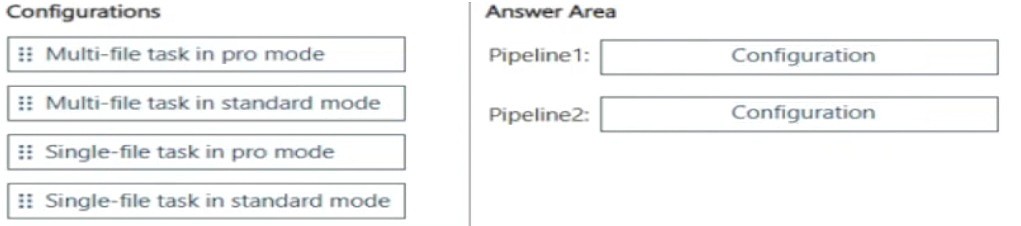
Move each item to the matching row:
- Multi-file task in pro mode
- Multi-file task in standard mode
- Single-file task in pro mode
- Single-file task in standard mode
- Pipeline1
- Pipeline2
Show answer
- Pipeline1 Single-file task in standard mode
- Pipeline2 Multi-file task in pro mode
WhyContent Understanding standard mode is the cost-effective option for high-volume processing of single, standalone files such as invoices. Pro mode adds multi-step reasoning, multi-file input and reference data, which is needed to validate documents against each other in Pipeline2.
- HOTSPOT
You have a Microsoft Foundry project that contains a workflow for a customer support triage process.
You have an Ask a question node that stores user responses in a local variable named Var01.
You need to create the following Power Fx expressions:
An if/else condition expression that ensures that Var01 contains a value
A Send message expression that returns the stored user response in uppercase
How should you configure the expressions? To answer, select the appropriate options in the answer area.
NOTE: Each correct selection is worth one point.
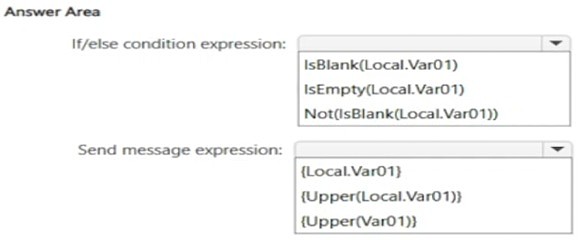
If/else condition expression IsBlank(Local.Var01) / IsEmpty(Local.Var01) / Not(IsBlank(Local.Var01)) Send message expression {Local.Var01} / {Upper(Local.Var01)} / {Upper(Var01)} Show answer
- If/else condition expression Not(IsBlank(Local.Var01))
- Send message expression {Upper(Local.Var01)}
WhyNot(IsBlank(Local.Var01)) is true only when the variable holds a value; IsBlank alone tests the opposite, and IsEmpty is for tables. In a Send message node, Power Fx inside braces is evaluated, and the variable must be referenced with its Local scope prefix, so {Upper(Local.Var01)} returns the answer in uppercase.
- HOTSPOT
You have a Microsoft Foundry project that contains a customer support agent built by using the Foundry Agent Service.
The agent uploads user-provided screenshots to Azure Storage through a ticketing tool and receives a blob URL for additional reasoning.
You need to use image moderation during agent runs and prevent harmful content from being returned during runs. Azure AI Content Safety must access the images by using the blob URL. The solution must follow the principle of least privilege.
What should you configure for Content Safety? To answer, select the appropriate options in the answer area.
NOTE: Each correct selection is worth one point.
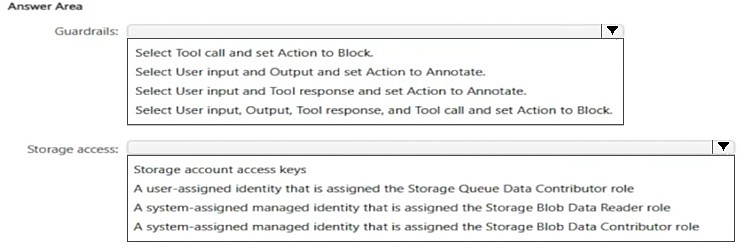
Guardrails Select Tool call and set Action to Block. / Select User input and Output and set Action to Annotate. / Select User input and Tool response and set Action to Annotate. / Select User input, Output, Tool response, and Tool call and set Action to Block. Storage access Storage account access keys / A user-assigned identity that is assigned the Storage Queue Data Contributor role / A system-assigned managed identity that is assigned the Storage Blob Data Reader role / A system-assigned managed identity that is assigned the Storage Blob Data Contributor role Show answer
- Guardrails Select User input, Output, Tool response, and Tool call and set Action to Block.
- Storage access A system-assigned managed identity that is assigned the Storage Blob Data Reader role
WhyTo keep harmful content out of agent runs, the guardrail must cover every intervention point (user input, tool call, tool response and output) with the Block action; Annotate only labels content. Content Safety only needs to read the blobs, so a managed identity with Storage Blob Data Reader is least privilege, unlike account keys or a Contributor role.
- You have an Azure Speech in Foundry Tools resource that hosts a custom speech to text model deployed to a custom endpoint. An agent uses the endpoint to perform real-time speech recognition.
You are approaching the expiration date of the custom speech to text model.
What is the expected behavior when the model expires?- ASpeech recognition requests will return a 4xx error until a new custom model is deployed.
- BSpeech recognition requests will continue to use the expired custom model until the model is removed manually.
- CSpeech recognition requests will fall back to the most recent base model for the same locale.
- DThe custom model will be deleted automatically when the model expires.
Show answer
Correct answer: C
WhyWhen a custom speech model expires, Azure Speech does not fail or delete it; recognition requests to the custom endpoint automatically fall back to the most recent base model for the same locale. You should retrain on a newer base model before expiry to keep the custom accuracy.
- A
- You have a Microsoft Foundry project.
You plan to build a customer support solution that contains an agent. The solution must meet the following requirements:
Provide accurate, context-aware responses grounded in internal product documentation stored in Azure AI Search.
Require deep, multi-step reasoning across long contexts.
Generate detailed natural language responses.
Which type of model should you use to power the agent?- Aa multimodal model
- Ba small language model (SLM)
- Ca key phrase extraction model
- Da large language model (LLM)
Show answer
Correct answer: D
WhyA large language model (such as GPT-4.1 or a reasoning model) is needed for deep multi-step reasoning over long, retrieved contexts and detailed natural language generation in a RAG agent. Small language models trade reasoning depth for cost, multimodal capability is not required, and key phrase extraction cannot generate answers.
- A
- You have a Microsoft Foundry project that contains a prompt agent used by a customer support web app.
The agent is invoked from a Python service that does NOT run in the Foundry portal.
You need to implement end-to-end tracing to capture latency breakdowns and exceptions across agent runs.
Which two components can you use? Each correct answer presents a complete solution.
NOTE: Each correct selection is worth one point.- Aa Log Analytics workspace
- BApplication Insights
- COpenTelemetry
- Dthe Azure Monitor Agent
- EMicrosoft Sentinel
Show answer
Correct answer: B, C
WhyInstrument the Python service with OpenTelemetry (the Azure AI/Foundry SDK tracing instrumentation) and export the spans to Application Insights, which is the trace store Foundry uses for agent tracing and latency and exception views. Log Analytics, Azure Monitor Agent and Sentinel are not the agent tracing components.
- A
- You have a Microsoft Foundry project that contains an agent and an image generation model deployment.
The agent generates original images from user-supplied product photos.
You need to ensure that the generated images maintain the product identity and visual characteristics of the provided photo.
What should you do?- ASet the input_fidelity parameter to high.
- BApply a groundedness detection filter.
- CInclude a prompt and input image in the request.
- DDecrease the value of the temperature parameter.
Show answer
Correct answer: A
WhyFor GPT-image edits, setting input_fidelity to high makes the model preserve fine details of the input image, such as product shape, logos and faces, so the output keeps the product identity. Simply sending the image and prompt uses low fidelity by default, groundedness detection is for text, and image models have no temperature control here.
- A
- You have an app named App1 that uses a Microsoft Foundry multimodal model deployment.
App1 runs optical character recognition (OCR) on uploaded images and appends the OCR output to the prompt as additional context.
Some uploaded images contain embedded text.
You need to prevent potentially malicious instructions from being processed by the model.
What should you use?- Aimage moderation
- Bprompt shields for documents
- Cprotected material text
- Dprompt shields for user prompts
Show answer
Correct answer: B
WhyOCR text appended to the prompt is third-party grounding content, so hidden instructions in it are an indirect prompt injection, which Prompt Shields for documents detects. Prompt Shields for user prompts targets direct jailbreaks typed by the user, image moderation checks harmful visuals, and protected material detects copyrighted text.
- A
- You have a Microsoft Foundry project that contains an agent.
The agent uses a knowledge source built from documents stored in Azure Blob Storage. The documents include digitally scanned PDFs that contain multipage tables.
You have an ingestion job that extracts only plain text, causing loss of table structure, headings, and page-number metadata.
Users frequently ask questions that require the retrieval of specific table rows across the pages.
You need to configure an ingestion job for a Retrieval Augmented Generation (RAG) pipeline that performs optical character recognition (OCR) on scanned PDFs, preserves tables and headings as structure-aware chunks, and stores page-number metadata with each chunk.
How should you configure the ingestion job?- AUse advanced data parsing to reingest the documents.
- BUse OCR and page-level chunking.
- CUse page-level OCR extraction and store each page as a single chunk.
- DUse basic parsing and fixed-size chunking.
Show answer
Correct answer: A
WhyAdvanced data parsing (layout-aware ingestion using Document Intelligence/Content Understanding layout) performs OCR on scanned PDFs, keeps tables and headings as structure-aware chunks and adds page-number metadata. Basic parsing with fixed-size or page-level chunking splits tables and loses structure.
- A
- You plan to configure an evaluation in Microsoft Foundry for a Retrieval Augmented Generation (RAG) chat app.
You need to provide scores for groundedness, relevance, and harmful content categories.
Which two evaluation categories can you use? Each correct answer presents a complete solution.
NOTE: Each correct selection is worth one point.- Arisk and safety metrics
- Bfluency evaluator
- Csimilarity evaluators
- DAI quality (NLP) metrics
- EAI quality (AI assisted) metrics
Show answer
Correct answer: A, E
WhyGroundedness and relevance are AI-assisted quality evaluators (an LLM acts as the judge), and harmful content categories such as hate, violence, sexual and self-harm are risk and safety evaluators. NLP metrics such as BLEU or F1 and the similarity and fluency evaluators do not score groundedness or harm.
- A
- DRAG DROP
You are developing an application that will detect faulty components produced on a factory production line. The components are specific to your business.
You need to use the Azure Custom Vision API to help detect common faults.
Which three actions should you perform in sequence? To answer, move the appropriate actions from the list of actions to the answer area and arrange them in the correct order.
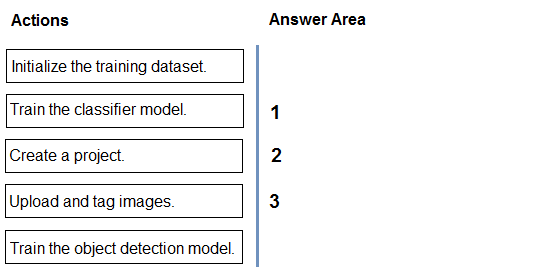
Arrange 3 of these in the correct order:
- Initialize the training dataset.
- Train the classifier model.
- Create a project.
- Upload and tag images.
- Train the object detection model.
Show answer
- Create a project.
- Upload and tag images.
- Train the classifier model.
WhyIn Custom Vision you create a project, upload and tag sample images of good and faulty components, and then train. Classifying each component image as faulty or a specific fault type is a classification project. Initialize the training dataset is not a Custom Vision step, and object detection would only be needed to locate several faults inside one image.
- You have an Azure subscription.
You need to build an app that will compare documents for semantic similarity. The solution must meet the following requirements:
• Return numeric vectors that represent the tokens of each document.
• Minimize development effort.
Which Azure OpenAI model should you use?- AGPT-3.5
- Bembeddings
- CGPT-4
- DDALL-E
Show answer
Correct answer: B
WhyThe Azure OpenAI embeddings models (such as text-embedding-3-small/large) return numeric vectors that represent text, so you can compare documents with cosine similarity with minimal code. GPT-3.5 and GPT-4 generate text, and DALL-E generates images.
- A
- You are building an app that will include one million scanned magazine articles. Each article will be stored as an image file.
You need to configure the app to extract text from the images. The solution must minimize development effort.
What should you include in the solution?- AAzure Document Intelligence in Foundry Tools
- Bthe Read API in Azure Vision in Foundry Tools
- CAzure Vision in Foundry Tools Image Analysis
- DAzure Language in Foundry Tools
Show answer
Correct answer: B
WhyThe Read OCR API in Azure Vision extracts printed and handwritten text from images and is designed for large asynchronous volumes, with minimal development. Image Analysis returns captions and tags, Azure Language needs text input, and Document Intelligence targets forms and structured documents rather than plain article text.
- A
- HOTSPOT
You have an Azure AI Search resource named Search1 that is used by multiple apps hosted in Azure.
You need to secure Search1. The solution must meet the following requirements:
• Prevent access to Search1 from the internet.
• Limit the access of each app to query specific indexes.
What should you do? To answer, select the appropriate options in the answer area.
NOTE: Each correct answer is worth one point.
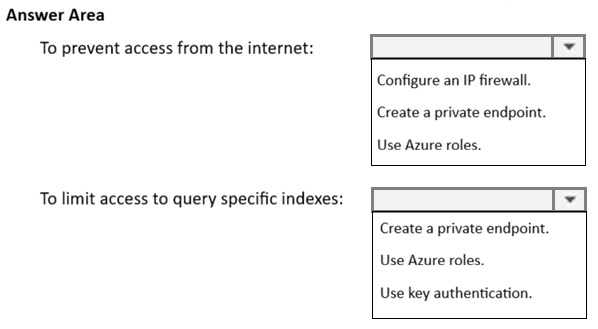
To prevent access from the internet: Configure an IP firewall. / Create a private endpoint. / Use Azure roles. To limit access to query specific indexes: Create a private endpoint. / Use Azure roles. / Use key authentication. Show answer
- To prevent access from the internet: Create a private endpoint.
- To limit access to query specific indexes: Use Azure roles.
WhyA private endpoint lets Azure apps reach Search1 over a private network while public access is disabled. Assigning the Search Index Data Reader role scoped to an index limits an app to querying that index, whereas query keys apply to all indexes on the service.
- You plan to build an app that will generate a list of tags for uploaded images. The app must meet the following requirements:
• Generate tags in a user’s preferred language.
• Support English, French, and Spanish.
• Minimize development effort.
You need to build a function that will generate the tags for the app.
Which Azure service endpoint should you use?- AAzure Vision in Foundry Tools Image Analysis
- BAzure Custom Vision image classification
- CContent Safety in Foundry Control Plane
- DCustom Translator
Show answer
Correct answer: A
WhyAzure Vision Image Analysis returns image tags and supports a language parameter that includes English, French and Spanish, so no training or translation is needed. Custom Vision needs training and returns your own labels, Content Safety classifies harm, and Custom Translator translates text.
- A