

AI-300 sample exam questions
15 exam-style questions for Microsoft AI-300: Operationalizing Machine Learning and Generative AI, with answers and explanations. Take them as a timed practice exam first if you want a score out of 1000.
- A team manages an Azure Machine Learning workspace where they deploy models to online endpoints.
The team needs to introduce a new version of a model to production without disrupting existing users.
The team must validate the new version before full rollout.
You need to reduce risk during deployment.
What should you do?- ADeploy the model to a batch endpoint.
- BSplit traffic between deployments.
- CReplace the existing endpoint.
- DRoute all traffic to the new deployment.
Show answer
Correct answer: B
WhyManaged online endpoints can host several deployments, and traffic splitting lets you send a small share to the new version, validate it, then increase. Replacing the endpoint or routing all traffic risks users, and batch endpoints are not for real-time use.
- A
- An organization maintains separate Azure Machine Learning workspaces for development and production.
Both environments must use the same validated assets without duplicating them.
Assets must be shared across workspaces while maintaining centralized governance and version control.
You need to enable reuse of assets across workspaces without copying them.
What should you do?- AEnable workspace-level Git integration and sync assets between repositories.
- BPublish the asset as a pipeline component.
- CCreate a shared Azure Machine Learning environment that includes the asset.
- DPublish the asset to an Azure Machine Learning registry.
Show answer
Correct answer: D
WhyAn Azure Machine Learning registry shares models, components, environments and data across workspaces with versioning and central governance, without copying. Git sync, pipeline components or a single environment do not provide cross-workspace asset sharing.
- A
- DRAG DROP
You have an existing GitHub repository containing Azure Machine Learning project files.
You need to clone the repository to your Azure Machine Learning shared workspace file system.
Which four actions should you perform in sequence? To answer, move the appropriate actions from the list of actions to the answer area and arrange them in the correct order.
NOTE: More than one order of answer choices is correct. You will receive credit for any of the correct orders you select.
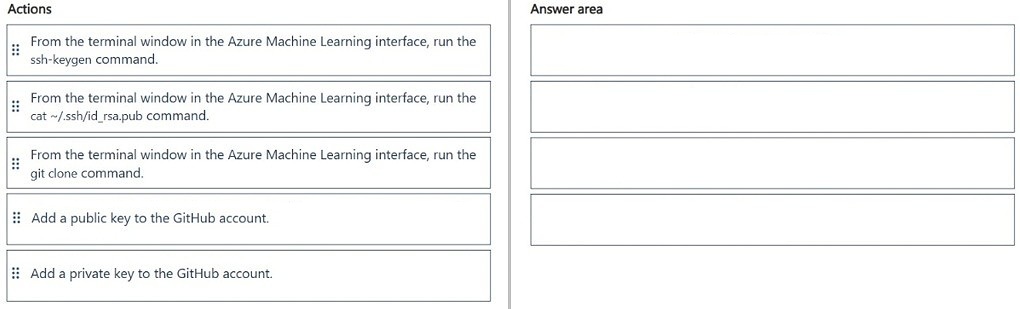
Arrange 4 of these in the correct order:
- From the terminal window in the Azure Machine Learning interface, run the ssh-keygen command.
- From the terminal window in the Azure Machine Learning interface, run the cat ~/.ssh/id_rsa.pub command.
- From the terminal window in the Azure Machine Learning interface, run the git clone command.
- Add a public key to the GitHub account.
- Add a private key to the GitHub account.
Show answer
- From the terminal window in the Azure Machine Learning interface, run the ssh-keygen command.
- From the terminal window in the Azure Machine Learning interface, run the cat ~/.ssh/id_rsa.pub command.
- Add a public key to the GitHub account.
- From the terminal window in the Azure Machine Learning interface, run the git clone command.
WhyGenerate an SSH key pair on the compute instance, display the public key with cat, and add it to GitHub so the terminal can authenticate. Then run git clone in the shared Users file system. The private key always stays on the compute and is never uploaded.
- You create a binary classification model. You use the Fairlearn package to assess model fairness.
You must eliminate the need to retrain the model.
You need to implement the Fairlearn package.
Which algorithm should you use?- Afairiearn.reductions.ExponentiatedGradient
- Bfairlearn.preprocessing.CorrelationRemover
- Cfairlearn.reductions.GridSearch
- Dfairlearn.postprocessing.ThresholdOptimizer
Show answer
Correct answer: D
WhyThresholdOptimizer is a Fairlearn post-processing algorithm that adjusts decision thresholds on an existing model's predictions, so no retraining is needed. ExponentiatedGradient and GridSearch are reduction methods that retrain, and CorrelationRemover is preprocessing.
- A
- A team deploys a model to a real-time endpoint in Azure Machine Learning. You deploy some updates to the endpoint.
The endpoint returns errors after the new deployment is released.
You need to restore the service as quickly as possible.
What should you do first?- ARoll back traffic to the previous deployment.
- BDelete the endpoint and immediately redeploy it.
- CChange the authentication type to Azure Machine Learning token-based authentication.
- DIncrease the compute size.
Show answer
Correct answer: A
WhyWith multiple deployments behind an endpoint, shifting traffic back to the previous working deployment restores service fastest. Deleting and redeploying is slow, and changing auth type or compute size does not fix errors from a bad release.
- A
- HOTSPOT
You use Azure Machine Learning to implement hyperparameter tuning for an Azure ML Python SDK v2-based model training.
Training runs must terminate when the primary metric is lowered by 25 percent or more compared to the best performing run.
You need to configure an early termination policy to terminate training jobs.
Which values should you use? To answer, select the appropriate options in the answer area.
NOTE: Each correct selection is worth one point.
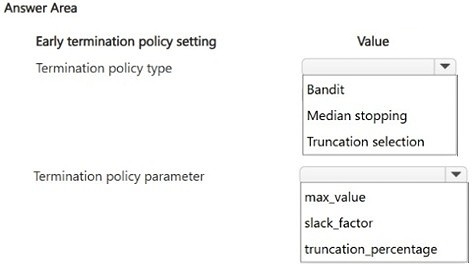
Termination policy type Bandit / Median stopping / Truncation selection Termination policy parameter max_value / slack_factor / truncation_percentage Show answer
- Termination policy type Bandit
- Termination policy parameter slack_factor
WhyA Bandit policy ends runs whose primary metric falls outside an allowed slack from the best run. Setting slack_factor to 0.25 expresses that gap as a ratio. Median stopping compares against running averages, and truncation selection cancels a fixed lowest-performing percentage of runs.
- You have a Microsoft Foundry project.
You plan to use the Microsoft Foundry portal to fine-tune a base Azure OpenAI Service model that can accept both text and images as input.
You need to choose the suitable model.
Which model should you choose?- Adavinci-002
- Bgpt-4o
- Cgpt-35-turbo
- Dgpt-4
Show answer
Correct answer: B
WhyAmong the options, gpt-4o is the model that accepts text and image input and supports vision fine-tuning in Foundry. davinci-002 and gpt-35-turbo are text-only, and gpt-4 does not support image fine-tuning.
- A
- Note: This question is part of a series of questions that present the same scenario. Each question in the series contains a unique solution that might meet the stated goals. Some question sets might have more than one correct solution, while others might not have a correct solution.
After you answer a question in this section, you will NOT be able to return to it. As a result, these questions will not appear on the review screen.
You work in Microsoft Foundry with a prompt flow.
You must manually evaluate prompts and compare results across prompt variants.
You need to capture the inputs, outputs, token usage, and latencies for each flow run for the evaluation.
Solution: Create prompt variants and compare their outputs in the Evaluation experience.
Does the solution meet the goal?- AYes
- BNo
Show answer
Correct answer: A
WhyPrompt variants run in prompt flow and compare in the evaluation view, which records inputs, outputs, token usage and latency for each run, supporting manual comparison. The solution meets the goal.
- A
- HOTSPOT
A team is standardizing MLOps practices by using automated deployments.
The team requires infrastructure to be defined declaratively and deployed through automation pipelines.
You need to configure infrastructure deployment.
What should you configure for each requirement? To answer, select the appropriate options in the answer area.
NOTE: Each correct selection is worth one point.
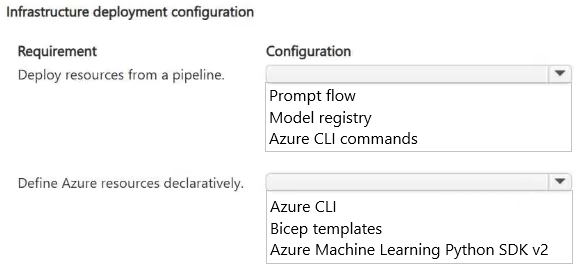
Deploy resources from a pipeline. Prompt flow / Model registry / Azure CLI commands Define Azure resources declaratively. Azure CLI / Bicep templates / Azure Machine Learning Python SDK v2 Show answer
- Deploy resources from a pipeline. Azure CLI commands
- Define Azure resources declaratively. Bicep templates
WhyBicep templates describe the desired Azure resources declaratively as infrastructure as code. A GitHub Actions or Azure Pipelines step can then run Azure CLI commands such as az deployment group create to apply them. The Python SDK and direct CLI resource commands are imperative.
- A team is developing a generative AI assistant. The team is experimenting with multiple prompt variants to improve the user experience.
When comparing prompt variants, the team plans to assess whether the generated responses are grammatically correct.
You need to evaluate the quality of the language from the generated responses.
Which evaluator should you use?- ACoherence
- BTextual similarity
- CGrounded ness
- DFluency
Show answer
Correct answer: D
WhyThe Fluency evaluator measures grammatical correctness and readability of the language. Coherence measures logical flow, textual similarity compares to ground truth, and groundedness checks support from source context.
- A
- DRAG DROP
An organization operates a generative AI application in production by using Microsoft Foundry. The application serves live user traffic and is updated by a data scientist team regularly as prompts and models evolve.
The application intermittently times out during production use, which requires ongoing visibility into runtime behavior.
The team must also validate model quality and safety before releasing new updates to avoid introducing regressions.
You need to apply the correct mechanisms for continuous runtime monitoring and for release time validation.
Which mechanisms should you use for each requirement? To answer, move the appropriate mechanisms to the correct requirements. You may use each mechanism once, more than once, or not at all. You may need to move the split bar between panes or scroll to view content.
NOTE: Each correct selection is worth one point.
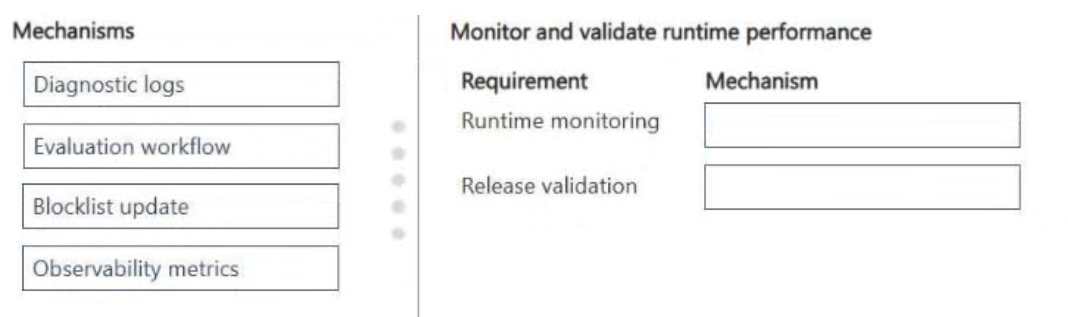
Move each item to the matching row:
- Diagnostic logs
- Evaluation workflow
- Blocklist update
- Observability metrics
- Runtime monitoring
- Release validation
Show answer
- Runtime monitoring Observability metrics
- Release validation Evaluation workflow
WhyObservability metrics give continuous visibility into live behavior such as latency, errors, and timeouts. An evaluation workflow runs quality and safety evaluators against test data before release, which catches regressions. Diagnostic logs help investigate specific problems, and blocklists only filter terms.
- A team develops and manages a conversational assistant by using Microsoft Foundry.
The team must be able to validate that the assistant does not produce hateful responses before the application is exposed to any users.
You need to evaluate the model output for hateful responses as part of a repeatable validation process.
Which evaluator should you configure first?- AProtected material
- BGroundedness
- CIndirect attacks
- DContent safety
Show answer
Correct answer: D
WhyThe content safety evaluators include hate and unfairness, which scores whether output is hateful, so they fit validation before exposure. Protected material, groundedness and indirect attacks check other risks.
- A
- An organization is deploying several generative AI workloads by using Microsoft Foundry. Each workload must meet different requirements related to data governance, task specialization, and operational cost control.
The organization requires models that meet the following requirements:
Model behavior aligns with the task being performed.
Data handling aligns with internal governance policies.
Operational complexity and cost are justified by workload needs.
You need to select the foundation model options that meet the requirements.
Which three models can you select? Each correct answer presents a complete solution. Choose three.
NOTE: Each correct selection is worth one point.- AA model that is optimized for conversational reasoning when deploying an interactive assistant
- BThe largest available model to simplify operational management
- CThe smallest available model to minimize the usage cost
- DA model that supports multiple input types when workloads require combined text and image analysis
- EA model that offers enterprise governance controls when workloads process regulated business data
Show answer
Correct answer: A, D, E
WhyChoosing a model suited to the task (conversational reasoning), with multimodal support when text and image analysis is required, and with enterprise governance controls for regulated data, matches the requirements. Largest or smallest by default ignore fit and cost-benefit.
- A
- HOTSPOT
A team is building a generative AI agent by using Retrieval-Augmented Generation (RAG) in Microsoft Foundry.
The team frequently updates prompt content. The team must be able to track changes across contributors while avoiding full application redeployments.
You need to enable rapid prompt iteration with traceability. Applications consuming the agent must be able to use updated prompts without requiring redeployment.
What should you configure for each requirement? To answer, select the appropriate options in the answer area.
NOTE: Each correct selection is worth one point.
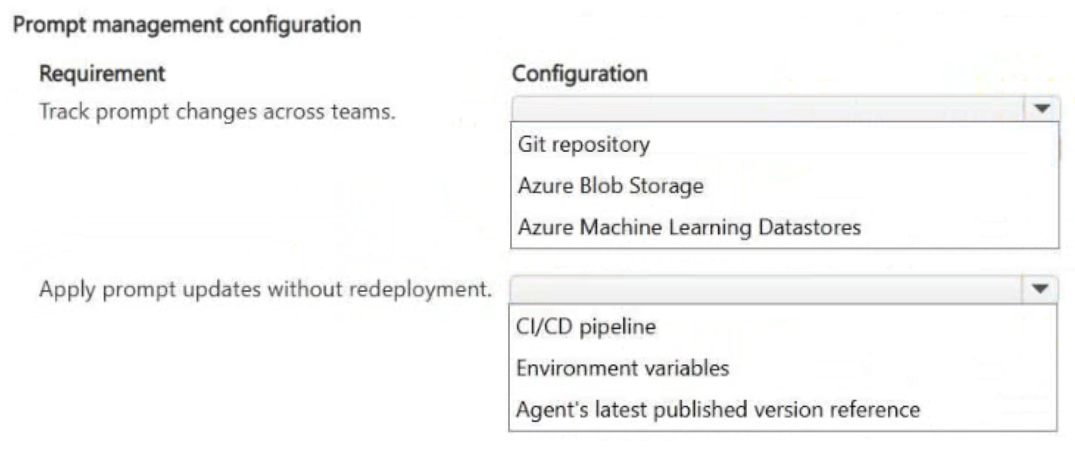
Track prompt changes across teams. Git repository / Azure Blob Storage / Azure Machine Learning Datastores Apply prompt updates without redeployment. CI/CD pipeline / Environment variables / Agent's latest published version reference Show answer
- Track prompt changes across teams. Git repository
- Apply prompt updates without redeployment. Agent's latest published version reference
WhyA Git repository records who changed each prompt and when, giving traceability across contributors. When applications reference the agent's latest published version, publishing a new prompt takes effect for them without redeploying. Blob storage and datastores offer no contributor history or review workflow.
- A Retrieval-Augmented Generation (RAG) solution returns incomplete answers because relevant content is inconsistently retrieved from the knowledge source.
You need to improve RAG accuracy without changing the embedding model currently in use. You need to achieve this goal while minimizing operational costs.
Which two actions should you perform? Each correct answer presents part of the solution. Choose two.
NOTE: Each correct selection is worth one point.- ATune chunk size and overlap to match content structure.
- BImplement an optimized re-ranker.
- CIncrease token limits for all requests.
- DOptimize the length of embedding vectors.
Show answer
Correct answer: A, B
WhyTuning chunk size and overlap and adding a re-ranker both improve retrieval without changing the embedding model and at modest cost. Raising token limits increases cost, and changing vector length alters the embedding setup.
- A