

AIF-C01 sample exam questions
15 exam-style questions for AWS AIF-C01: AI Practitioner, with answers and explanations. Take them as a timed practice exam first if you want a score out of 1000.
- A company makes forecasts each quarter to decide how to optimize operations to meet expected demand. The company uses ML models to make these forecasts.
An AI practitioner is writing a report about the trained ML models to provide transparency and explainability to company stakeholders.
What should the AI practitioner include in the report to meet the transparency and explainability requirements?- ACode for model training
- BPartial dependence plots (PDPs)
- CSample data for training
- DModel convergence tables
Show answer
Correct answer: B
WhyPartial dependence plots show how changing a feature affects the model's predictions, which helps stakeholders understand its behavior. Training code, sample data and convergence tables do not explain how inputs drive the forecasts.
- A
- What does an F1 score measure in the context of foundation model (FM) performance?
- AModel precision and recall
- BModel speed in generating responses
- CFinancial cost of operating the model
- DEnergy efficiency of the model’s computations
Show answer
Correct answer: A
WhyF1 is the harmonic mean of precision and recall, so it measures both together. It does not measure speed, cost or energy use.
- A
- A financial company is using AI systems to obtain customer credit scores as part of the loan application process. The company wants to expand to a new market in a different geographic area. The company must ensure that it can operate in that geographic area.
Which compliance laws should the company review?- ALocal health data protection laws
- BLocal payment card data protection laws
- CLocal education privacy laws
- DLocal algorithm accountability laws
Show answer
Correct answer: D
WhyAI-based credit scoring makes automated decisions about people, so local algorithm accountability laws apply directly. Health, payment card and education privacy laws relate to other kinds of data.
- A
- HOTSPOT
A company wants to use Amazon SageMaker features for various use cases.
Select the correct SageMaker feature from the following list for each use case. Each SageMaker feature should be selected one time or not at all.
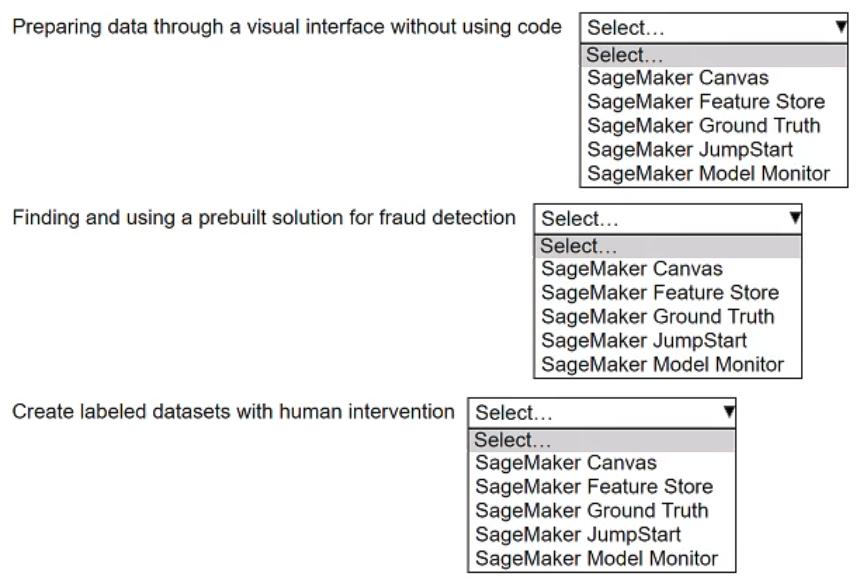
Preparing data through a visual interface without using code SageMaker Canvas / SageMaker Feature Store / SageMaker Ground Truth / SageMaker JumpStart / SageMaker Model Monitor Finding and using a prebuilt solution for fraud detection SageMaker Canvas / SageMaker Feature Store / SageMaker Ground Truth / SageMaker JumpStart / SageMaker Model Monitor Create labeled datasets with human intervention SageMaker Canvas / SageMaker Feature Store / SageMaker Ground Truth / SageMaker JumpStart / SageMaker Model Monitor Show answer
- Preparing data through a visual interface without using code SageMaker Canvas
- Finding and using a prebuilt solution for fraud detection SageMaker JumpStart
- Create labeled datasets with human intervention SageMaker Ground Truth
WhySageMaker Canvas prepares data visually without code. JumpStart offers prebuilt solutions, including for fraud detection. Ground Truth creates labeled datasets with human involvement.
- A retail company wants to build an ML model to recommend products to customers. The company wants to build the model based on responsible practices.
Which practice should the company apply when collecting data to decrease model bias?- AUse data from only customers who match the demographics of the company's overall customer base.
- BCollect data from customers who have a past purchase history.
- CEnsure that the data is balanced and collected from a diverse group.
- DEnsure that the data is from a publicly available dataset.
Show answer
Correct answer: C
WhyBalanced data from a diverse group reduces bias at collection time. Limiting data to one demographic match or past purchasers can exclude groups, and public datasets are not automatically free of bias.
- A
- A company is making a chatbot. The chatbot uses Amazon Lex and Amazon OpenSearch Service. The chatbot uses the company's private data to answer questions. The company needs to convert the data into a vector representation before storing the data in a database.
Which type of foundation model (FM) meets these requirements?- AText completion model
- BInstruction following model
- CText embeddings model
- DImage generation model
Show answer
Correct answer: C
WhyA text embeddings model converts text into vectors that can be stored and searched in OpenSearch. Completion and instruction following models generate text, and image generation models create images.
- A
- A grocery store wants to create a chatbot to help customers find products in the store. The chatbot must check the inventory in real time and provide the product location in the store.
Which prompt engineering technique should the store use to build the chatbot?- AZero-shot prompting
- BFew-shot prompting
- CLeast-to-most prompting
- DReasoning and acting (ReAct) prompting
Show answer
Correct answer: D
WhyReAct combines reasoning with actions, such as calling a tool to check live inventory and location. Zero-shot, few-shot and least-to-most prompting do not include acting on external systems.
- A
- A company is working on a large language model (LLM) and noticed that the LLM’s outputs are not as diverse as expected.
Which parameter should the company adjust?- ATemperature
- BBatch size
- CLearning rate
- DOptimizer type
Show answer
Correct answer: A
WhyRaising temperature adds randomness, which makes outputs more diverse. Batch size, learning rate and optimizer type affect training rather than variety at generation time.
- A
- HOTSPOT
An ecommerce company is developing a generative AI solution to create personalized product recommendations for its application users. The company wants to track how effectively the AI solution increases product sales and user engagement in the application.
Select the correct business metric from the following list for each business goal. Each business metric should be selected one time.
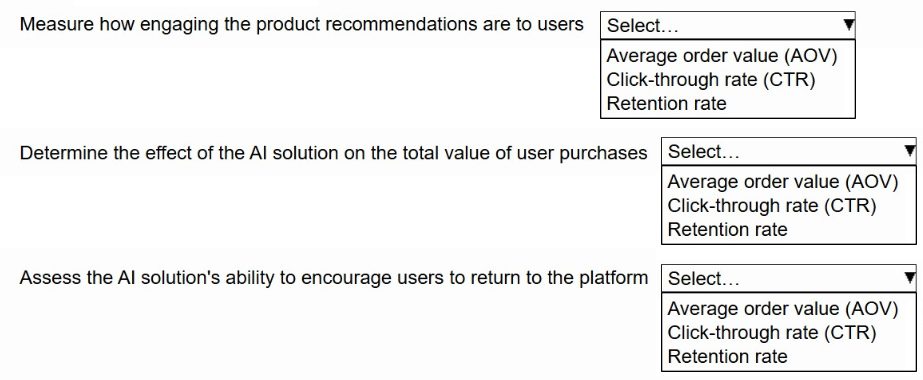
Measure how engaging the product recommendations are to users Average order value (AOV) / Click-through rate (CTR) / Retention rate Determine the effect of the AI solution on the total value of user purchases Average order value (AOV) / Click-through rate (CTR) / Retention rate Assess the AI solution's ability to encourage users to return to the platform Average order value (AOV) / Click-through rate (CTR) / Retention rate Show answer
- Measure how engaging the product recommendations are to users Click-through rate (CTR)
- Determine the effect of the AI solution on the total value of user purchases Average order value (AOV)
- Assess the AI solution's ability to encourage users to return to the platform Retention rate
WhyClick-through rate measures engagement with recommendations. Average order value shows the effect on what users spend. Retention rate shows whether users return.
- Sentiment analysis is a subset of which broader field of AI?
- AComputer vision
- BRobotics
- CNatural language processing (NLP)
- DTime series forecasting
Show answer
Correct answer: C
WhySentiment analysis determines the feeling expressed in language, so it belongs to NLP. Computer vision uses images, robotics concerns physical machines, and forecasting predicts future values.
- A
- HOTSPOT
Select and order the steps from the following list to correctly describe the ML lifecycle for a new custom model. Select each step one time.
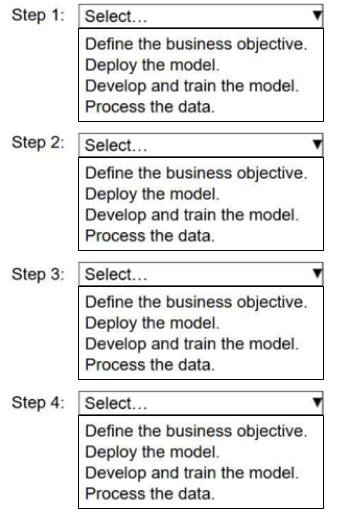
Arrange 4 of these in the correct order:
- Define the business objective.
- Deploy the model.
- Develop and train the model.
- Process the data.
Show answer
- Define the business objective.
- Process the data.
- Develop and train the model.
- Deploy the model.
WhyThe lifecycle starts by defining the business objective, then processing the data, developing and training the model, and finally deploying it.
- A healthcare company wants to create a model to improve disease diagnostics by analyzing patient voices. The company has recorded hundreds of patient voices for this project.
The company is currently filtering voice recordings according to duration and language.
Which phase of the ML lifecycle describes the current project phase?- AData collection
- BData preprocessing
- CFeature engineering
- DModel training
Show answer
Correct answer: B
WhyThe recordings already exist, and filtering them by duration and language is data preprocessing. Collection gathers them, feature engineering creates model inputs, and training comes later.
- A
- HOTSPOT
A company wants to build generative AI applications by using Amazon Bedrock. The company wants to minimize development effort.
Select and order the model development techniques from the following list from the LEAST development effort to the MOST development effort. Each model development technique should be selected one time.
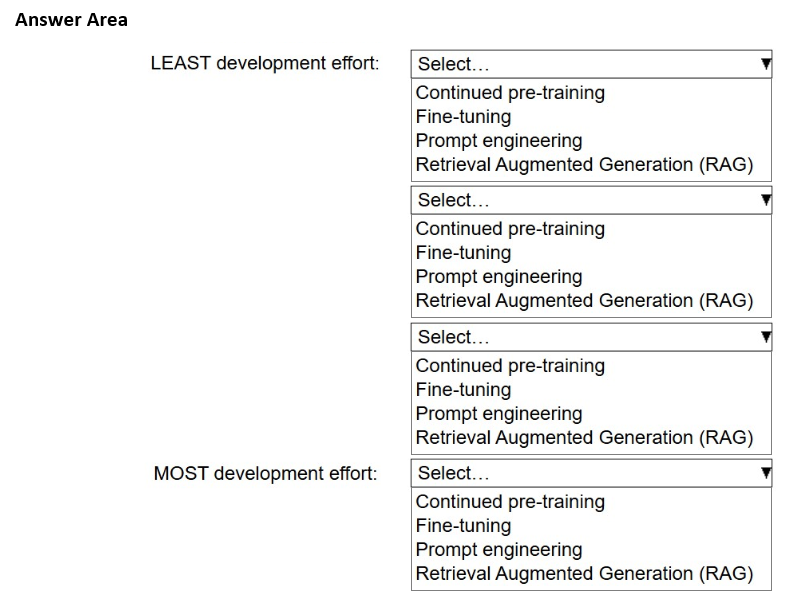
Arrange 4 of these in the correct order:
- Continued pre-training
- Fine-tuning
- Prompt engineering
- Retrieval Augmented Generation (RAG)
Show answer
- Prompt engineering
- Retrieval Augmented Generation (RAG)
- Fine-tuning
- Continued pre-training
WhyPrompt engineering needs no data preparation or training. RAG adds a data source but no training. Fine-tuning requires labeled data and a training job. Continued pre-training requires large amounts of unlabeled data and takes the most work.
- Which AWS service helps select foundation models (FMs) for generative AI use cases?
- AAmazon Personalize
- BAmazon Bedrock
- CAmazon Q Developer
- DAmazon Rekognition
Show answer
Correct answer: B
WhyAmazon Bedrock offers a choice of foundation models and evaluation tools for comparing them. Personalize makes recommendations, Q Developer assists with code, and Rekognition analyzes images and video.
- A
- HOTSPOT
A company is building an AI assistant application. The company must implement a core governance process for the application development project. The company must ensure that the application aligns with responsible AI practices.
Select and order the steps from the following list to correctly describe the implementation of a core governance process for this use case. Select each step one time.
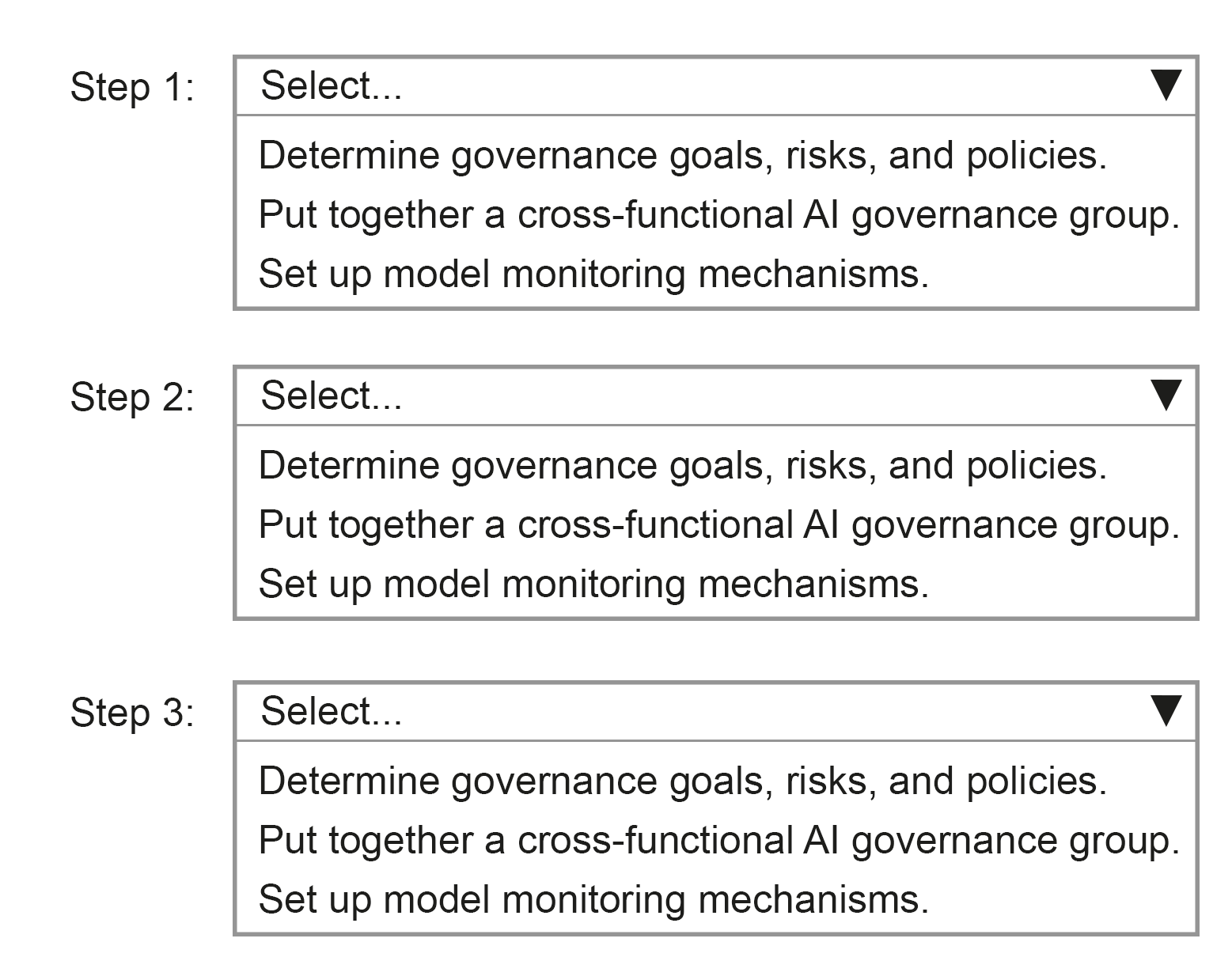
Arrange 3 of these in the correct order:
- Determine governance goals, risks, and policies.
- Put together a cross-functional AI governance group.
- Set up model monitoring mechanisms.
Show answer
- Put together a cross-functional AI governance group.
- Determine governance goals, risks, and policies.
- Set up model monitoring mechanisms.
WhyA cross-functional governance group is formed first, so the right people are in place. That group determines governance goals, risks and policies, and then model monitoring mechanisms put oversight into practice.