

AZ-500 sample exam questions
15 exam-style questions for Microsoft AZ-500: Azure Security Technologies, with answers and explanations. Take them as a timed practice exam first if you want a score out of 1000.
- You want to gather logs from a large number of Windows Server 2016 computers using Azure Log Analytics.
You are configuring an Azure Resource Manager template to deploy the Microsoft Monitoring Agent to all the servers automatically.
Which of the following should be included in the template? (Choose all that apply.)- AWorkspaceID
- BAzureADApplicationID
- CWorkspaceKey
- DStorageAccountKey
Show answer
Correct answer: A, C
WhyThe Microsoft Monitoring Agent extension needs the Log Analytics workspace ID in its public settings and the workspace key in protected settings to connect. No Entra application ID or storage account key is required. MMA is retired; the Azure Monitor Agent with data collection rules replaces it.
- A
- You have an Azure subscription that contains a user named User1.
You need to ensure that User1 can perform the following tasks:
• Create groups.
• Create access reviews for role-assignable groups.
• Assign Azure AD roles to groups.
The solution must use the principle of least privilege.
Which role should you assign to User1?- AGroups administrator
- BAuthentication administrator
- CIdentity Governance Administrator
- DPrivileged role administrator
Show answer
Correct answer: D
WhyPrivileged Role Administrator can create role-assignable groups, assign Microsoft Entra roles to groups and manage access reviews for them. Groups Administrator cannot manage role-assignable groups, Identity Governance Administrator cannot assign Entra roles, and Authentication Administrator is unrelated.
- A
- HOTSPOT
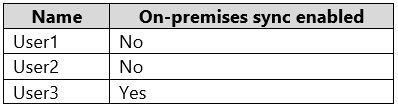
Your network contains an on-premises Active Directory domain that syncs to a Microsoft Entra tenant. The tenant contains the users shown in the following table.
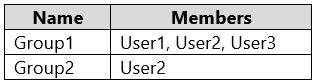
The tenant contains the groups shown in the following table.
You configure a multi-factor authentication (MFA) registration policy that has the following settings:
• Assignments:
o Include: Group1
o Exclude: Group2
• Controls: Require Azure MFA registration
• Enforce Policy: On
For each of the following statements, select Yes if the statement is true. Otherwise, select No.
NOTE: Each correct selection is worth one point.
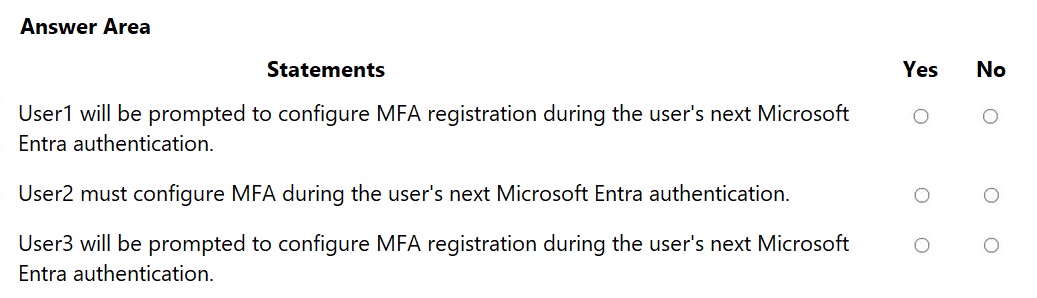
User1 will be prompted to configure MFA registration during the user's next Microsoft Entra authentication. Yes / No User2 must configure MFA during the user's next Microsoft Entra authentication. Yes / No User3 will be prompted to configure MFA registration during the user's next Microsoft Entra authentication. Yes / No Show answer
- User1 will be prompted to configure MFA registration during the user's next Microsoft Entra authentication. Yes
- User2 must configure MFA during the user's next Microsoft Entra authentication. No
- User3 will be prompted to configure MFA registration during the user's next Microsoft Entra authentication. Yes
WhyThe MFA registration policy applies to Group1 minus Group2. User1 and User3 are in scope, and synced users register just like cloud-only users. User2 is excluded through Group2, so the policy never applies to User2.
- Note: This question is part of a series of questions that present the same scenario. Each question in the series contains a unique solution that might
meet the stated goals. Some question sets might have more than one correct solution, while others might not have a correct solution.
After you answer a question in this section, you will NOT be able to return to it. As a result, these questions will not appear in the review screen.
You have an Azure subscription. The subscription contains 50 virtual machines that run Windows Server 2012 R2 or Windows Server 2016.
You need to deploy Microsoft Antimalware to the virtual machines.
Solution: You connect to each virtual machine and add a Windows feature.
Does this meet the goal?- AYes
- BNo
Show answer
Correct answer: B
WhyMicrosoft Antimalware for Azure is deployed as a VM extension (IaaSAntimalware), not by adding a Windows feature inside each VM. Manually adding a feature on 50 VMs does not deploy Microsoft Antimalware for Azure.
- A
- You have an Azure subscription that contains a user named Admin1 and a virtual machine named VM1. VM1 runs Windows Server 2019 and was deployed by
using an Azure Resource Manager template. VM1 is the member of a backend pool of a public Azure Basic Load Balancer.
Admin1 reports that VM1 is listed as Unsupported on the Just in time VM access blade of Azure Security Center.
You need to ensure that Admin1 can enable just in time (JIT) VM access for VM1.
What should you do?- ACreate and configure a network security group (NSG).
- BCreate and configure an additional public IP address for VM1.
- CReplace the Basic Load Balancer with an Azure Standard Load Balancer.
- DAssign an Azure Active Directory Premium Plan 1 license to Admin1.
Show answer
Correct answer: A
WhyJIT VM access shows a VM as Unsupported when it has no network security group (or Azure Firewall) to control the management ports. Creating and associating an NSG with VM1's NIC or subnet makes it eligible. The load balancer type, extra public IPs and Entra licenses are not requirements.
- A
- HOTSPOT
You have an Azure subscription that contains the following Azure firewall:
• Name: Fw1
• Azure region: UK West
• Private IP address: 10.1.3.4
• Public IP address: 23.236.62.147
The subscription contains the virtual networks shown in the following table.

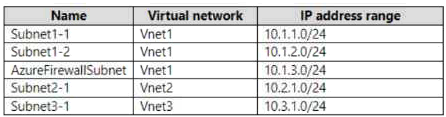
The subscription contains the subnets shown in the following table.
The subscription contains the routes shown in the following table.
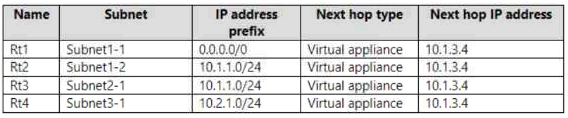
For each of the following statements, select Yes if the statement is true. Otherwise, select No.
NOTE: Each correct selection is worth one point.
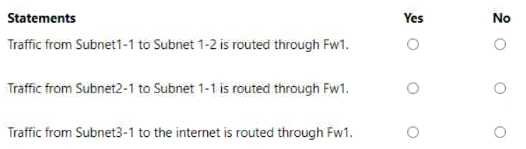
Traffic from Subnet1-1 to Subnet 1-2 is routed through Fw1. Yes / No Traffic from Subnet2-1 to Subnet 1-1 is routed through Fw1. Yes / No Traffic from Subnet3-1 to the internet is routed through Fw1. Yes / No Show answer
- Traffic from Subnet1-1 to Subnet 1-2 is routed through Fw1. No
- Traffic from Subnet2-1 to Subnet 1-1 is routed through Fw1. Yes
- Traffic from Subnet3-1 to the internet is routed through Fw1. No
WhyAzure picks the route with the longest matching prefix. In Subnet1-1, the 10.1.0.0/16 VNet system route beats Rt1 (0.0.0.0/0). Rt3 sends 10.1.1.0/24 from Subnet2-1 to Fw1 across the peering. Subnet3-1 only has Rt4 for 10.2.1.0/24, so its internet traffic goes out directly.
- You have a web app named WebApp1.
You create a web application firewall (WAF) policy named WAF1.
You need to protect WebApp1 by using WAF1.
What should you do first?- ADeploy an Azure Front Door.
- BAdd an extension to WebApp1.
- CDeploy Azure Firewall.
Show answer
Correct answer: A
WhyA WAF policy cannot be attached to an App Service web app directly. It must be associated with a supported front end, so you first deploy Azure Front Door (or Application Gateway). Azure Firewall does not use WAF policies, and an extension is not how WAF is applied.
- A
- DRAG DROP
Your network contains an on-premises Active Directory domain named contoso.com. The domain contains a user named User1.
You have an Azure subscription that is linked to an Azure Active Directory (Azure AD) tenant named contoso.com. The tenant contains an Azure Storage account named storage1. Storage1 contains an Azure file share named share1.
Currently, the domain and the tenant are not integrated.
You need to ensure that User1 can access share1 by using his domain credentials.
Which three actions should you perform in sequence? To answer, move the appropriate actions from the list of actions to the answer area and arrange them in the correct order.
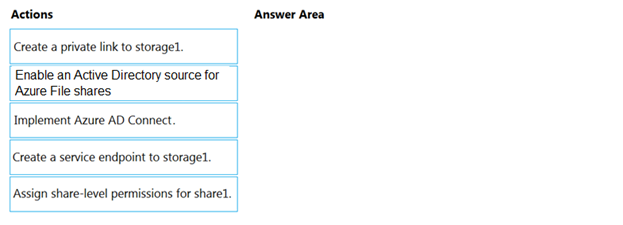
Arrange 3 of these in the correct order:
- Create a private link to storage1.
- Enable an Active Directory source for Azure File shares
- Implement Azure AD Connect.
- Create a service endpoint to storage1.
- Assign share-level permissions for share1.
Show answer
- Implement Azure AD Connect.
- Enable an Active Directory source for Azure File shares
- Assign share-level permissions for share1.
WhyUser1 must first be synced to Azure AD with Azure AD Connect (now Microsoft Entra Connect). Then enable AD DS identity-based authentication on storage1 for Azure Files, and assign a share-level RBAC role such as Storage File Data SMB Share Contributor. Private links and service endpoints only affect network access.
- HOTSPOT
You have an Azure Subscription that is connected to an on-premises datacenter and contains the resources shown in the following table.
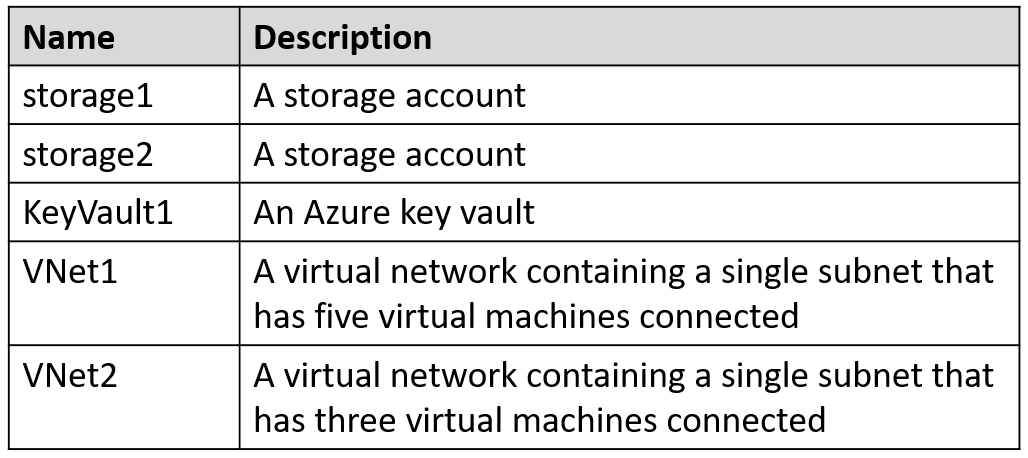
You need to configure virtual network service endpoints for VNet1 and VNet2. The solution must meet the following requirements:
• The virtual machines that connect to the subnet of VNet1 must access storage1, storage2, and Azure AD by using the Microsoft backbone network.
• The virtual machines that connect to the subnet of VNet2 must access storage1 and KeyVault1 by using the Microsoft backbone network.
• The virtual machines must use the Microsoft backbone network to communicate between VNet1 and VNet2.
How many service endpoints should you configure for each virtual network? To answer, select the appropriate options in the answer area.
NOTE: Each correct selection is worth one point.
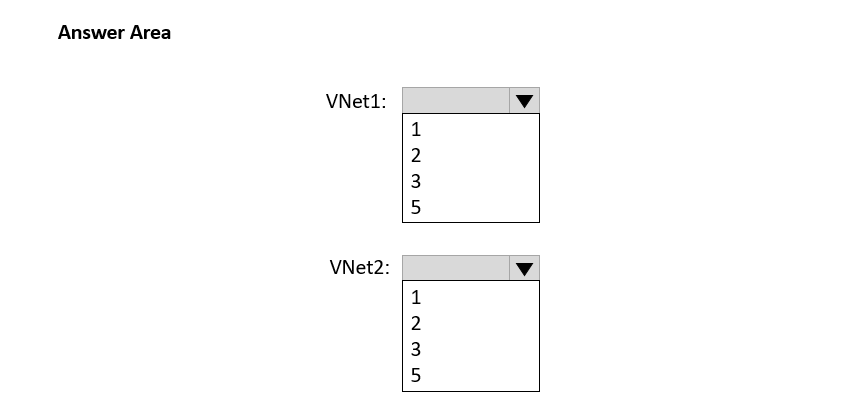
VNet1: 1 / 2 / 3 / 5 VNet2: 1 / 2 / 3 / 5 Show answer
- VNet1: 2
- VNet2: 2
WhyEndpoints are per service, not per resource. VNet1 needs Microsoft.Storage and Microsoft.AzureActiveDirectory; VNet2 needs Microsoft.Storage and Microsoft.KeyVault. Peering already covers traffic between the networks. The Azure AD endpoint is outdated and no longer a supported option.
- You have an Azure subscription.
You need to deploy an Azure virtual WAN to meet the following requirements:
• Create three secured virtual hubs located in the East US, West US, and North Europe Azure regions.
• Ensure that security rules sync between the regions.
What should you use?- AAzure Virtual Network Manager
- BAzure Front Door
- CAzure Network Function Manager
- DAzure Firewall Manager
Show answer
Correct answer: D
WhyAzure Firewall Manager creates secured virtual hubs in a Virtual WAN and manages firewall policies centrally, syncing rules across regions. Virtual Network Manager handles virtual network connectivity and admin rules, not secured hubs; Front Door and Network Function Manager do not fit.
- A
- You have an Azure subscription that contains a storage account and an Azure web app named App1.
App1 connects to an Azure Cosmos DB database named Cosmos1 that uses a private endpoint named Endpoint1. Endpoint1 has the default settings.
You need to validate the name resolution to Cosmos1.
Which DNS zone should you use?- Aendpoint1.privatelink.documents.azure.com
- Bendpoint1.privatelink.blob.core.windows.net
- Cendpoint1.privatelink.azurewebsites.net
- Dendpoint1.privatelink.database.azure.com
Show answer
Correct answer: A
WhyA Cosmos DB for NoSQL private endpoint registers its records in the privatelink.documents.azure.com private DNS zone. The blob, azurewebsites and database.azure.com zones belong to other services, so they will not resolve Cosmos1.
- A
- HOTSPOT
Your company uses cloud-based resources from the following platforms:
• Azure
• Amazon Web Services (AWS)
• Google Cloud Platform (GCP)
You plan to implement Microsoft Defender for Cloud.
On which platforms can you use Defender for Cloud to protect containers and storage? To answer, select the appropriate options in the answer area.
NOTE: Each correct selection is worth one point.
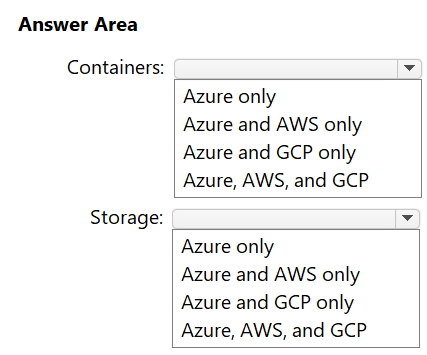
Containers: Azure only / Azure and AWS only / Azure and GCP only / Azure, AWS, and GCP Storage: Azure only / Azure and AWS only / Azure and GCP only / Azure, AWS, and GCP Show answer
- Containers: Azure, AWS, and GCP
- Storage: Azure only
WhyDefender for Containers protects AKS, Amazon EKS and Google GKE clusters through multicloud connectors. The Defender for Storage plan protects Azure Storage only. Multicloud coverage changes often, so check the current Defender for Cloud support matrix.
- You need to configure WebApp1 to meet the data and application requirements.
Which two actions should you perform? Each correct answer presents part of the solution.
NOTE: Each correct selection is worth one point.- AUpload a public certificate.
- BTurn on the HTTPS Only protocol setting.
- CSet the Minimum TLS Version protocol setting to 1.2.
- DChange the pricing tier of the App Service plan.
- ETurn on the Incoming client certificates protocol setting.
Show answer
Correct answer: B, E
WhyHTTPS Only forces encrypted traffic to protect data in transit, and Incoming client certificates make the web app require client certificate authentication. Setting TLS 1.2 or uploading a public certificate does not by itself satisfy the stated requirements, and tier change is not needed.
- A
- You plan to configure Azure Disk Encryption for VM4.
Which key vault can you use to store the encryption key?- AKeyVault1
- BKeyVault2
- CKeyVault3
Show answer
Correct answer: A
WhyAzure Disk Encryption requires the key vault to be in the same region and subscription as the VM and to have disk encryption access enabled. Only KeyVault1 satisfies that for VM4 according to the exhibit, so the others are excluded.
- A
- You need to ensure that users can access VM0. The solution must meet the platform protection requirements.
What should you do?- AMove VM0 to Subnet1.
- BOn Firewall, configure a network traffic filtering rule.
- CAssign RT1 to AzureFirewallSubnet.
- DOn Firewall, configure a DNAT rule.
Show answer
Correct answer: A
WhyPlatform protection requirements usually route subnet traffic through the firewall using the route table. VM0 is not in a subnet that reaches users correctly, so moving it to Subnet1 gives it the required path, whereas rules or route table changes do not solve this.
- A