

AZ-800 sample exam questions
15 exam-style questions for Microsoft AZ-800: Windows Server Hybrid Core Infrastructure, with answers and explanations. Take them as a timed practice exam first if you want a score out of 1000.
- HOTSPOT
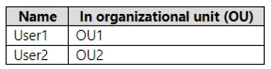
Your network contains an on-premises Active Directory Domain Services (AD DS) domain named contoso.com that syncs with an Azure AD tenant. The tenant contains a group named Group1 and the users shown in the following table.
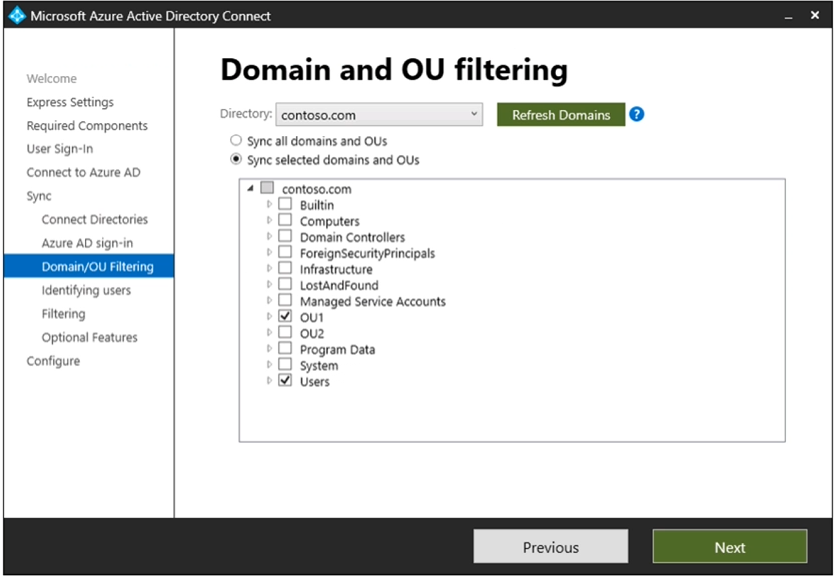
Domain/OU filtering in Azure AD Connect is configured as shown in the Filtering exhibit. (Click the Filtering tab.)
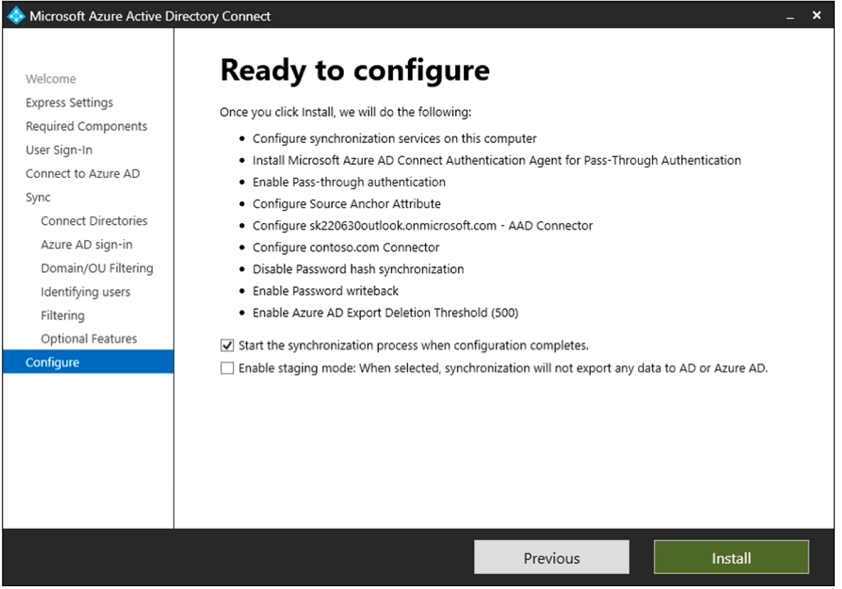
You review the Azure AD Connect configurations as shown in the Configure exhibit. (Click the Configure tab.)
For each of the following statements, select Yes if the statement is true. Otherwise, select No.
NOTE: Each correct selection is worth one point.
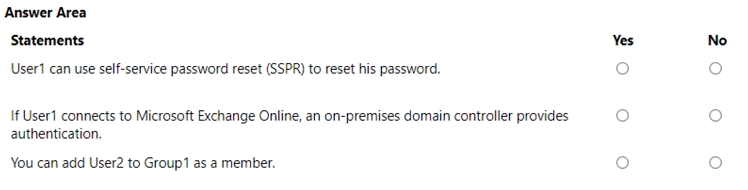
User1 can use self-service password reset (SSPR) to reset his password. Yes / No If User1 connects to Microsoft Exchange Online, an on-premises domain controller provides authentication. Yes / No You can add User2 to Group1 as a member. Yes / No Show answer
- User1 can use self-service password reset (SSPR) to reset his password. Yes
- If User1 connects to Microsoft Exchange Online, an on-premises domain controller provides authentication. Yes
- You can add User2 to Group1 as a member. No
WhyOU1 is synced and password writeback is enabled, so User1 can use SSPR. Pass-through authentication validates sign-ins against on-premises DCs. OU2 is not in scope, so User2 never reaches the tenant and cannot be added to Group1. Azure AD Connect is now Microsoft Entra Connect.
- You have an Active Directory Domain Services (AD DS) domain that contains the domain controllers shown in the following table.
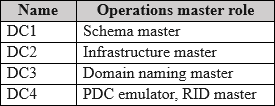
The domain contains an app named App1 that uses a custom application partition to store configuration data.
You decommission App1.
When you attempt to remove the custom application partition, the process fails.
Which domain controller is unavailable?- ADC1
- BDC2
- CDC3
- DDC4
Show answer
Correct answer: C
WhyRemoving an application partition requires the replica holders and the domain naming master to be reachable. Exhibit is missing, so this follows the community answer DC3, presumably the DC that holds a replica of the partition or the domain naming master.
- A
- You have an on premises Active Directory Domain Services (AD DS) domain that syncs with an Azure Active Directory (Azure AD) tenant. The domain contains
two servers named Server1 and Server2.
A user named Admin1 is a member of the local Administrators group on Server1 and Server2.
You plan to manage Server1 and Server2 by using Azure Arc. Azure Arc objects will be added to a resource group named RG1.
You need to ensure that Admin1 can configure Server1 and Server2 to be managed by using Azure Arc.
What should you do first?- AFrom the Azure portal, generate a new onboarding script.
- BAssign Admin1 the Azure Connected Machine Onboarding role for RG1.
- CHybrid Azure AD join Server1 and Server2.
- DCreate an Azure cloud-only account for Admin1.
Show answer
Correct answer: B
WhyTo onboard servers to Azure Arc, the admin needs the Azure Connected Machine Onboarding role, or Contributor, on the target resource group RG1. A script can only be generated and run successfully with that permission. Hybrid join and a cloud account are not required.
- A
- HOTSPOT
You have a server that runs Windows Server and contains 10 physical disks.
You plan to implement storage spaces that will use the disks.
You are evaluating whether to configure the following options:
• A two-way mirror
• A parity storage layout
What is the maximum number of disks that can fail without data loss for each option? To answer, select the appropriate options in the answer area.
NOTE: Each correct selection is worth one point.
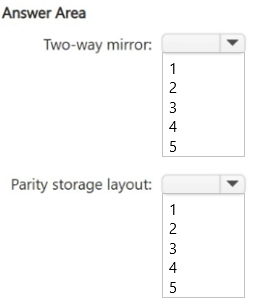
Two-way mirror: 1 / 2 / 3 / 4 / 5 Parity storage layout: 1 / 2 / 3 / 4 / 5 Show answer
- Two-way mirror: 1
- Parity storage layout: 2
WhyA two-way mirror keeps two copies of the data, so it survives one disk failure. With seven or more disks, a Storage Spaces parity space can use dual parity, which survives two simultaneous disk failures, so 10 disks allow a maximum of two.
- Your on-premises network has an IP address range of 10.0.0.0/23.
You have an Azure virtual network named VNet1 that contains a virtual machine named VM1.
VNet1 has an IP address range of 10.0.1.0/24.
You need to deploy a Site-to-Site (S2S) VPN to connect the on-premises network to VNet1.
What should you do first?- ADeploy Azure Bastion to VNet1.
- BDeploy Azure Extended Network.
- CConfigure VNet1 to use the IP address range of 10.0.2.0/24.
- DConfigure VNet1 to use an IP address range of 10.0.1.128/25.
Show answer
Correct answer: C
WhyOn-premises 10.0.0.0/23 covers 10.0.0.0 to 10.0.1.255, so it overlaps VNet1's 10.0.1.0/24, and S2S VPN needs non-overlapping ranges. Changing VNet1 to 10.0.2.0/24 removes the overlap. 10.0.1.128/25 is still inside the on-premises range, and Bastion or Extended Network do not solve it.
- A
- DRAG DROP
You have an Azure subscription. The subscription contains multiple virtual machines that run Windows Server.
You need to create an Azure Machine Configuration package.
Which three actions should you perform in sequence? To answer, move the appropriate actions from the list of actions to the answer area and arrange them in the correct order.
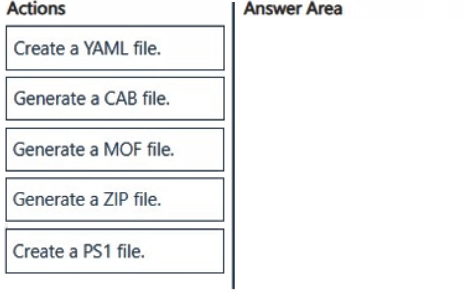
Arrange 3 of these in the correct order:
- Create a YAML file.
- Generate a CAB file.
- Generate a MOF file.
- Generate a ZIP file.
- Create a PS1 file.
Show answer
- Create a PS1 file.
- Generate a MOF file.
- Generate a ZIP file.
WhyWrite a DSC configuration in a PS1 script and compile it to produce a MOF file. New-GuestConfigurationPackage then bundles the MOF and its required modules into a ZIP file, which is the Azure Machine Configuration package format.
- Your network contains an Active Directory Domain Services (AD DS) domain. The domain contains a user named User1 and the servers shown in the following table.

You need to ensure that User1 can manage only Scope1 and Scope3.
What should you do?- AAdd User1 to the DHCP Administrators group on Server1 and Server2.
- BImplement IP Address Management (IPAM).
- CAdd User1 to the DHCP Administrators domain local group.
- DImplement Windows Admin Center and add connections to Server1 and Server2.
Show answer
Correct answer: B
WhyScope-level delegation across servers is done with IPAM, which uses role-based access control with access scopes and roles so User1 can manage only Scope1 and Scope3. DHCP Administrators group membership grants access to the whole server, and Windows Admin Center does not limit access per scope.
- A
- HOTSPOT
Your network contains the segments shown in the following table.
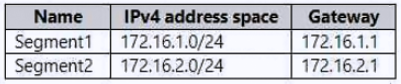
You have servers that run Windows Server and are configured as shown in the following table.

You deploy a server named Server4 that runs Windows Server and has a static IP address of 172.16.1.1. You connect Server4 to Segment1.
For each of the following statements, select Yes if the statement is true. Otherwise, select No.
NOTE: Each correct selection is worth one point,
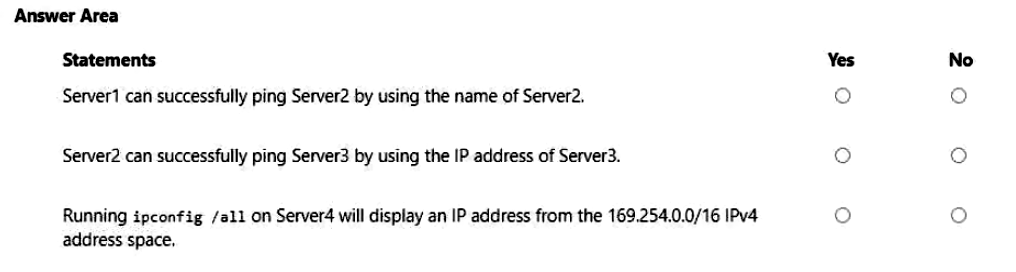
Server1 can successfully ping Server2 by using the name of Server2. Yes / No Server2 can successfully ping Server3 by using the IP address of Server3. Yes / No Running ipconfig /all on Server4 will display an IP address from the 169.254.0.0/16 IPv4 address space. Yes / No Show answer
- Server1 can successfully ping Server2 by using the name of Server2. No
- Server2 can successfully ping Server3 by using the IP address of Server3. No
- Running ipconfig /all on Server4 will display an IP address from the 169.254.0.0/16 IPv4 address space. Yes
WhyServer2 has a Segment2 address but sits on Segment1. Server1 routes to it via the gateway, which delivers to Segment2, and Server2 tries ARP for Server3 on the wrong segment; both fail. Server4 duplicates the gateway's address, so Windows detects the conflict and adds an APIPA address.
- You have a server named Server1 that runs Windows Server.
You plan to host applications in Windows containers.
You need to configure Server1 to run containers.
What should you install?- AWindows Admin Center
- BDocker
- Cthe Windows Subsystem for Linux
- DHyper-V
Show answer
Correct answer: B
WhyRunning Windows containers on Windows Server needs a container runtime, which is Docker (Docker Engine or Mirantis), along with the Containers feature. WSL runs Linux, Windows Admin Center is only a management tool, and Hyper-V is needed only for Hyper-V isolation, not the base setup.
- A
- HOTSPOT
Your company has a main office and 10 branch offices that are connected by using WAN links. The network contains an Active Directory domain.
All users have laptops and regularly travel between offices.
You plan to implement BranchCache in the branch offices.
In each branch office, you install a server that runs Windows Server and the BranchCache feature. You register the servers in Active Directory.
You need to configure the laptops to use the local BranchCache server automatically. The solution must minimize administrative effort.
Which two Group Policy settings should you configure? To answer, select the settings in the answer area.
NOTE: Each correct selection is worth one point.
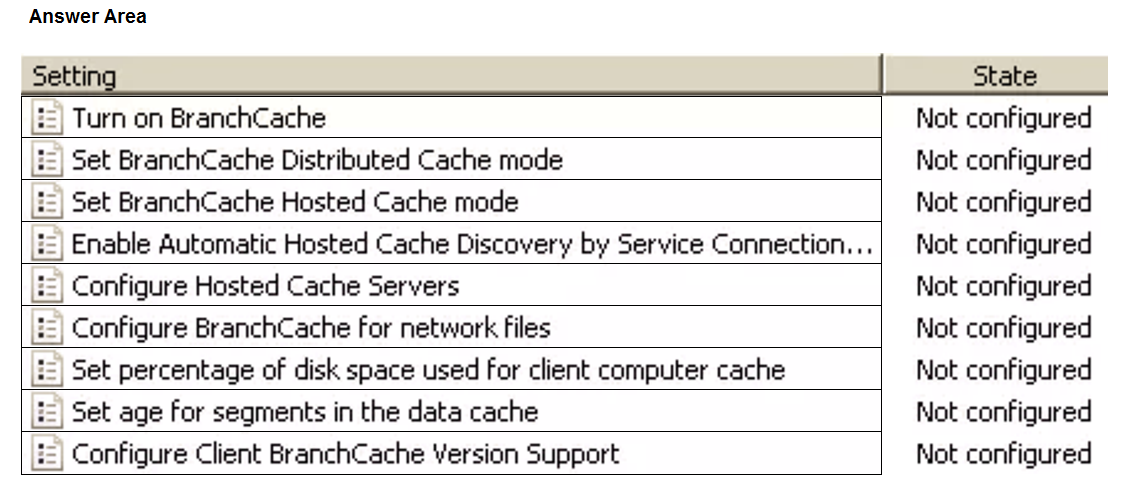
Turn on BranchCache Yes / No Set BranchCache Distributed Cache mode Yes / No Set BranchCache Hosted Cache mode Yes / No Enable Automatic Hosted Cache Discovery by Service Connection Point Yes / No Configure Hosted Cache Servers Yes / No Configure BranchCache for network files Yes / No Set percentage of disk space used for client computer cache Yes / No Set age for segments in the data cache Yes / No Configure Client BranchCache Version Support Yes / No Show answer
- Turn on BranchCache Yes
- Set BranchCache Distributed Cache mode No
- Set BranchCache Hosted Cache mode No
- Enable Automatic Hosted Cache Discovery by Service Connection Point Yes
- Configure Hosted Cache Servers No
- Configure BranchCache for network files No
- Set percentage of disk space used for client computer cache No
- Set age for segments in the data cache No
- Configure Client BranchCache Version Support No
WhyTurn on BranchCache enables the client, and automatic discovery by service connection point lets laptops find the hosted cache server registered in Active Directory for their current site. Travelling users therefore need no per-office server list, which minimizes administrative effort.
- What should you implement for the deployment of DC3?
- AAzure Active Directory Domain Services (Azure AD DS)
- Ban Azure virtual machine
- Can Azure AD administrative unit
- DAzure AD Application Proxy
Show answer
Correct answer: B
WhyA domain controller DC3 in Azure is deployed as an Azure virtual machine running AD DS. Azure AD DS is a managed service and does not provide a real DC you join to the on-premises forest. Administrative units and Application Proxy are unrelated.
- A
- You need to meet the technical requirements for the site links.
Which users can perform the required tasks?- AAdmin1, Admin2, and Admin3
- BAdmin1 and Admin3 only
- CAdmin1 only
- DAdmin1 and Admin2 only
- EAdmin3 only
Show answer
Correct answer: C
WhyCreating and changing AD DS site links requires membership in Enterprise Admins, or delegated rights in the Inter-Site Transports container in the Configuration partition. According to the exhibit only Admin1 has that, so Admin1 only is the community answer.
- A
- You are planning the implementation Azure Arc to support the planned changes.
You need to configure the environment to support configuration management policies.
What should you do?- ACreate a hybrid runbook worker in Azure Automation.
- BDeploy the Azure Monitor agent to all the servers.
- CDeploy the Azure Connected Machine agent to all the servers.
- DHybrid Azure AD join all the serves.
Show answer
Correct answer: C
WhyAzure Arc configuration management (Azure Policy guest configuration, Automanage machine configuration) requires servers to be Arc-enabled. That is done by installing the Azure Connected Machine agent. A hybrid runbook worker, Azure Monitor agent or hybrid join does not onboard servers to Arc.
- A
- You need to meet the technical requirements for VM2.
What should you do?- AImplement shielded virtual machines.
- BEnable the Guest services integration service.
- CImplement Credential Guard.
- DEnable enhanced session mode.
Show answer
Correct answer: D
WhyEnhanced session mode on the Hyper-V host lets a VM use clipboard, drive and device redirection through the Remote Desktop connection. Guest services only copies files, while shielded VMs and Credential Guard are security features that do not provide redirection.
- A
- You need to implement an availability solution for DHCP that meets the networking requirements.
Which two actions should you perform? Each correct answer presents part of the solution.
NOTE: Each correct selection is worth one point.- AOn DHCP1, create a scope that contains 25 percent of the IP addresses from Scope2.
- BOn the router in each office, configure a DHCP relay.
- CDHCP2, configure a scope that contains 25 percent of the IP addresses from Scope1.
- DOn each DHCP server, install the Failover Clustering feature and add the DHCP cluster role.
- EOn each DHCP scope, configure DHCP failover.
Show answer
Correct answer: B, E
WhyDHCP failover (E) gives two servers shared scope information with load balance or hot standby, and DHCP relay on each office router (B) lets clients in other subnets reach both servers. Split scopes and DHCP clustering are older, more complex approaches not required here.
- A