

AZ-801 sample exam questions
15 exam-style questions for Microsoft AZ-801: Windows Server Hybrid Advanced Services, with answers and explanations. Take them as a timed practice exam first if you want a score out of 1000.
- You have a server that runs Windows Server. The server is configured to encrypt all incoming traffic by using a connection security rule.
You need to ensure that Server1 can respond to the unencrypted tracert commands initiated from computers on the same network.
What should you do from Windows Defender Firewall with Advanced Security?- AFrom the IPsec Settings, configure IPsec defaults.
- BCreate a new custom outbound rule that allows ICMPv4 protocol connections for all profiles.
- CChange the Firewall state of the Private profile to Off.
- DFrom the IPsec Settings, configure IPsec exemptions.
Show answer
Correct answer: D
WhyA connection security rule requiring encryption blocks unencrypted inbound traffic such as ICMP from tracert. Configuring IPsec exemptions under IPsec Settings exempts ICMP from the requirement, so Server1 can reply. An outbound ICMP rule or disabling the profile does not fit.
- A
- HOTSPOT
Your network contains an on-premises Active Directory Domain Services (AD DS) domain.
The domain contains the servers shown in the following table.
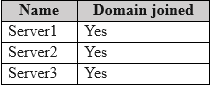
Server1 has the connection security rule as shown in the Server exhibit. (Click the Server1 tab.)

Server2 has the connection security rule as shown in the Server2 exhibit. (Click the Server2 tab.)

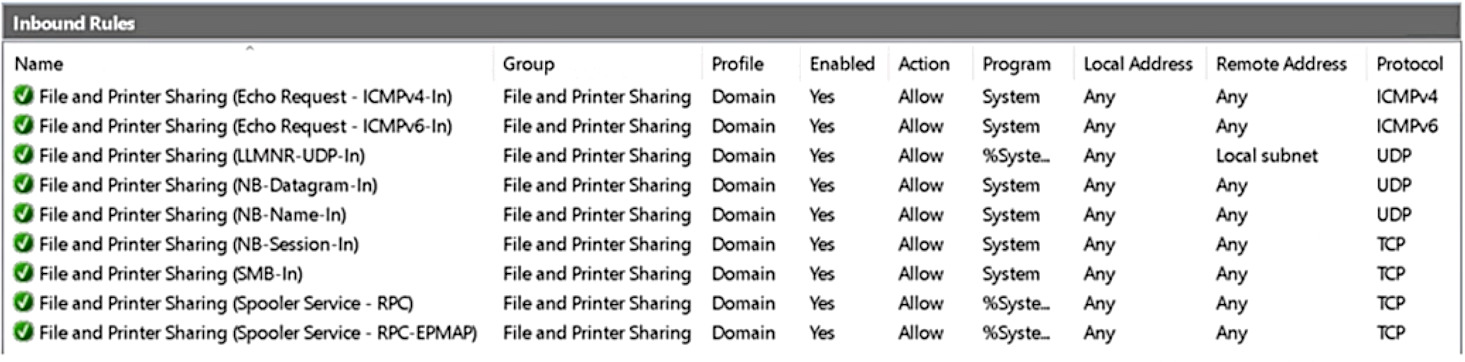
Server1 has the inbound firewall rules as shown in the Server1 inbound rules exhibit. (Click the Server1 inbound rules tab.)
For each of the following statements, select Yes if the statement is true. Otherwise, select No.
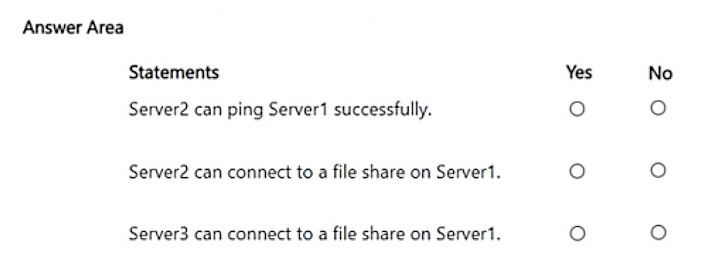
Server2 can ping Server1 successfully. Yes / No Server2 can connect to a file share on Server1. Yes / No Server3 can connect to a file share on Server1. Yes / No Show answer
- Server2 can ping Server1 successfully. Yes
- Server2 can connect to a file share on Server1. Yes
- Server3 can connect to a file share on Server1. No
WhyRule1 on Server1 applies only to TCP, so ICMP pings are allowed by the Echo Request rule without IPsec. Server2 has a matching Kerberos rule, so its SMB (TCP 445) connection authenticates. Server3 has no connection security rule, so it cannot satisfy Server1's required inbound authentication for TCP.
- Note: This question is part of a series of questions that present the same scenario. Each question in the series contains a unique solution that might meet the stated goals. Some question sets might have more than one correct solution, while others might not have a correct solution.
After you answer a question in this section, you will NOT be able to return to it. As a result, these questions will not appear in the review screen.
You have a failover cluster named Cluster1 that hosts an application named App1.
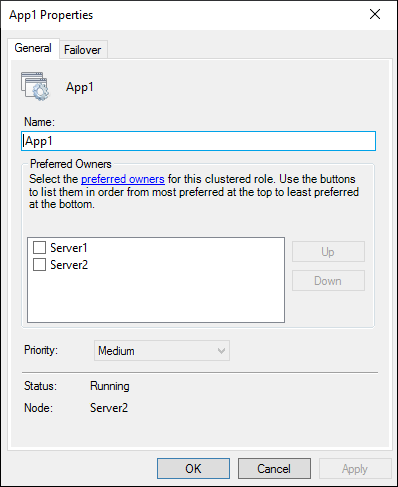
The General tab in App1 Properties is shown in the General exhibit. (Click the General tab.)
The Failover tab in App1 Properties is shown in the Failover exhibit. (Click the Failover tab.)
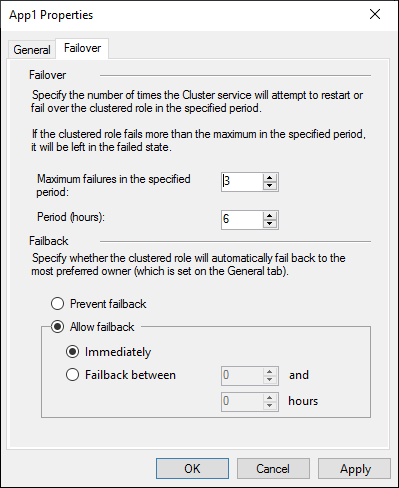
Server1 shuts down unexpectedly.
You need to ensure that when you start Server1, App1 continues to run on Server2.
Solution: From the General settings, you increase the priority of Server2 in the Preferred Owners list.
Does this meet the goal?- AYes
- BNo
Show answer
Correct answer: A
WhyThe exhibit shows no preferred owners selected and the Up and Down buttons disabled, so increasing Server2's priority cannot be done as described. The community answer is A, but the correct mechanism is Prevent failback, so treat this as a weak yes.
- A
- HOTSPOT
Your network is configured as shown in the following exhibit.
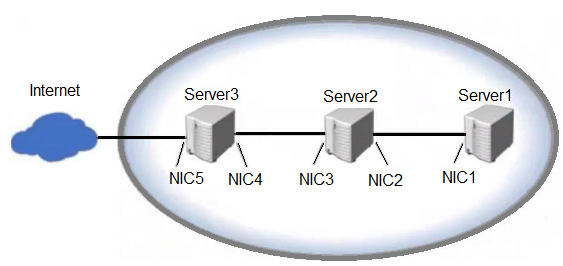
The servers run Windows Server and have the network configurations shown in the following table.
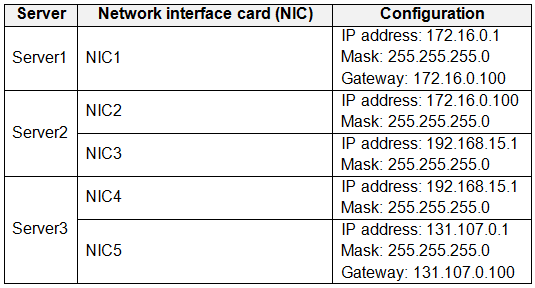
Server3 is configured as a NAT gateway. All the servers allow ICMP requests.
Use the drop-down menus to select the answer choice that completes each statement based on the information presented in the graphic.
NOTE: Each correct selection is worth one point.
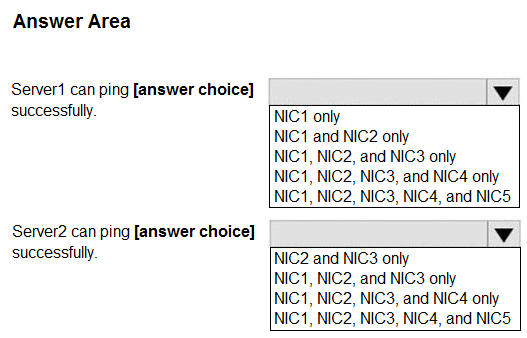
Server1 can ping [answer choice] successfully. NIC1 only / NIC1 and NIC2 only / NIC1, NIC2, and NIC3 only / NIC1, NIC2, NIC3, and NIC4 only / NIC1, NIC2, NIC3, NIC4, and NIC5 Server2 can ping [answer choice] successfully. NIC2 and NIC3 only / NIC1, NIC2, and NIC3 only / NIC1, NIC2, NIC3, and NIC4 only / NIC1, NIC2, NIC3, NIC4, and NIC5 Show answer
- Server1 can ping [answer choice] successfully. NIC1 and NIC2 only
- Server2 can ping [answer choice] successfully. NIC1, NIC2, and NIC3 only
WhyServer2 is not configured as a router, so Server1 reaches only its own NIC and NIC2 on the same subnet. NIC3 and NIC4 share the duplicate address 192.168.15.1, so Server2 cannot reach NIC4. Server2 has no default gateway, so NIC5 is unreachable.
- Your network contains an on-premises Active Directory Domain Services (AD DS) domain. The domain contains two virtual machines named VM1 and VM2 that run Windows Server.
You plan to implement a failover cluster named Cluster1 that will use VM1 and VM2 as nodes.
You need to ensure that Cluster1 can use floating IP addresses.
Which two components should you deploy? Each correct answer presents part of the solution.
NOTE: Each correct selection is worth one point.- ANetwork Load Balancing (NLB)
- Bthe MultiPoint Services role
- Cthe Network Controller role
- Dthe Host Guardian Service role
- ESoftware Load Balancer (SLB)
Show answer
Correct answer: C, E
WhyFloating IP addresses in a cluster on SDN rely on Software Load Balancer, which is part of the Network Controller role. So deploy Network Controller and SLB. NLB is a separate feature, and MultiPoint Services and Host Guardian Service are unrelated.
- A
- DRAG DROP
Your network contains an Active Directory Domain Services (AD DS) domain. The domain contains two domain controllers named Server1 and Server2 and an organizational unit (OU) named OU. The domain is backed up once daily.
You need to perform an authoritative restore of OU1.
Which four actions should you perform in sequence? To answer, move the appropriate actions from the list of actions to the answer area and arrange them in the correct order.
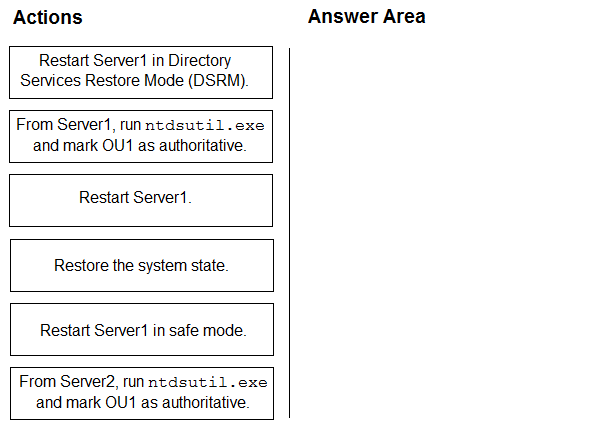
Arrange 4 of these in the correct order:
- Restart Server1 in Directory Services Restore Mode (DSRM).
- From Server1, run ntdsutil.exe and mark OU1 as authoritative.
- Restart Server1.
- Restore the system state.
- Restart Server1 in safe mode.
- From Server2, run ntdsutil.exe and mark OU1 as authoritative.
Show answer
- Restart Server1 in Directory Services Restore Mode (DSRM).
- Restore the system state.
- From Server1, run ntdsutil.exe and mark OU1 as authoritative.
- Restart Server1.
WhyThe AD DS database can only be restored offline, so boot into DSRM and restore the system state on that same DC. Ntdsutil then marks OU1 authoritative before the normal restart, so its higher version numbers replicate out to Server2.
- Note: This question is part of a series of questions that present the same scenario. Each question in the series contains a unique solution that might meet the stated goals. Some question sets might have more than one correct solution, while others might not have a correct solution.
After you answer a question in this section, you will NOT be able to return to it. As a result, these questions will not appear in the review screen.
You deploy Azure Migrate to an on-premises network.
You have an on-premises physical server named Server1 that runs Windows Server and has the following configurations:
• Operating system disk: 600 GB
• Data disk: 3 TB
• NIC Teaming: Enabled
• Mobility service: Installed
• Windows Defender Firewall: Enabled
• Microsoft Defender Antivirus: Enabled
You need to ensure that you can use Azure Migrate to migrate Server1.
Solution: You shrink the data disk on Server1.
Does this meet the goal?- AYes
- BNo
Show answer
Correct answer: B
WhyA 3 TB data disk is within the supported disk size for Azure Migrate server migration, so shrinking it is unnecessary. The actual blocker in this series is elsewhere in the server configuration, so this solution does not meet the goal.
- A
- DRAG DROP
Your on-premises network contains an Active Directory Domain Services (AD DS) domain. The domain contains the servers shown in the following table.

You have an Azure subscription.
You plan to migrate the data on FS1 to Azure by using Azure Data Box Gateway.
You need to configure a Data Box Gateway virtual device.
Which four actions should you perform in sequence? To answer, move the appropriate actions from the list of actions to the answer area and arrange them in the correct order.
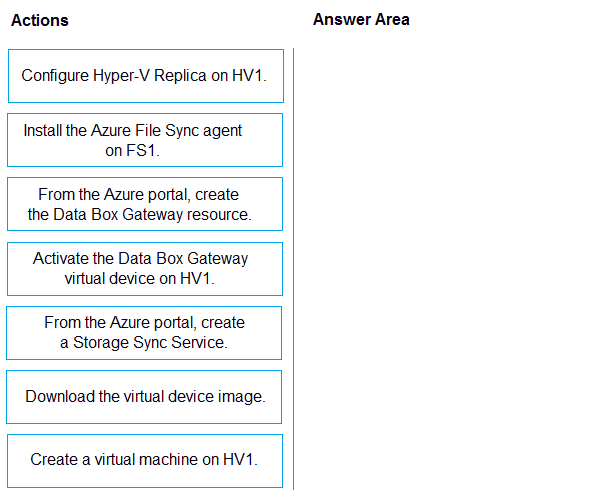
Arrange 4 of these in the correct order:
- Configure Hyper-V Replica on HV1.
- Install the Azure File Sync agent on FS1.
- From the Azure portal, create the Data Box Gateway resource.
- Activate the Data Box Gateway virtual device on HV1.
- From the Azure portal, create a Storage Sync Service.
- Download the virtual device image.
- Create a virtual machine on HV1.
Show answer
- From the Azure portal, create the Data Box Gateway resource.
- Download the virtual device image.
- Create a virtual machine on HV1.
- Activate the Data Box Gateway virtual device on HV1.
WhyData Box Gateway is a virtual appliance managed from an Azure resource. Create the resource, which provides the image download and activation key, then build a VM from that image on the Hyper-V host HV1, and finally activate the device with the key.
- Your network contains an Active Directory Domain Services (AD DS) domain. The domain contains 20 Active Directory sites. All user management is performed
from a central site.
You add users to a group.
You discover that group changes do NOT appear on a domain controller in a remote site.
You need to identify whether the group changes appear on other domain controllers.
What should you use?- AActive Directory Sites and Services
- BActive Directory Replication Status Tool
- CMicrosoft Support and Recovery Assistant
- DFile Replication Service (FRS) Status Viewer
Show answer
Correct answer: B
WhyThe Active Directory Replication Status Tool checks replication health and shows whether changes reach other domain controllers. It has since been retired; repadmin /replsummary or Get-ADReplicationPartnerMetadata do the same today. Sites and Services does not report status.
- A
- HOTSPOT
Your network contains an Active Directory Domain Services (AD DS) domain. The domain contains two servers named Server1 and Server2 that run Windows Server.
On Server1, you create an event subscription named Subscription1 that retrieves events from Server2. The Query Filter settings for Subscription1 are configured as shown in the following exhibit.
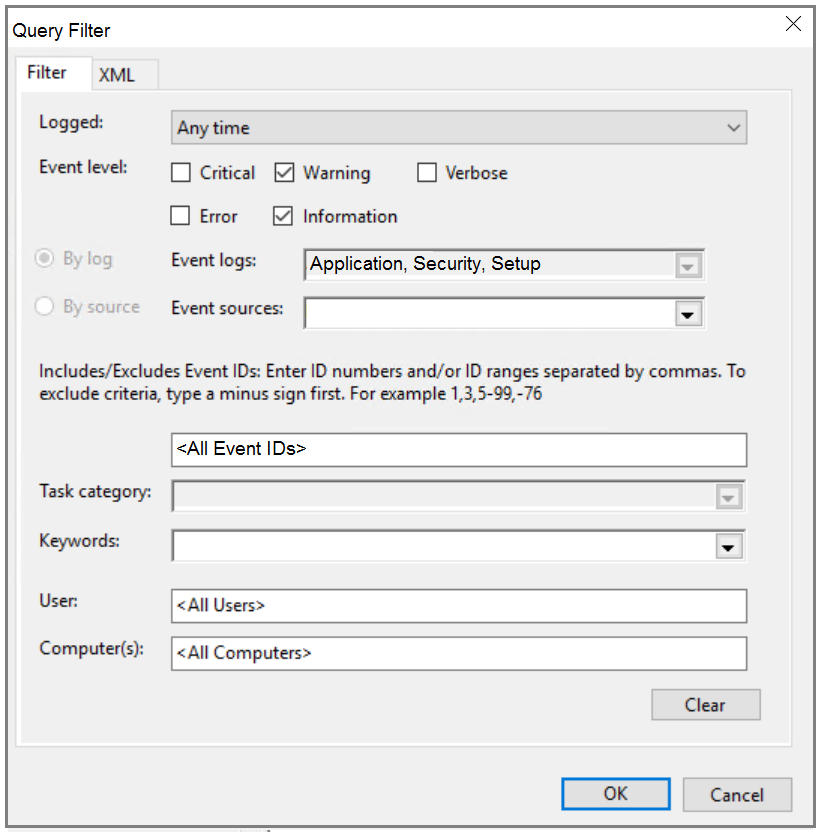
Subscription1 stores events in the Forwarded Events log.
On Server1, you create a custom view named View1 as shown in the following exhibit.
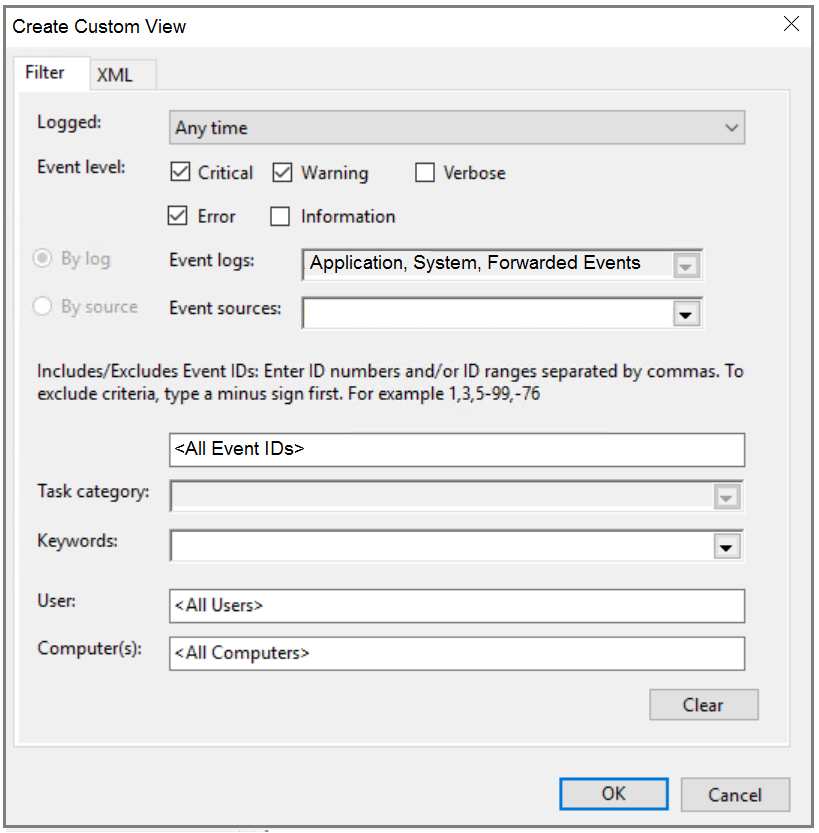
For each of the following statements, select Yes if the statement is true. Otherwise, select No.
NOTE: Each correct selection is worth one point.
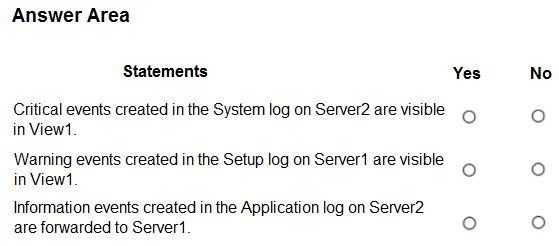
Critical events created in the System log on Server2 are visible in View1. Yes / No Warning events created in the Setup log on Server1 are visible in View1. Yes / No Information events created in the Application log on Server2 are forwarded to Server1. Yes / No Show answer
- Critical events created in the System log on Server2 are visible in View1. No
- Warning events created in the Setup log on Server1 are visible in View1. No
- Information events created in the Application log on Server2 are forwarded to Server1. Yes
WhySubscription1 forwards only Warning and Information events from the Application, Security, and Setup logs, so critical System events from Server2 never arrive. View1 reads only the Application, System, and Forwarded Events logs, excluding Setup on Server1. Information events in Server2's Application log match the subscription filter.
- You are remediating the firewall security risks to meet the security requirements.
What should you configure to reduce the risks?- Aa Group Policy Object (GPO)
- Badaptive network hardening in Microsoft Defender for Cloud
- Ca network security group (NSG) in Sub1
- Dan Azure Firewall policy
Show answer
Correct answer: A
WhyCase study answer: the firewall risks are on on-premises Windows servers, so a GPO that configures Windows Defender Firewall rules centrally fits. Adaptive network hardening, NSGs and Azure Firewall policy all apply to Azure resources, not to domain-joined on-premises servers.
- A
- You are planning the migration of Archive1 to support the on-premises migration plan.
What is the minimum number of IP addresses required for the node and cluster roles on Cluster3?- A2
- B3
- C4
- D5
Show answer
Correct answer: C
WhyA two-node failover cluster needs one IP per node, one for the cluster name (CNO) and one for the clustered file server role, giving 4. Votes were split with B, but the role-name address is needed in addition to the cluster and node addresses.
- A
- You need to back up Server 4 to meet the technical requirements.
What should you do first?- ADeploy Microsoft Azure Backup Server (MABS).
- BConfigure Windows Server Backup.
- CInstall the Microsoft Azure Recovery Services (MARS) agent.
- DConfigure Storage Replica.
Show answer
Correct answer: C
WhyTo back up a single server directly to Azure, first install the Microsoft Azure Recovery Services (MARS) agent and register it with a Recovery Services vault. MABS is for larger workloads such as SQL or Hyper-V, Windows Server Backup is local only, and Storage Replica is replication, not backup.
- A
- You are planning the data share migration to support the on-premises migration plan.
What should you use to perform the migration?- AStorage Migration Service
- BMicrosoft File Server Migration Toolkit
- CFile Server Resource Manager (FSRM)
- DWindows Server Migration Tools
Show answer
Correct answer: A
WhyStorage Migration Service is the supported tool for migrating file shares, permissions and server identity to a newer server or Azure. FSRM is for quotas and file screening, and Windows Server Migration Tools do not migrate file shares well. There is no product named File Server Migration Toolkit today.
- A
- You need to meet the technical requirements for User1.
To which group in contoso.com should you add User1?- ADomain Admins
- BAccount Operators
- CSchema Admins
- DBackup Operators
Show answer
Correct answer: A
WhyCase study answer: the community choice is Domain Admins, the group that gives the broad rights the technical requirement for User1 describes. Account Operators and Backup Operators have limited rights, and Schema Admins only allows schema changes.
- A