

DOP-C02 sample exam questions
15 exam-style questions for AWS DOP-C02: DevOps Engineer Professional, with answers and explanations. Take them as a timed practice exam first if you want a score out of 1000.
- A company's developers use Amazon EC2 instances as remote workstations. The company is concerned that users can create or modify EC2 security groups to allow unrestricted inbound access.
A DevOps engineer needs to develop a solution to detect when users create unrestricted security group rules. The solution must detect changes to security group rules in near real time, remove unrestricted rules, and send email notifications to the security team. The DevOps engineer has created an AWS Lambda function that checks for security group ID from input, removes rules that grant unrestricted access, and sends notifications through Amazon Simple Notification Service (Amazon SNS).
What should the DevOps engineer do next to meet the requirements?- AConfigure the Lambda function to be invoked by the SNS topic. Create an AWS CloudTrail subscription for the SNS topic. Configure a subscription filter for security group modification events.
- BCreate an Amazon EventBridge scheduled rule to invoke the Lambda function. Define a schedule pattern that runs the Lambda function every hour.
- CCreate an Amazon EventBridge event rule that has the default event bus as the source. Define the rule’s event pattern to match EC2 security group creation and modification events. Configure the rule to invoke the Lambda function.
- DCreate an Amazon EventBridge custom event bus that subscribes to events from all AWS services. Configure the Lambda function to be invoked by the custom event bus.
Show answer
Correct answer: C
WhyAn EventBridge rule on the default event bus matches security group API calls from CloudTrail and invokes the function in near real time. CloudTrail does not subscribe to SNS with filters this way, an hourly schedule is too slow, and AWS service events arrive on the default bus rather than a custom one.
- A
- A company is deploying a new application that uses Amazon EC2 instances. The company needs a solution to query application logs and AWS account API activity.
Which solution will meet these requirements?- AUse the Amazon CloudWatch agent to send logs from the EC2 instances to Amazon CloudWatch Logs. Configure AWS CloudTrail to deliver the API logs to Amazon S3. Use CloudWatch to query both sets of logs.
- BUse the Amazon CloudWatch agent to send logs from the EC2 instances to Amazon CloudWatch Logs. Configure AWS CloudTrail to deliver the API logs to CloudWatch Logs. Use CloudWatch Logs Insights to query both sets of logs.
- CUse the Amazon CloudWatch agent to send logs from the EC2 instances to Amazon Kinesis. Configure AWS CloudTrail to deliver the API logs to Kinesis. Use Kinesis to load the data into Amazon Redshift. Use Amazon Redshift to query both sets of logs.
- DUse the Amazon CloudWatch agent to send logs from the EC2 instances to Amazon S3. Use AWS CloudTrail to deliver the API logs to Amazon S3. Use Amazon Athena to query both sets of logs in Amazon S3.
Show answer
Correct answer: B
WhyThe CloudWatch agent and CloudTrail can both send logs to CloudWatch Logs, and Logs Insights queries them together. CloudWatch does not directly query CloudTrail logs in S3, the agent does not write to Kinesis or S3 directly, and Redshift adds unneeded work.
- A
- A company runs applications in AWS accounts that are in an organization in AWS Organizations. The applications use Amazon EC2 instances and Amazon S3.
The company wants to detect potentially compromised EC2 instances, suspicious network activity, and unusual API activity in its existing AWS accounts and in any AWS accounts that the company creates in the future. When the company detects one of these events, the company wants to use an existing Amazon Simple Notification Service (Amazon SNS) topic to send a notification to its operational support team for investigation and remediation.
Which solution will meet these requirements in accordance with AWS best practices?- AIn the organization’s management account, configure an AWS account as the Amazon GuardDuty administrator account. In the GuardDuty administrator account, add the company’s existing AWS accounts to GuardDuty as members. In the GuardDuty administrator account, create an Amazon EventBridge rule with an event pattern to match GuardDuty events and to forward matching events to the SNS topic.
- BIn the organization’s management account, configure Amazon GuardDuty to add newly created AWS accounts by invitation and to send invitations to the existing AWS accounts. Create an AWS CloudFormation stack set that accepts the GuardDuty invitation and creates an Amazon EventBridge rule. Configure the rule with an event pattern to match GuardDuty events and to forward matching events to the SNS topic. Configure the CloudFormation stack set to deploy into all AWS accounts in the organization.
- CIn the organization’s management account, create an AWS CloudTrail organization trail. Activate the organization trail in all AWS accounts in the organization. Create an SCP that enables VPC Flow Logs in each account in the organization. Configure AWS Security Hub for the organization. Create an Amazon EventBridge rule with an event pattern to match Security Hub events and to forward matching events to the SNS topic.
- DIn the organization’s management account, configure an AWS account as the AWS CloudTrail administrator account. In the CloudTrail administrator account, create a CloudTrail organization trail. Add the company’s existing AWS accounts to the organization trail. Create an SCP that enables VPC Flow Logs in each account in the organization. Configure AWS Security Hub for the organization. Create an Amazon EventBridge rule with an event pattern to match Security Hub events and to forward matching events to the SNS topic.
Show answer
Correct answer: A
WhyAmazon GuardDuty detects compromised instances, suspicious network activity and unusual API activity, and a delegated administrator manages member accounts. An EventBridge rule there forwards findings to SNS. Invitations are not needed within an organization, and CloudTrail, flow logs and SCPs do not detect these threats by themselves.
- A
- A large enterprise is deploying a web application on AWS. The application runs on Amazon EC2 instances behind an Application Load Balancer. The instances run in an Auto Scaling group across multiple Availability Zones. The application stores data in an Amazon RDS for Oracle DB instance and Amazon DynamoDB. There are separate environments for development, testing, and production.
What is the MOST secure and flexible way to obtain password credentials during deployment?- ARetrieve an access key from an AWS Systems Manager SecureString parameter to access AWS services. Retrieve the database credentials from a Systems Manager SecureString parameter.
- BLaunch the EC2 instances with an EC2 IAM role to access AWS services. Retrieve the database credentials from AWS Secrets Manager.
- CRetrieve an access key from an AWS Systems Manager plaintext parameter to access AWS services. Retrieve the database credentials from a Systems Manager SecureString parameter.
- DLaunch the EC2 instances with an EC2 IAM role to access AWS services. Store the database passwords in an encrypted config file with the application artifacts.
Show answer
Correct answer: B
WhyAn EC2 IAM role provides temporary AWS credentials with no stored keys, and Secrets Manager stores and rotates database credentials for each environment. Access keys in parameters are long-term secrets, and a password in a config file with the artifacts is harder to secure and change.
- A
- A company has a mission-critical application on AWS that uses automatic scaling. The company wants the deployment lifecycle to meet the following parameters:
• The application must be deployed one instance at a time to ensure the remaining fleet continues to serve traffic.
• The application is CPU intensive and must be closely monitored.
• The deployment must automatically roll back if the CPU utilization of the deployment instance exceeds 85%.
Which solution will meet these requirements?- AUse AWS CloudFormation to create an AWS Step Functions state machine and Auto Scaling lifecycle hooks to move to one instance at a time into a wait state. Use AWS Systems Manager automation to deploy the update to each instance and move it back into the Auto Scaling group using the heartbeat timeout.
- BUse AWS CodeDeploy with Amazon EC2 Auto Scaling Configure an alarm tied to the CPU utilization metric. Use the CodeDeployDefault OneAtAtime configuration as a deployment strategy. Configure automatic rollbacks within the deployment group to roll back the deployment if the alarm thresholds are breached.
- CUse AWS Elastic Beanstalk for load balancing and AWS Auto Scaling. Configure an alarm tied to the CPU utilization metric. Configure rolling deployments with a fixed batch size of one instance. Enable enhanced health to monitor the status of the deployment and roll back based on the alarm previously created.
- DUse AWS Systems Manager to perform a blue/green deployment with Amazon EC2 Auto Scaling. Configure an alarm tied to the CPU utilization metric. Deploy updates one at a time. Configure automatic rollbacks within the Auto Scaling group to roll back the deployment if the alarm thresholds are breached.
Show answer
Correct answer: B
WhyCodeDeploy's OneAtATime configuration deploys one instance at a time, and an alarm on CPU utilization can automatically roll back the deployment group. Elastic Beanstalk does not roll back based on an alarm like this, and Step Functions or Systems Manager options need much more custom work.
- A
- A DevOps engineer notices that all Amazon EC2 instances running behind an Application Load Balancer in an Auto Scaling group are failing to respond to user requests. The EC2 instances are also failing target group HTTP health checks.
Upon inspection, the engineer notices the application process was not running in any EC2 instances. There are a significant number of out of memory messages in the system logs. The engineer needs to improve the resilience of the application to cope with a potential application memory leak. Monitoring and notifications should be enabled to alert when there is an issue.
Which combination of actions will meet these requirements? (Choose two.)- AChange the Auto Scaling configuration to replace the instances when they fail the load balancer's health checks.
- BChange the target group health check HealthCheckIntervalSeconds parameter to reduce the interval between health checks.
- CChange the target group health checks from HTTP to TCP to check if the port where the application is listening is reachable.
- DEnable the available memory consumption metric within the Amazon CloudWatch dashboard for the entire Auto Scaling group. Create an alarm when the memory utilization is high. Associate an Amazon SNS topic to the alarm to receive notifications when the alarm goes off.
- EUse the Amazon CloudWatch agent to collect the memory utilization of the EC2 instances in the Auto Scaling group. Create an alarm when the memory utilization is high and associate an Amazon SNS topic to receive a notification.
Show answer
Correct answer: A, E
WhyUsing load balancer health checks lets Auto Scaling replace failed instances, and the CloudWatch agent is needed to collect memory data for an alarm and SNS notification. Memory is not a default EC2 metric, a shorter interval does not fix anything, and TCP checks could pass while the application is unhealthy.
- A
- A company manages AWS accounts for application teams in AWS Control Tower. Individual application teams are responsible for securing their respective AWS accounts.
A DevOps engineer needs to enable Amazon GuardDuty for all AWS accounts in which the application teams have not already enabled GuardDuty. The DevOps engineer is using AWS CloudFormation StackSets from the AWS Control Tower management account.
How should the DevOps engineer configure the CloudFormation template to prevent failure during the StackSets deployment?- ACreate a CloudFormation custom resource that invokes an AWS Lambda function. Configure the Lambda function to conditionally enable GuardDuty if GuardDuty is not already enabled in the accounts.
- BUse the Conditions section of the CloudFormation template to enable GuardDuty in accounts where GuardDuty is not already enabled.
- CUse the CloudFormation Fn::GetAtt intrinsic function to check whether GuardDuty is already enabled. If GuardDuty is not already enabled, use the Resources section of the CloudFormation template to enable GuardDuty.
- DManually discover the list of AWS account IDs where GuardDuty is not enabled. Use the CloudFormation Fn::ImportValue intrinsic function to import the list of account IDs into the CloudFormation template to skip deployment for the listed AWS accounts.
Show answer
Correct answer: A
WhyA GuardDuty detector fails to create if one already exists, so a custom resource with Lambda can check first and enable it only when needed. Conditions cannot query the account state, Fn::GetAtt reads template resources, and a manual list is not automated.
- A
- A company uses an Amazon API Gateway regional REST API to host its application API. The REST API has a custom domain. The REST API's default endpoint is deactivated.
The company's internal teams consume the API. The company wants to use mutual TLS between the API and the internal teams as an additional layer of authentication.
Which combination of steps will meet these requirements? (Choose two.)- AUse AWS Certificate Manager (ACM) to create a private certificate authority (CA). Provision a client certificate that is signed by the private CA.
- BProvision a client certificate that is signed by a public certificate authority (CA). Import the certificate into AWS Certificate Manager (ACM).
- CUpload the provisioned client certificate to an Amazon S3 bucket. Configure the API Gateway mutual TLS to use the client certificate that is stored in the S3 bucket as the trust store.
- DUpload the provisioned client certificate private key to an Amazon S3 bucket. Configure the API Gateway mutual TLS to use the private key that is stored in the S3 bucket as the trust store.
- EUpload the root private certificate authority (CA) certificate to an Amazon S3 bucket. Configure the API Gateway mutual TLS to use the private CA certificate that is stored in the S3 bucket as the trust store.
Show answer
Correct answer: A, E
WhyA private CA suits internal teams and issues client certificates, and API Gateway mutual TLS uses a trust store in S3 containing the root CA certificate. The trust store does not hold client certificates or private keys, and public CAs are not needed.
- A
- A company has started using AWS across several teams. Each team has multiple accounts and unique security profiles. The company manages the accounts in an organization in AWS Organizations. Each account has its own configuration and security controls.
The company's DevOps team wants to use preventive and detective controls to govern all accounts. The DevOps team needs to ensure the security of accounts now and in the future as the company creates new accounts in the organization.
Which solution will meet these requirements?- AUse Organizations to create OUs that have appropriate SCPs attached for each team. Place team accounts in the appropriate OUs to apply security controls. Create any new team accounts in the appropriate OUs.
- BCreate an AWS Control Tower landing zone. Configure OUs and appropriate controls in AWS Control Tower for the existing teams. Configure trusted access for AWS Control Tower. Enroll the existing accounts in the appropriate OUs that match the appropriate security policies for each team. Use AWS Control Tower to provision any new accounts.
- CCreate AWS CloudFormation stack sets in the organization's management account. Configure a stack set that deploys AWS Config with configuration rules and remediation actions for all controls to each account in the organization. Update the stack sets to deploy to new accounts as the accounts are created.
- DConfigure AWS Config to manage the AWS Config rules across all AWS accounts in the organization. Deploy conformance packs that provide AWS Config rules and remediation actions across the organization.
Show answer
Correct answer: B
WhyAWS Control Tower provides preventive and detective controls by OU, enrolls existing accounts, and applies them to new accounts created through it. SCPs alone are only preventive, stack sets and conformance packs alone are mainly detective and require more upkeep.
- A
- A company has an organization in AWS Organizations. A DevOps engineer needs to maintain multiple AWS accounts that belong to different OUs in the organization. All resources, including IAM policies and Amazon S3 policies within an account, are deployed through AWS CloudFormation. All templates and code are maintained in an AWS CodeCommit repository. Recently, some developers have not been able to access an S3 bucket from some accounts in the organization.
The following policy is attached to the S3 bucket:
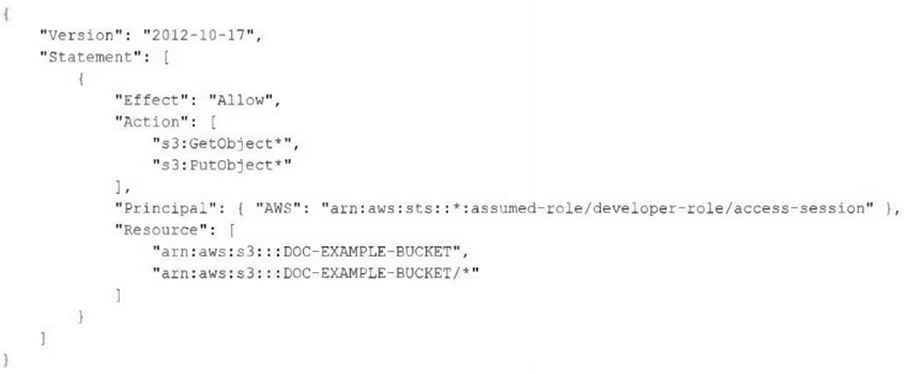
What should the DevOps engineer do to resolve this access issue?- AModify the S3 bucket policy. Turn off the S3 Block Public Access setting on the S3 bucket. In the S3 policy, add the aws:SourceAccount condition. Add the AWS account IDs of all developers who are experiencing the issue.
- BVerify that no IAM permissions boundaries are denying developers access to the S3 bucket. Make the necessary changes to IAM permissions boundaries. Use an AWS Config recorder in the individual developer accounts that are experiencing the issue to revert any changes that are blocking access. Commit the fix back into the CodeCommit repository. Invoke deployment through CloudFormation to apply the changes.
- CConfigure an SCP that stops anyone from modifying IAM resources in developer OUs. In the S3 policy, add the aws:SourceAccount condition. Add the AWS account IDs of all developers who are experiencing the issue. Commit the fix back into the CodeCommit repository. Invoke deployment through CloudFormation to apply the changes.
- DEnsure that no SCP is blocking access for developers to the S3 bucket. Ensure that no IAM policy permissions boundaries are denying access to developer IAM users. Make the necessary changes to the SCP and IAM policy permissions boundaries in the CodeCommit repository. Invoke deployment through CloudFormation to apply the changes.
Show answer
Correct answer: D
WhyDevelopers have access from only some accounts, so check for SCPs and permissions boundaries that block them, then make fixes in CodeCommit and deploy through CloudFormation. Turning off Block Public Access and adding accounts by hand are not relevant, and an AWS Config recorder does not revert changes.
- A
- During a security audit, a company discovered that some security groups allow SSH traffic from 0.0.0.0/0. A security team must implement a solution to detect and remediate this issue as soon as possible. The company uses one organization in AWS Organizations to manage all the company's AWS accounts.
Which solution will meet these requirements?- AEnable AWS Config for all AWS accounts. Use a periodic trigger to activate the vpe-sg-port-restriction-check AWS Config rule. Create an AWS Lambda function to remediate any noncompliant rules.
- BCreate an AWS Lambda function in each AWS account to delete all the security group rules. Create an Amazon EventBridge rule to match security group update events or creation events. Set the Lambda function in each account as a target for the rule.
- CEnable AWS Config for all AWS accounts. Create a custom AWS Config rule to run on the restricted-ssh configuration change trigger. Configure the rule to invoke an AWS Lambda function to remediate any noncompliant resources.
- DCreate an AWS Systems Manager Automation document in each account to inspect all security groups and to delete noncompliant rules. Use an Amazon EventBridge rule to run the Automation document every hour.
Show answer
Correct answer: C
WhyAWS Config evaluates security groups on configuration changes across accounts, and a function can remediate noncompliant rules quickly. The check is the restricted-ssh logic. A periodic trigger is slower, deleting all rules is too broad, and hourly automation leaves a gap.
- A
- A company detects unusual login attempts in many of its AWS accounts. A DevOps engineer must implement a solution that sends a notification to the company's security team when multiple failed login attempts occur. The DevOps engineer has already created an Amazon Simple Notification Service (Amazon SNS) topic and has subscribed the security team to the SNS topic.
Which solution will provide the notification with the LEAST operational effort?- AConfigure AWS CloudTrail to send management events to an Amazon CloudWatch Logs log group. Create a CloudWatch Logs metric filter to match failed ConsoleLogin events. Create a CloudWatch alarm that is based on the metric filter. Configure an alarm action to send messages to the SNS topic.
- BConfigure AWS CloudTrail to send management events to an Amazon S3 bucket. Create an Amazon Athena query that returns a failure if the query finds failed logins in the logs in the S3 bucket. Create an Amazon EventBridge rule to periodically run the query. Create a second EventBridge rule to detect when the query fails and to send a message to the SNS topic.
- CConfigure AWS CloudTrail to send data events to an Amazon CloudWatch Logs log group. Create a CloudWatch logs metric filter to match failed ConsoleLogin events. Create a CloudWatch alarm that is based on the metric filter. Configure an alarm action to send messages to the SNS topic.
- DConfigure AWS CloudTrail to send data events to an Amazon S3 bucket. Configure an Amazon S3 event notification for the s3:ObjectCreated event type. Filter the event type by ConsoleLogin failed events. Configure the event notification to forward to the SNS topic.
Show answer
Correct answer: A
WhyConsole sign-ins are management events, so CloudTrail in CloudWatch Logs with a metric filter and alarm sends messages to SNS with little work. Athena schedules take more effort, and data events do not include ConsoleLogin.
- A
- A DevOps team supports an application that runs in an Amazon Elastic Container Service (Amazon ECS) cluster behind an Application Load Balancer (ALB). Currently, the DevOps team uses AWS CodeDeploy to deploy the application by using a blue/green all-at-once strategy. Recently, the DevOps team had to roll back a deployment when a new version of the application dramatically increased response times for requests.
The DevOps team needs use to a deployment strategy that will allow the team to monitor a new version of the application before the team shifts all traffic to the new version. If a new version of the application increases response times, the deployment should be rolled back as quickly as possible.
Which combination of steps will meet these requirements? (Choose two.)- AModify the CodeDeploy deployment to use the CodeDeployDefault.ECSCanary10Percent5Minutes configuration.
- BModify the CodeDeploy deployment to use the CodeDeployDefault.ECSLinear10PercentEvery3Minutes configuration.
- CCreate an Amazon CloudWatch alarm to monitor the UnHealthyHostCount metric for the ALB. Set the alarm to activate if the metric is higher than the desired value. Associate the alarm with the CodeDeploy deployment group. Modify the deployment group to roll back when a deployment fails.
- DCreate an Amazon CloudWatch alarm to monitor the TargetResponseTime metric for the ALB. Set the alarm to activate if the metric is higher than the desired value. Associate the alarm with the CodeDeploy deployment group. Modify the deployment group to roll back when alarm thresholds are met.
- ECreate an Amazon CloudWatch alarm to monitor the TargetConnectionErrorCount metric for the ALB. Set the alarm to activate if the metric is higher than the desired value. Associate the alarm with the CodeDeploy deployment group. Modify the deployment group to roll back when alarm thresholds are met.
Show answer
Correct answer: A, D
WhyA canary sends 10% of traffic for 5 minutes, which allows monitoring before a full shift. A TargetResponseTime alarm with rollback on the deployment group reacts directly to slower responses. Linear shifting exposes more traffic over time, and the other metrics do not measure response time.
- A
- A company hosts an application in its AWS account. The application uses an Amazon S3 bucket to store objects that contain sensitive information.
The company needs to capture object-level S3 API calls, including calls that are rejected because the calls were made by using credentials that are not valid.
Which solution will meet these requirements?- ACreate an AWS CloudTrail trail in the account. Enable S3 data events logging. Configure the trail to log to Amazon CloudWatch.
- BCreate a new S3 bucket. Configure access logging on the application's S3 bucket. Deliver the access logs to the new S3 bucket.
- CConfigure Amazon GuardDuty with S3 protection enabled for the account. Create an Amazon EventBridge rule that matches findings that are associated with the S3 bucket. Configure the rule to use an Amazon Simple Queue Service (Amazon SQS) queue as the target.
- DCreate an AWS CloudTrail trail and a new S3 bucket in the account. Configure the trail to log to the S3 new bucket.
Show answer
Correct answer: B
WhyS3 server access logs include authentication failures, such as requests with invalid credentials, which CloudTrail does not record. CloudTrail is needed for many other audit purposes, but it does not capture these rejected calls, and GuardDuty only reports findings.
- A
- A company runs a development environment website and database on an Amazon EC2 instance that uses Amazon Elastic Block Store (Amazon EBS) storage. The company wants to make the instance more resilient to underlying hardware issues. The company wants to automatically recover the EC2 instance if AWS determines the instance has lost network connectivity.
Which solution will meet these requirements?- AAdd the EC2 instance to an Auto Scaling group. Set the minimum, maximum, and desired capacity to 1.
- BAdd the EC2 instance to an Auto Scaling group. Configure a lifecycle hook to detach the EBS volume if the EC2 instance shuts down or terminates
- CCreate an Amazon CloudWatch alarm for the StatusCheckFailed_System metric. Add an EC2 action to recover the instance when the alarm state is in ALARM
- DCreate an Amazon CloudWatch alarm for the NetworkOut metric. Add an EC2 action to recover the instance when the alarm state is in INSUFFICIENT_DATA.
Show answer
Correct answer: C
WhyA StatusCheckFailed_System alarm with the recover action moves the instance to healthy hardware and keeps its EBS volume, including after loss of network connectivity. Auto Scaling replaces instances and can lose data, and NetworkOut in INSUFFICIENT_DATA is not a reliable signal for recovery.
- A