

DP-750 sample exam questions
15 exam-style questions for Microsoft DP-750: Azure Databricks Data Engineer, with answers and explanations. Take them as a timed practice exam first if you want a score out of 1000.
- You have an Azure Databricks workspace that is attached to a Unity Catalog metastore named metastore1, metastore1 contains a catalog named catalog1.
You need to create a new schema named schema2 that meets the following requirements:
Is contained in catalog1
Uses abfss://[email protected]/data as the managed location
Which SQL statement should you execute?- ACREATE SCHEMA catalog1.schema2
LOCATION ‘abfss://[email protected]/data’; - BCREATE SCHEMA catalog1.schema2
MANAGED LOCATION ‘abfss://[email protected]/data’; - CCREATE CATALOG schema2
MANAGED LOCATION ‘abfss://[email protected]/data’; - DCREATE SCHEMA catalog1.schema2
WITH DBPROPERTIES (LOCATION-’abfss://[email protected]/data’);
Show answer
Correct answer: B
WhyA schema-level managed storage location in Unity Catalog is set with CREATE SCHEMA ... MANAGED LOCATION. Plain LOCATION is for external tables or other objects, CREATE CATALOG would make the wrong object, and DBPROPERTIES has no location property.
- A
- You have an Azure Databricks workspace named Workspace1.
You create a compute cluster named Cluster1 that will be used to ingest data.
You need to install the required libraries on Cluster1. The solution must use Unity Catalog for access control.
What should you do?- AInstall the libraries by using pip3.
- BCreate a custom dependency management script and run the script from a Databricks notebook.
- CUpload the libraries to Workspace1 and install the libraries on Cluster1.
- DInstall the libraries on Cluster1 and manually restart the cluster.
Show answer
Correct answer: C
WhyLibraries uploaded to the workspace and installed on the cluster are governed through the cluster's library installation and Unity Catalog compatible access. pip3 and custom scripts bypass governance, and installing then manually restarting does not by itself address access control.
- A
- You have an Azure Databricks workspace that contains an all-purpose cluster named Cluster1.
You need to configure Cluster1 to meet the following requirements:
Scale up automatically when workloads increase
Scale down automatically when workloads decrease
Minimize costs
Which two actions should you perform? Each correct answer presents part of the solution.
NOTE: Each correct selection is worth one point.- ADisable Photon acceleration.
- BEnable autoscaling for Cluster1.
- CApply a compute policy that enables users to manage the cluster settings.
- DSpecify a fixed number of workers.
- EConfigure Cluster1 to terminate after 30 minutes of inactivity.
Show answer
Correct answer: B, E
WhyEnabling autoscaling lets the cluster add and remove workers with load, and an auto-termination timeout stops paying for idle compute. A fixed worker count prevents scaling, disabling Photon does not drive scaling, and a policy for managing settings does not scale or cut costs.
- A
- HOTSPOT
You have an Azure Databricks workspace that is enabled for Unity Catalog and contains a managed Delta table named Table1.
Table1 is written by batch jobs every hour and is queried frequently by filtering two columns named CustomerId and EventDate.
You expect Table1 to grow significantly over time.
The rows in Table1 are frequently updated and deleted to support compliance requests.
You need to keep query performance consistent as Table1 grows. The solution must minimize update and deletion effort.
What should you include in the solution? To answer, select the appropriate options in the answer area.
NOTE: Each correct selection is worth one point.
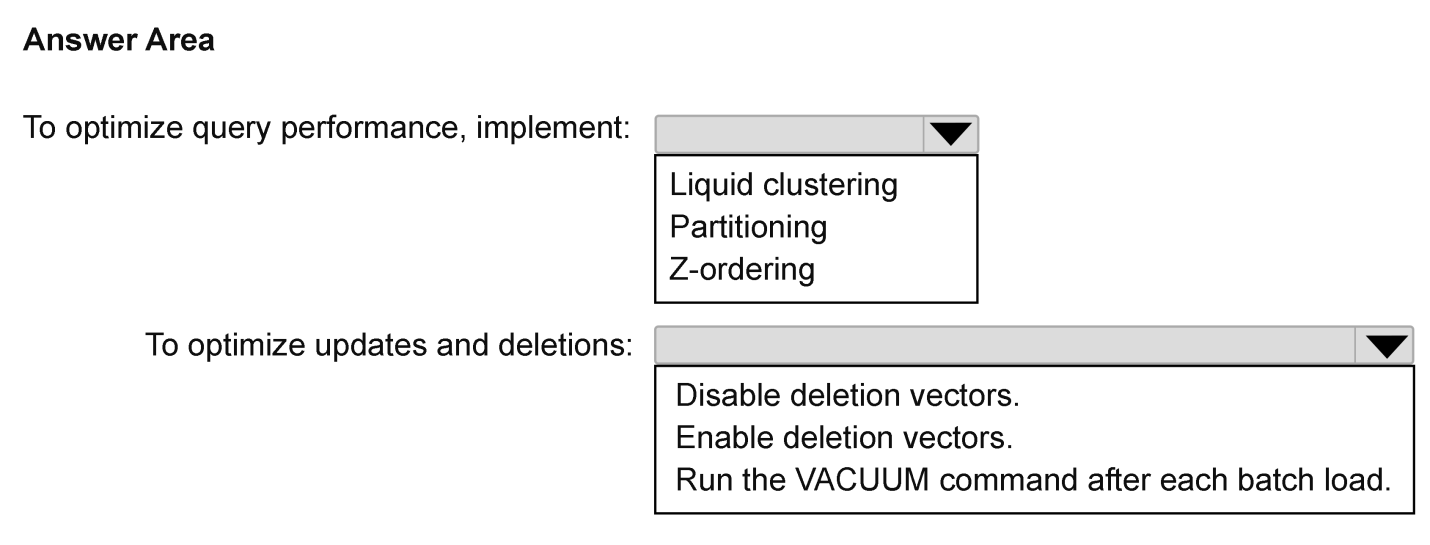
To optimize query performance, implement: Liquid clustering / Partitioning / Z-ordering To optimize updates and deletions: Disable deletion vectors. / Enable deletion vectors. / Run the VACUUM command after each batch load. Show answer
- To optimize query performance, implement: Liquid clustering
- To optimize updates and deletions: Enable deletion vectors.
WhyLiquid clustering replaces partitioning and Z-ordering for new tables and adapts to growth on keys such as CustomerId and EventDate. Deletion vectors mark rows as removed without rewriting whole Parquet files, which reduces update and delete effort. VACUUM only cleans up old files.
- You have an Azure Databricks workspace.
You are creating a Lakeflow Spark Declarative Pipelines (SDP) pipeline that scales automatically.
You need to configure compute for the pipeline. The solution must minimize operational costs and administrative effort.
What should you use?- Aserverless compute
- Ba single-node, all-purpose cluster
- Can all-purpose cluster that uses autoscaling
- Dan existing SQL warehouse
- Ea job cluster that uses autoscaling
Show answer
Correct answer: A
WhyServerless compute for pipelines autoscales and needs no cluster configuration or management, so it minimizes both cost and administrative effort. Job clusters need configuring, all-purpose clusters cost more, single node cannot scale, and SQL warehouses are not pipeline compute.
- A
- HOTSPOT
You have an Azure Databricks workspace that contains a cluster named Cluster1.
Cluster1 has the following characteristics:
Configured as a single node cluster
Uses a general purpose virtual machine node type
The cluster runtime environment has the following configurations:
Uses Databricks Runtime for Machine Learning (Databricks Runtime ML)
Includes common machine learning libraries
Supports Python workloads
For each of the following statements, select Yes if the statement is true. Otherwise, select No.
NOTE: Each correct selection is worth one point.
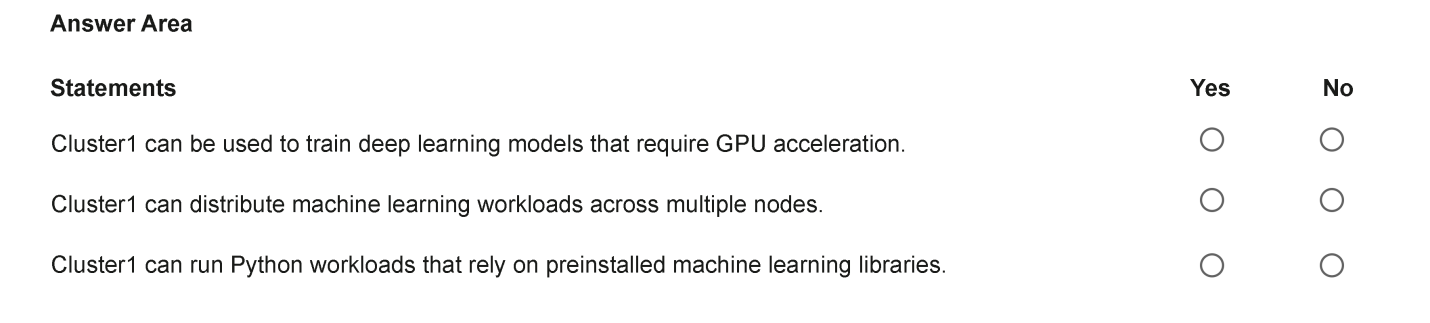
Cluster1 can be used to train deep learning models that require GPU acceleration. Yes / No Cluster1 can distribute machine learning workloads across multiple nodes. Yes / No Cluster1 can run Python workloads that rely on preinstalled machine learning libraries. Yes / No Show answer
- Cluster1 can be used to train deep learning models that require GPU acceleration. No
- Cluster1 can distribute machine learning workloads across multiple nodes. No
- Cluster1 can run Python workloads that rely on preinstalled machine learning libraries. Yes
WhyA general purpose VM has no GPU, so GPU-accelerated training needs a GPU node type. A single node cluster has no workers, so work cannot be distributed across nodes. Databricks Runtime ML preinstalls common libraries such as scikit-learn and PyTorch for Python use.
- You have an Azure Databricks workspace that contains the objects shown in the following table.
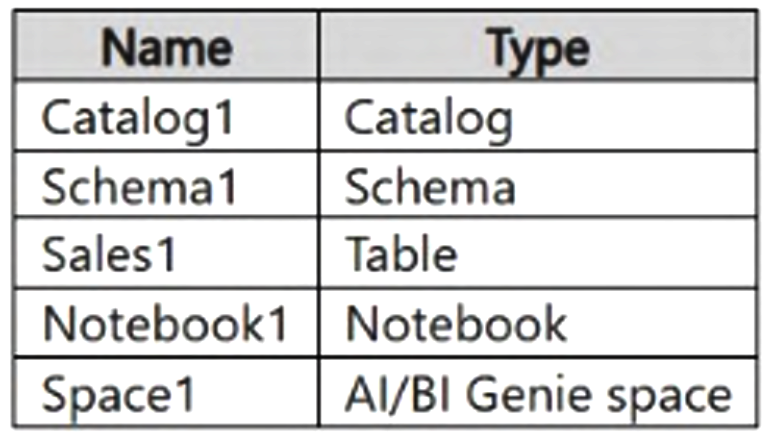
Users often use the following words to refer to a sale: transaction, event, order, and invoice.
You need to create a knowledge store. The solution must ensure that when the users use any of the words in Space1, Genie queries the Sales1 table. Any other Genie spaces must remain unaffected.
To which object should you add the instructions?- ASales1
- BSchema1
- CSpace1
- DCatalog1
- ENotebook1
Show answer
Correct answer: C
WhyInstructions added to the Genie space itself apply only to that space, so Space1 mapping the words to Sales1 leaves other spaces unaffected. Table, schema or catalog comments affect every space using them, and a notebook is not a Genie knowledge store.
- A
- HOTSPOT
You have an Azure Databricks workspace that is enabled for Unity Catalog.
You need to ensure that data lineage is captured and can be reviewed for tables accessed by Databricks notebooks and jobs. The solution must minimize administrative effort.
Which compute configuration should you use to capture the data lineage and what should you use to review the data lineage? To answer, select the appropriate options in the answer area.
NOTE: Each correct selection is worth one point.
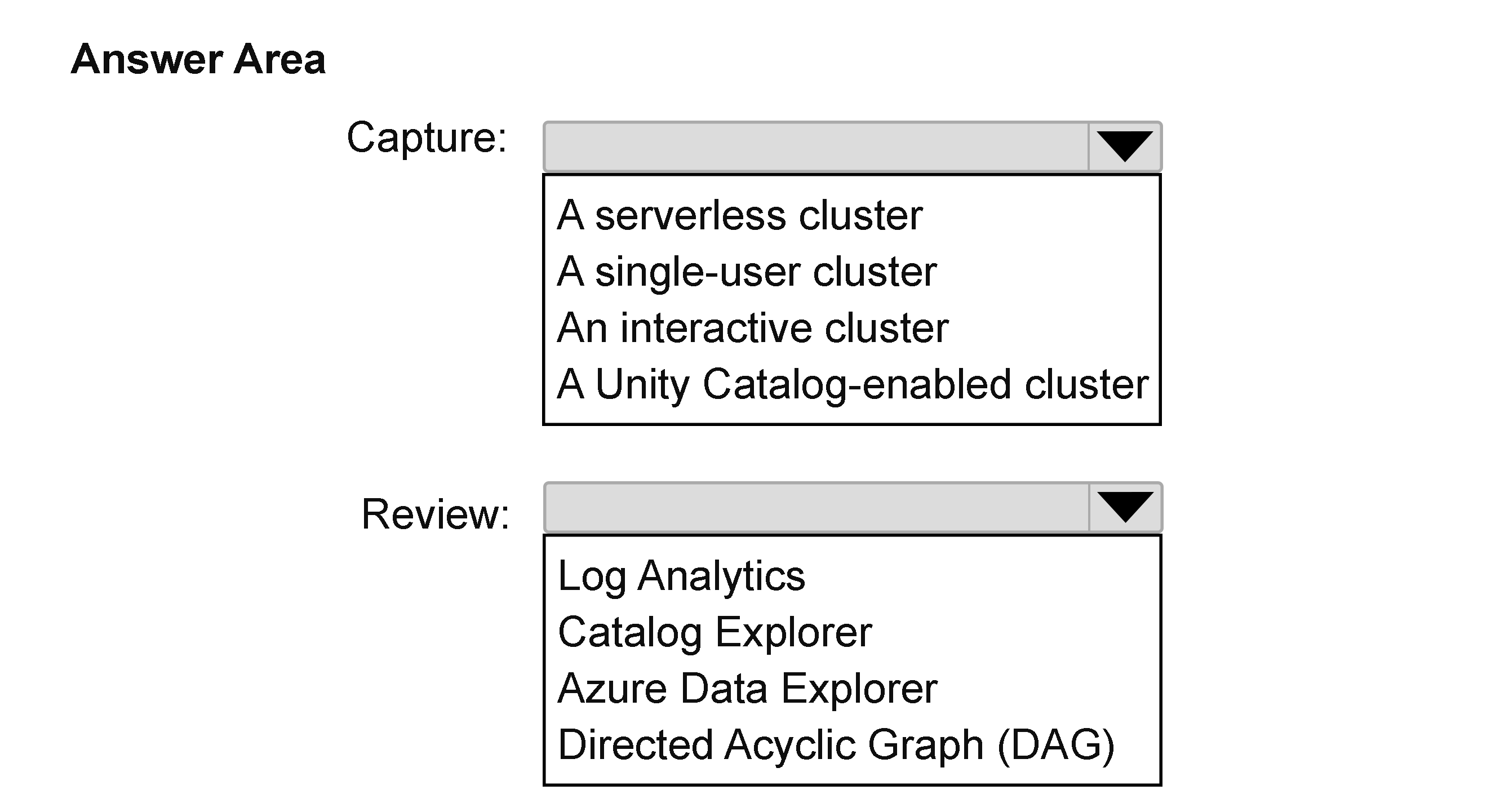
Capture: A serverless cluster / A single-user cluster / An interactive cluster / A Unity Catalog-enabled cluster Review: Log Analytics / Catalog Explorer / Azure Data Explorer / Directed Acyclic Graph (DAG) Show answer
- Capture: A Unity Catalog-enabled cluster
- Review: Catalog Explorer
WhyUnity Catalog captures runtime lineage automatically for queries run on Unity Catalog-enabled compute, with no extra setup. Catalog Explorer shows the lineage graph on each table's Lineage tab. Log Analytics and Azure Data Explorer are not lineage viewers, and a DAG describes job task flow.
- You have an Azure Databricks workspace that is enabled for Unity Catalog and contains a managed Delta table named Table1. Table1 stores customer data.
You need to implement a data retention solution that meets the following requirements:
Deleted data must be retained for 30 days to support audits.
Deleted data that is older than 30 days must be removed permanently.
The solution must minimize administrative effort
Which two properties should you configure? Each correct answer presents part of the solution.
NOTE: Each correct selection is worth one point.- Adelta.timeUntilArchived
- Bdelta.enableDeletionVectors
- Cdelta.logRetentionDuration
- Ddelta.deletedFileRetentionDuration
- Edelta.autoOptimize.autoCompact
Show answer
Correct answer: C, D
Whydelta.deletedFileRetentionDuration set to 30 days controls how long removed data files are kept before VACUUM can delete them, and delta.logRetentionDuration keeps the history needed for time travel audits over the same period. Archive, deletion vectors and auto compaction do not govern retention.
- A
- Note: This section contains one or more sets of questions with the same scenario and problem. Each question presents a unique solution to the problem. You must determine whether the solution meets the stated goals. More than one solution in the set might solve the problem. It is also possible that none of the solutions in the set solve the problem.
After you answer a question in this section, you will NOT be able to return. As a result, these questions do not appear on the Review Screen.
You have an Azure Databricks workspace named Workspace1 that contains a lakehouse and is enabled for Unity Catalog.
You have a connection to a Microsoft SQL Server database named DB1.
You need to expose the schemas and tables of DB1 to meet the following requirements:
The schemas and tables can be queried in Databricks.
The schemas and tables appear alongside other Unity Catalog objects.
The data is NOT copied into Databricks-managed storage.
Solution: You create a Lakeflow Connect pipeline and connect it to DB1.
Does this meet the goal?- AYes
- BNo
Show answer
Correct answer: B
WhyLakeflow Connect ingests data by copying it into Delta tables in Databricks-managed storage, which violates the no-copy requirement. Lakehouse Federation with a foreign catalog over the SQL Server connection queries it in place and shows it beside Unity Catalog objects.
- A
- HOTSPOT
You have an Azure Databricks workspace that is enabled for Unity Catalog and contains a Delta table named db1.sales_orders.
db1.sales_orders is updated nightly and has change data feed (CDF) enabled.
You need to ingest all the changes from the db1.sales_orders table, including inserts, updates, and deletes, into a downstream pipeline.
How should you complete the PsySpark code segment? To answer, select the appropriate options in the answer area.
NOTE: Each correct selection is worth one point.
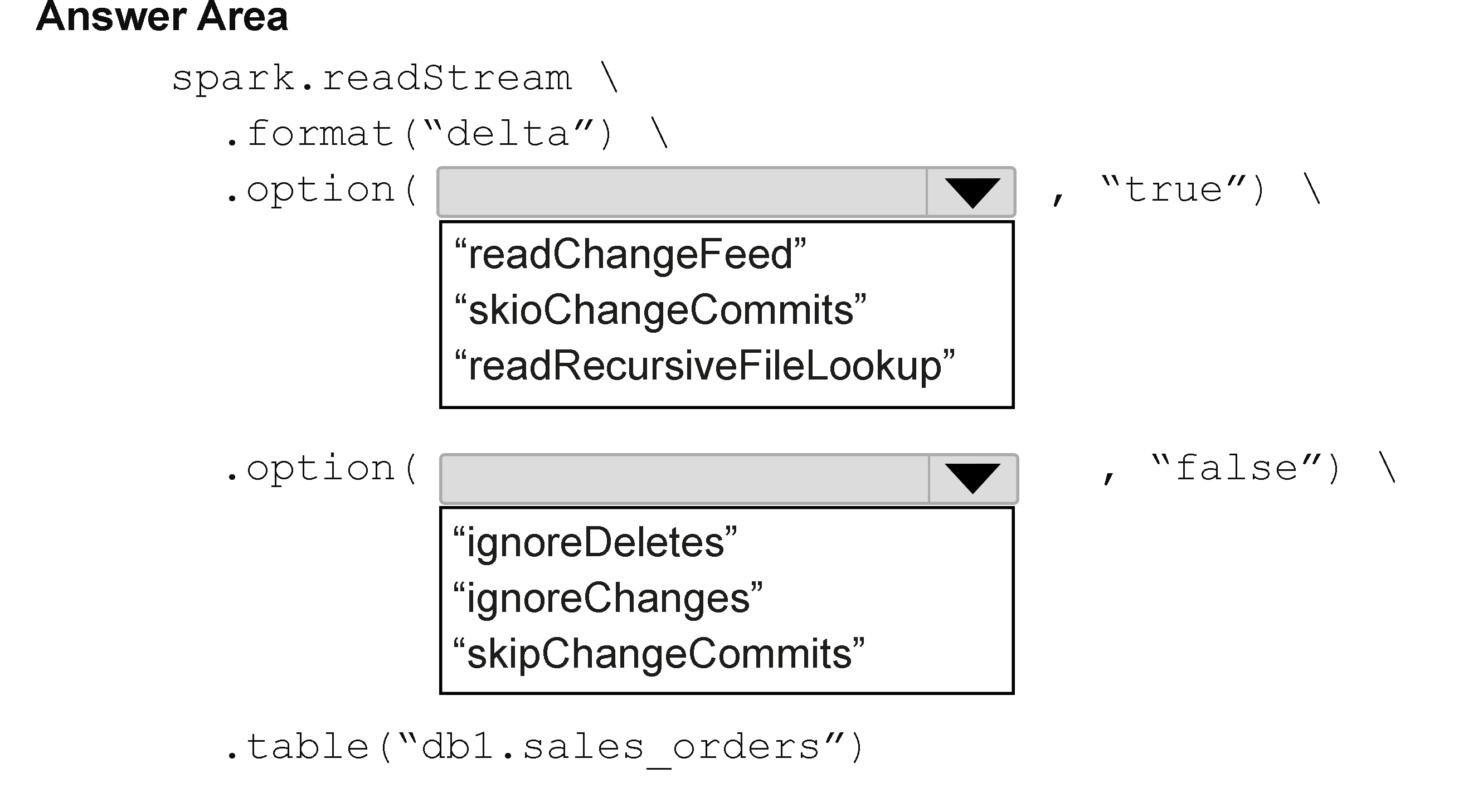
.option( [first option] , "true") “readChangeFeed” / “skioChangeCommits” / “readRecursiveFileLookup” .option( [second option] , "false") “ignoreDeletes” / “ignoreChanges” / “skipChangeCommits” Show answer
- .option( [first option] , "true") “readChangeFeed”
- .option( [second option] , "false") “ignoreDeletes”
WhySetting readChangeFeed to true streams row-level inserts, updates and deletes from the change data feed. Setting ignoreDeletes to false ensures delete events are not dropped, and false is also its default. ignoreChanges is deprecated in favour of skipChangeCommits, so avoid it in new code.
- Note: This section contains one or more sets of questions with the same scenario and problem. Each question presents a unique solution to the problem. You must determine whether the solution meets the stated goals. More than one solution in the set might solve the problem. It is also possible that none of the solutions in the set solve the problem.
After you answer a question in this section, you will NOT be able to return. As a result, these questions do not appear on the Review Screen.
You have an Azure Databricks workspace that is enabled for Unity Catalog and contains a Delta table named Orders.
You load the Orders table into an Apache Spark DataFrame named df.
You need to create a DataFrame that excludes rows where the order amount is null.
Solution: You run the following expression.
df.dropna(subset=[“order_amount”])
Does this meet the goal?- AYes
- BNo
Show answer
Correct answer: A
Whydropna with subset=["order_amount"] removes only rows where that column is null and keeps other columns' nulls untouched. This produces the required DataFrame.
- A
- You have an Azure Databricks workspace that is enabled for Unity Catalog.
You need to profile a table to meet the following requirements:
• The count of null values per column must be evaluated repeatedly as new records are added to the table.
• Changes in the count of null values must be observable over the progression of the dataset.
Which type of profile should you create?- Asnapshot
- Binference
- Ctime series
Show answer
Correct answer: C
WhyA time series profile in Lakehouse Monitoring computes metrics, such as null counts, over time windows as new data arrives, letting you see trends. Snapshot profiles recompute the full table each time without history, and inference profiles are for model inputs and outputs.
- A
- HOTSPOT
You have an Azure Databricks workspace that contains an all-purpose cluster named Cluster1.
You discover that out-of-memory (OOM) errors intermittently cause jobs running on Cluster1 to fail.
You need to identify the root cause of the failures by analyzing the runtime execution behavior.
What should you do? To answer, select the appropriate options in the answer area.
NOTE: Each correct selection is worth one point.
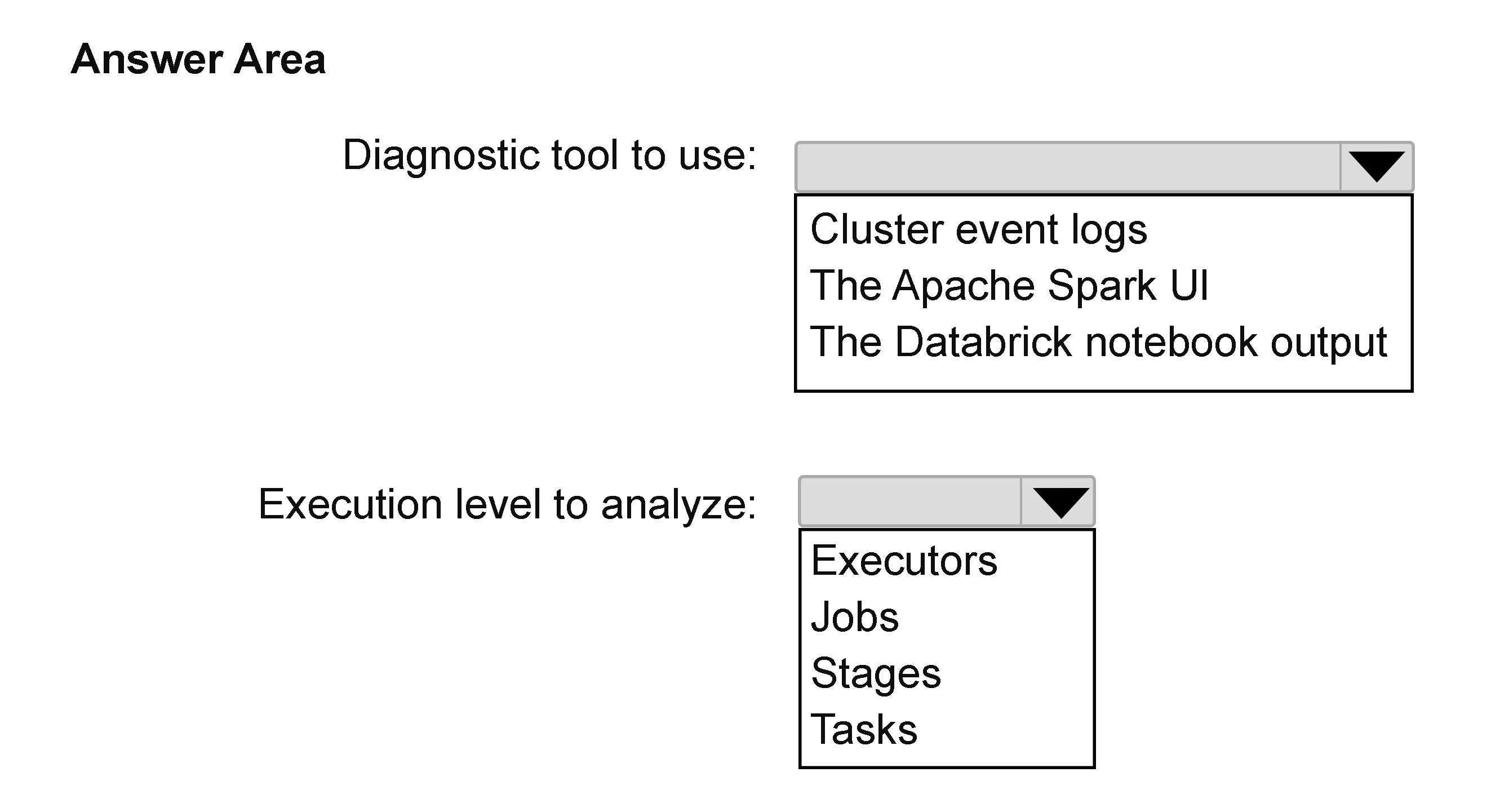
Diagnostic tool to use: Cluster event logs / The Apache Spark UI / The Databrick notebook output Execution level to analyze: Executors / Jobs / Stages / Tasks Show answer
- Diagnostic tool to use: The Apache Spark UI
- Execution level to analyze: Executors
WhyThe Spark UI shows runtime execution detail, while cluster event logs only record lifecycle events such as resizing and terminations. Its Executors tab reports memory use, garbage collection time and failures per executor, which is where out-of-memory problems show up most directly.
- You have an Azure Databricks workspace that contains a job in Lakeflow Jobs named Job1. Job1 contains multiple tasks.
Failures of non-critical tasks must be logged but must NOT trigger notifications. Notifications must be triggered only when critical tasks have failed, and Job1 has completed.
You need to configure the job alerting behavior.
What should trigger a notification?- Atask success
- Ba job failure
- Ca task failure
- Djob success
Show answer
Correct answer: B
WhyConfiguring the notification on job failure fires only once the whole job has completed with a failure. Task-level failure alerts would also notify for non-critical tasks, and success events are not wanted. Non-critical tasks can be set to continue the run on failure.
- A