

SC-100 sample exam questions
15 exam-style questions for Microsoft SC-100: Cybersecurity Architect, with answers and explanations. Take them as a timed practice exam first if you want a score out of 1000.
- HOTSPOT
You have a Microsoft 365 E5 subscription that uses Microsoft Purview, SharePoint Online, and OneDrive for Business.
You need to recommend a ransomware protection solution that meets the following requirements:
• Mitigates attacks that make copies of files, encrypt the copies, and then delete the original files
• Mitigates attacks that encrypt files in place
• Minimizes administrative effort
What should you include in the recommendation? To answer, select the appropriate options in the answer area.
NOTE: Each correct selection is worth one point.
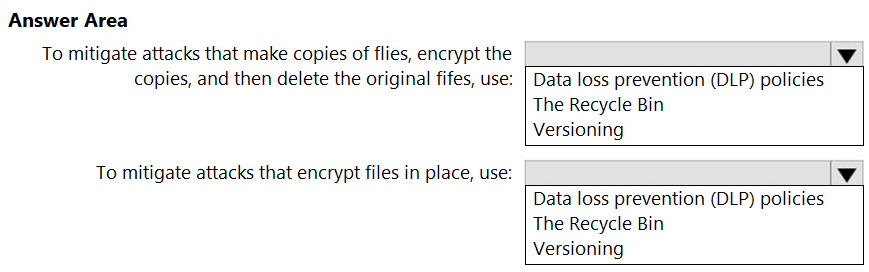
To mitigate attacks that make copies of files, encrypt the copies, and then delete the original files, use Data loss prevention (DLP) policies / The Recycle Bin / Versioning To mitigate attacks that encrypt files in place, use Data loss prevention (DLP) policies / The Recycle Bin / Versioning Show answer
- To mitigate attacks that make copies of files, encrypt the copies, and then delete the original files, use The Recycle Bin
- To mitigate attacks that encrypt files in place, use Versioning
WhyDeleted originals in SharePoint Online and OneDrive can be restored from the Recycle Bin (93 days), and files encrypted in place can be rolled back with built-in versioning, both with no extra setup. DLP policies prevent data sharing, not encryption damage.
- You have a Microsoft Entra tenant that contains 10 Windows 11 devices and two groups named Group1 and Group2. The Windows 11 devices are joined to the Microsoft Entra tenant and are managed by using Microsoft Intune.
You are designing a privileged access strategy based on the rapid modernization plan (RaMP). The strategy will include the following configurations:
• Each user in Group1 will be assigned a Windows 11 device that will be configured as a privileged access device.
• The Security Administrator role will be mapped to the privileged access security level.
• The users in Group1 will be assigned the Security Administrator role.
• The users in Group2 will manage the privileged access devices.
You need to configure the local Administrators group for each privileged access device. The solution must follow the principle of least privilege.
What should you include in the solution?- AOnly add Group2 to the local Administrators group.
- BConfigure Windows Local Administrator Password Solution (Windows LAPS) in legacy Microsoft LAPS emulation mode.
- CAdd Group2 to the local Administrators group. Add the user that is assigned the Security Administrator role to the local Administrators group of the user's assigned privileged access device.
Show answer
Correct answer: A
WhyIn the RaMP privileged access model, the privileged device user must not be a local administrator; only the dedicated device management group (Group2) is added to local Administrators, enforcing least privilege. Adding the Security Administrator user to local admins weakens the device, and LAPS legacy emulation mode is unrelated.
- A
- HOTSPOT
You have a multicloud environment that contains an Azure subscription and an Amazon Web Services (AWS) subscription.
You need to design a solution that meets the following requirements:
• Dynamically discovers the permissions granted to and used by each user
• Generates an aggregated metric that evaluates the level of risk associated with the number of unused or excessive permissions
• Automatically revokes permissions that have been unused for 90 days
• Supports granting on-demand permissions for limited periods of time
• Minimizes administrative effort
Which cloud service should you use for each subscription? To answer, select the options in the answer area.
NOTE: Each correct answer is worth one point.
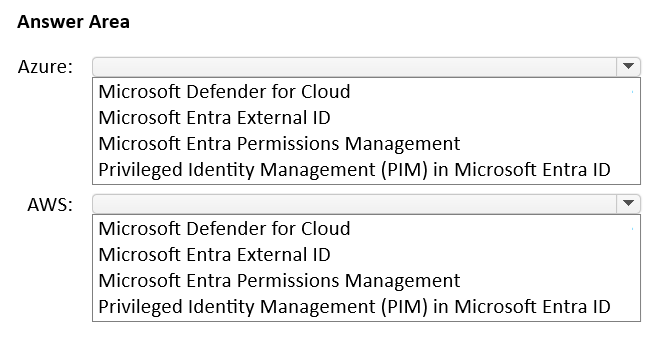
Azure: Microsoft Defender for Cloud / Microsoft Entra External ID / Microsoft Entra Permissions Management / Privileged Identity Management (PIM) in Microsoft Entra ID AWS: Microsoft Defender for Cloud / Microsoft Entra External ID / Microsoft Entra Permissions Management / Privileged Identity Management (PIM) in Microsoft Entra ID Show answer
- Azure: Microsoft Entra Permissions Management
- AWS: Microsoft Entra Permissions Management
WhyEntra Permissions Management is a CIEM tool for Azure, AWS and GCP: it discovers granted vs used permissions, computes the Permission Creep Index, removes unused permissions and grants permissions on demand. Note: Microsoft retired Permissions Management for new customers in 2025, so this feature is outdated.
- You have a Microsoft Entra tenant named contoso.onmicrosoft.com and an Azure subscription named Sub1.
You need to implement Microsoft Entra Verified ID by using Quick Verified ID setup.
What should you create first?- Aa security principal in contoso.onmicrosoft.com
- Ba custom domain in contoso.onmicrosoft.com
- Ca user-assigned managed identity in Sub1
- Dan Azure key vault in Sub1
Show answer
Correct answer: B
WhyQuick Verified ID setup uses a custom domain verified in the Microsoft Entra tenant to build the issuer's decentralized identifier, so the custom domain must exist first. Quick setup removes the need to create your own Azure Key Vault or app registrations, unlike advanced setup.
- A
- HOTSPOT
You have on-premises servers and virtual machines that run Windows Server, Red Hat Enterprise Linux (RHEL) 7, or RHEL 8.
You have an Azure subscription. The subscription contains virtual machines that run Windows Server Datacenter: Azure Edition.
You need to recommend a solution to manage operating system updates for the on-premises servers and the virtual machines. The solution must meet the following requirements:
• Enable hotpatching for the Azure virtual machines.
• Enable the on-demand inventory and deployment of updates.
• Enable the deployment of Extended Security Update (ESU) patches to the on-premises servers.
What should you include in the recommendation? To answer, select the options in the answer area.
NOTE: Each correct answer is worth one point.
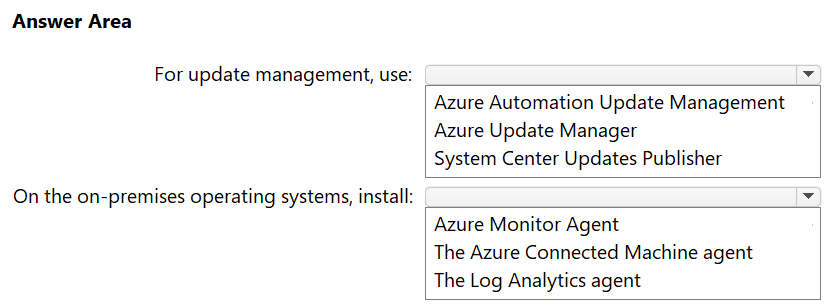
For update management, use: Azure Automation Update Management / Azure Update Manager / System Center Updates Publisher On the on-premises operating systems, install: Azure Monitor Agent / The Azure Connected Machine agent / The Log Analytics agent Show answer
- For update management, use: Azure Update Manager
- On the on-premises operating systems, install: The Azure Connected Machine agent
WhyAzure Update Manager offers on-demand assessment and deployment, supports hotpatching on Azure Edition, and delivers ESU patches to Arc-enabled servers. On-premises machines need the Azure Connected Machine agent. Automation Update Management and the Log Analytics agent are retired.
- You have a multicloud environment that contains an Azure subscription, an Amazon Web Services (AWS) subscription, and a Google Cloud Platform (GCP) subscription.
You plan to assess data security and compliance.
You need to design a Compliance Manager solution that meets the following requirements:
• Provides recommended improvement actions that include detailed implementation guidance
• Automatically monitors regulatory compliance
• Minimizes administrative effort
What should you include in the solution?- AMicrosoft Defender for Cloud
- BCompliance Manager connectors
- CMicrosoft Defender for Cloud Apps
- DMicrosoft Sentinel
Show answer
Correct answer: B
WhyCompliance Manager connectors (multicloud support for Azure, AWS and GCP) let Compliance Manager automatically assess and monitor those clouds, with improvement actions that include implementation guidance and little effort. Defender for Cloud, Defender for Cloud Apps and Sentinel are not Compliance Manager components.
- A
- HOTSPOT
You have an on-premises datacenter named Site1.
You have an Azure subscription that contains a virtual network named VNet1 and multiple Azure App Service apps. Site1 is connected to VNet1 by using a Site-to-Site (P2S) VPN connection. The apps are accessed by using public internet connections.
You need to recommend a solution for providing secure access to the apps. The solution must meet the following requirements:
• Servers on Site1 must use a VPN connection to access the apps.
• Access to the apps must be restricted to specific servers on Site1.
• Security administrators for VNet1 must be able to control which servers can access the apps.
• Costs must be minimized.
What should you include in the recommendation? To answer, select the appropriate options in the answer area.
NOTE: Each correct selection is worth one point.
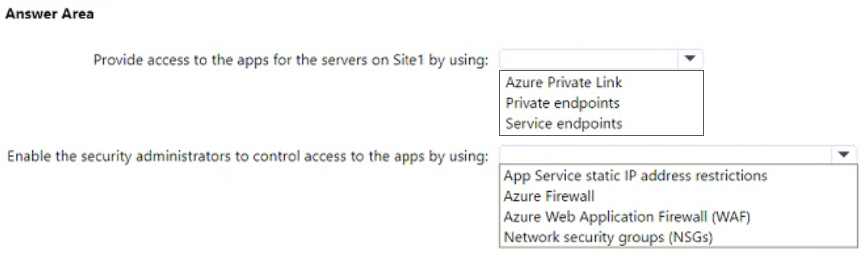
Provide access to the apps for the servers on Site1 by using: Azure Private Link / Private endpoints / Service endpoints Enable the security administrators to control access to the apps by using: App Service static IP address restrictions / Azure Firewall / Azure Web Application Firewall (WAF) / Network security groups (NSGs) Show answer
- Provide access to the apps for the servers on Site1 by using: Private endpoints
- Enable the security administrators to control access to the apps by using: Network security groups (NSGs)
WhyPrivate endpoints give the apps private addresses in VNet1 that Site1 reaches across the VPN, whereas service endpoints do not serve on-premises traffic. NSGs on the endpoint subnet let VNet1 security administrators filter by server address at no cost. Azure Firewall would add cost.
- You have an Azure subscription. The subscription contains multiple Azure App Service web apps that are distributed across multiple Azure regions and are accessed via the internet.
You need to ensure that all incoming requests to the apps are inspected for threats based on the Core Rule Set (CRS) from the Open Web Application Security Project (OWASP). The solution must meet the following requirements:
• Support the use of Microsoft-managed X.509 certificates.
• Route users to the geographically closest app.
• Minimize administrative effort.
What should you use?- AAzure Firewall Premium
- BAzure Front Door with a web application firewall (WAF)
- CAzure Firewall Standard
- DAzure Application Gateway with a web application firewall (WAF)
Show answer
Correct answer: B
WhyAzure Front Door with WAF inspects global HTTP traffic using the Microsoft default rule set based on OWASP CRS, supports Front Door-managed certificates, and routes users to the closest healthy app. Application Gateway is regional, and Azure Firewall does not provide OWASP CRS web inspection or geographic routing.
- A
- Your company wants to optimize using Microsoft Defender for Endpoint to protect its resources against ransomware based on Microsoft Security Best Practices.
You need to prepare a post-breach response plan for compromised computers based on the Microsoft Detection and Response Team (DART) approach in Microsoft Security Best Practices.
What should you include in the response plan?- Acontrolled folder access
- Bapplication isolation
- Cmemory scanning
- Dmachine isolation
- Euser isolation
Show answer
Correct answer: D
WhyDART post-breach guidance for compromised computers is to isolate the machine with Defender for Endpoint device (machine) isolation, cutting network access except to the Defender service while keeping investigation possible. Controlled folder access and memory scanning are preventive, and app or user isolation are not the DART containment action.
- A
- HOTSPOT
Your company wants to optimize using Azure to protect its resources from ransomware.
You need to recommend which capabilities of Azure Backup and Azure Storage provide the strongest protection against ransomware attacks. The solution must follow Microsoft Security Best Practices.
What should you recommend? To answer, select the appropriate options in the answer area.
NOTE: Each correct selection is worth one point.
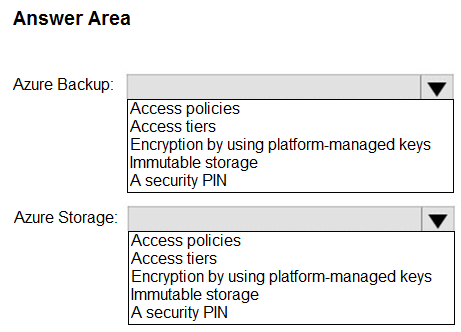
Azure Backup: Access policies / Access tiers / Encryption by using platform-managed keys / Immutable storage / A security PIN Azure Storage: Access policies / Access tiers / Encryption by using platform-managed keys / Immutable storage / A security PIN Show answer
- Azure Backup: A security PIN
- Azure Storage: Immutable storage
WhyA security PIN is required for critical Azure Backup operations, so stolen credentials alone cannot destroy backups. Immutable storage keeps blobs in a write-once state that ransomware cannot alter. Outdated: Azure Backup now also offers immutable vaults and multi-user authorization.
- You need to recommend a solution to meet the security requirements for the InfraSec group.
What should you use to delegate the access?- Aa subscription
- Ba custom role-based access control (RBAC) role
- Ca resource group
- Da management group
Show answer
Correct answer: B
WhyA custom Azure RBAC role grants the InfraSec group exactly the permissions the case study requires, following least privilege. Subscriptions, resource groups and management groups are only scopes where a role is assigned; they do not define which actions are delegated.
- A
- You need to recommend a solution to meet the security requirements for the virtual machines.
What should you include in the recommendation?- Ajust-in-time (JIT) VM access
- Ban Azure Bastion host
- CAzure Virtual Desktop
- Da network security group (NSG)
Show answer
Correct answer: C
WhyAzure Virtual Desktop gives users access to the VMs' applications and desktops through a brokered service without exposing the VMs or opening RDP, meeting the case study security requirements. JIT, Bastion and NSGs are administrative or network controls that still require direct VM connections.
- A
- You need to recommend a strategy for routing internet-bound traffic from the landing zones. The solution must meet the landing zone requirements.
What should you recommend as part of the landing zone deployment?- Alocal network gateways
- Bforced tunneling
- Cservice chaining
Show answer
Correct answer: C
WhyService chaining uses user-defined routes across peered virtual networks to send landing zone internet-bound traffic through the hub firewall or NVA, meeting the landing zone requirements. Forced tunneling sends traffic back to on-premises, and local network gateways represent on-premises VPN endpoints.
- A
- You need to design a strategy for securing the SharePoint Online and Exchange Online data. The solution must meet the application security requirements.
Which two services should you leverage in the strategy? Each correct answer presents part of the solution.
NOTE: Each correct selection is worth one point.- AAzure AD Conditional Access
- Baccess reviews in Azure AD
- CMicrosoft Defender for Cloud
- DMicrosoft Defender for Cloud Apps
- EMicrosoft Defender for Endpoint
Show answer
Correct answer: A, D
WhyMicrosoft Entra Conditional Access (formerly Azure AD) controls access to SharePoint Online and Exchange Online based on device and risk conditions, and Defender for Cloud Apps adds session controls and data protection policies such as blocking downloads. Defender for Cloud, Defender for Endpoint and access reviews do not secure this data the same way.
- A
- You need to recommend a solution to secure the MedicalHistory data in the ClaimsDetail table. The solution must meet the Contoso developer requirements.
What should you include in the recommendation?- Arow-level security (RLS)
- BTransparent Data Encryption (TDE)
- CAlways Encrypted
- Ddata classification
- Edynamic data masking
Show answer
Correct answer: C
WhyAlways Encrypted encrypts the MedicalHistory column on the client so even developers and DBAs with database access cannot see plaintext, meeting the developer requirement. Dynamic data masking only obscures query output and can be bypassed by privileged users, TDE protects data at rest only, and RLS filters rows.
- A