

SC-500 sample exam questions
15 exam-style questions for Microsoft SC-500: Cloud and AI Security Engineer, with answers and explanations. Take them as a timed practice exam first if you want a score out of 1000.
- You have a management group named MG1 that contains two subscriptions named Sub1 and Sub2.
Sub1 contains a resource group named RG-Exception and a resource group named RG1 that hosts Microsoft Foundry resources.
You need to assign an Azure policy to force new Foundry deployments in MG1 to use private endpoints. The solution must NOT restrict deployments in RG-Exception.
How should you configure the policy?- AAssign the policy to MG1 and exclude RG-Exception.
- BAssign the policy to Sub1 and RG-Exception.
- CAssign the policy to MG1 and RG-Exception.
- DAssign the policy to Sub1 and exclude RG-Exception.
Show answer
Correct answer: A
WhyAssigning the policy at the MG1 management group scope covers all current and future subscriptions, and an exclusion (notScopes) for RG-Exception exempts that resource group. Assigning to a resource group cannot be done as an inclusion with a subscription, and assigning to Sub1 would miss Sub2.
- A
- DRAG DROP
You have a Microsoft Entra tenant.
You need to implement passwordless authentication. The solution must meet the following requirements:
Users can sign in without a password by using a mobile device.
New users that sign in for the first time must use a helpdesk-issued sign-in method that expires.
Which authentication method should you enable for each requirement? To answer, drag the appropriate methods to the correct requirements. Each method may be used once, more than once, or not at all. You may need to drag the split bar between panes or scroll to view content.
NOTE: Each correct selection is worth one point.
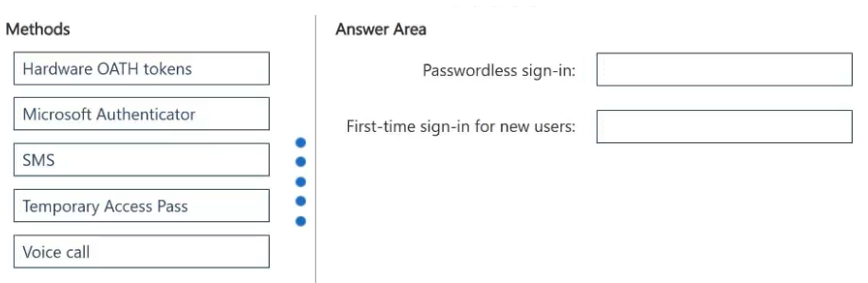
Move each item to the matching row:
- Hardware OATH tokens
- Microsoft Authenticator
- SMS
- Temporary Access Pass
- Voice call
- Passwordless sign-in:
- First-time sign-in for new users:
Show answer
- Passwordless sign-in: Microsoft Authenticator
- First-time sign-in for new users: Temporary Access Pass
WhyMicrosoft Authenticator offers passwordless phone sign-in from a mobile device. A Temporary Access Pass is a time-limited passcode issued by an administrator or helpdesk, letting new users sign in and register passwordless methods without ever having a password.
- DRAG DROP
You have an Azure subscription named Sub1 that contains a virtual network named VNet1.
VNet1 contains multiple virtual machines, including two virtual machines named VM1 and VM2.
Sub1 is linked to a Microsoft Entra tenant named contoso.com.
A partner company has an Azure subscription named Sub2 that contains a virtual network named VNet2. VNet2 contains a virtual machine named VM3.
Sub2 is linked to a Microsoft Entra tenant named fabrikam.com.
VM1 and VM2 contain data used by an application that runs on VM3.
You need to ensure that VM3 can access VM1 and VM2. The solution must deny VM3 access to any other resources in Sub1.
What should you configure on each virtual network? To answer, drag the components to the correct virtual networks. Each component may be used once, more than once, or not at all. You may need to drag the split bar between panes or scroll to view content.
NOTE: Each correct selection is worth one point.
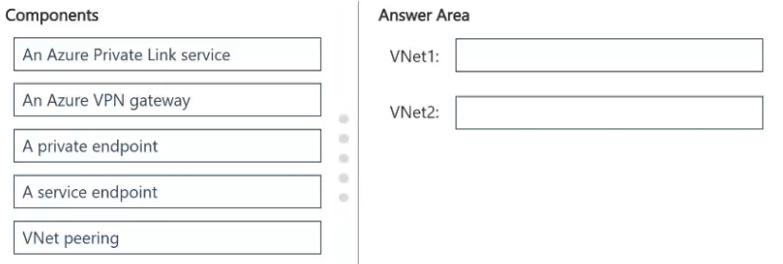
Move each item to the matching row:
- An Azure Private Link service
- An Azure VPN gateway
- A private endpoint
- A service endpoint
- VNet peering
- VNet1:
- VNet2:
Show answer
- VNet1: An Azure Private Link service
- VNet2: A private endpoint
WhyA Private Link service in front of VM1 and VM2, behind a Standard Load Balancer, exposes only those machines. A private endpoint in VNet2 connects to it, even across tenants. Peering or a VPN would open wider network reachability into Sub1.
- Note: This section contains one or more sets of questions with the same scenario and problem. Each question presents a unique solution to the problem. You must determine whether the solution meets the stated goals. More than one solution in the set might solve the problem. It is also possible that none of the solutions in the set solve the problem.
After you answer a question in this section, you will NOT be able to return. As a result, these questions do not appear on the Review Screen.
You have a Microsoft Sentinel workspace.
You have a multi-tier Security Operations Center (SOC) team.
You need to ensure that all new security incidents are assigned immediately to the Tier 1 analysts group and flagged for triage.
Solution: You create a hunting query.
Does this meet the goal?- AYes
- BNo
Show answer
Correct answer: B
WhyA hunting query is a manual proactive search of data. It cannot assign incidents or set tags when incidents are created. Incident assignment and flagging at creation requires an automation rule.
- A
- You have an Azure subscription named Sub1 that contains a resource group named RG1.
RG1 contains a virtual network named VNet1 and a storage account named storage1. Several engineers are assigned the Owner role for Sub1.
You need to prevent updates to and deletions from VNet1. The solution must ensure that engineers can continue updating other resources in RG1.
Which lock should you apply?- Aa Read-only resource lock at the RG1 scope
- Ba Delete resource lock at the RG1 scope
- Ca Read-only resource lock at the VNet1 scope
- Da Delete resource lock at the VNet1 scope
Show answer
Correct answer: C
WhyA Delete lock still allows updates, so it would not prevent changes. A Read-only lock on VNet1 blocks both updates and deletions of that resource only, leaving other resources in RG1 editable. Applying it at the RG1 scope would block changes to storage1 as well.
- A
- HOTSPOT
You have a Microsoft Entra tenant that contains the users shown in the following table.
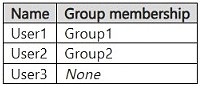
You have a location named HQ-Trusted that contains the IP address of the corporate network.
The tenant contains a Conditional Access policy named CA1 that has the following settings:
• Assignments:
o Users or agents:
- Include: All users
- Exclude: Group1
• Target resources:
o Resources (formerly cloud apps):
- Include: Office 365
• Conditions:
o Client apps: Not configured
• Access controls:
o Grant:
- Require multifactor authentication
o Grant:
- Require device to be marked as compliant
o For multiple controls:
- Require all the selected controls
The tenant contains a Conditional Access policy named CA2 that has the following settings:
• Assignments:
o Users or agents:
- Include: All users
- Exclude: Group2
• Target resources:
o Resources (formerly cloud apps):
- Include: All resources
• Conditions:
o Locations:
- Configure: Yes
- Include: Any network or location
- Exclude: HQ-Trusted
• Access controls:
o Grant:
- Block access
For each of the following statements, select Yes if the statement is true. Otherwise, select No.
NOTE: Each correct selection is worth one point.
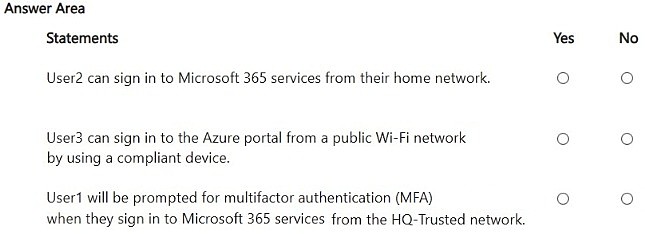
User2 can sign in to Microsoft 365 services from their home network. Yes / No User3 can sign in to the Azure portal from a public Wi-Fi network by using a compliant device. Yes / No User1 will be prompted for multifactor authentication (MFA) when they sign in to Microsoft 365 services from the HQ-Trusted network. Yes / No Show answer
- User2 can sign in to Microsoft 365 services from their home network. Yes
- User3 can sign in to the Azure portal from a public Wi-Fi network by using a compliant device. No
- User1 will be prompted for multifactor authentication (MFA) when they sign in to Microsoft 365 services from the HQ-Trusted network. No
WhyUser2 is excluded from the CA2 block, so only CA1 applies and sign-in succeeds with MFA and a compliant device. User3 is subject to CA2, which blocks access outside HQ-Trusted. User1 is excluded from CA1, and CA2 does not apply on HQ-Trusted, so no MFA is requested.
- You have an Azure key vault named KV1.
You have an Azure App Service web app named App1. App1 is integrated with a virtual network named VNet1 that is linked to an Azure Private DNS zone. App1 accesses secrets stored in KV1.
You need to configure KV1 to meet the following requirements:
• App1 must access the secrets by using a private IP address on VNet1.
• Requests from outside VNet1 must be denied.
Which two actions should you perform for KV1? Each correct answer presents part of the solution.
NOTE: Each correct selection is worth one point.- ACreate a private endpoint.
- BAdd the IP addresses of App1.
- CDisable public access.
- DCreate an access policy.
Show answer
Correct answer: A, C
WhyCreate a private endpoint for KV1 so App1 reaches it by a private IP in VNet1 (resolved through the Private DNS zone), and disable public network access so requests from outside are denied. IP rules and access policies are permission or firewall settings that do not provide private connectivity.
- A
- You have an Azure Storage account named storage1 that hosts a blob container used by an internal application.
You plan to enable a third-party workflow system to upload blobs to storage1.
You need to provide time-bound, least-privilege upload access to the third-party system.
Which authorization method should you use?- AConfigure the workflow system to use a user delegation shared access signature (SAS).
- BEnable a managed identity for the workflow system and assign a role for storage1.
- CEnable anonymous public read access for the blob container.
- DConfigure the workflow system to use Shared Key authorization.
Show answer
Correct answer: A
WhyA user delegation SAS is signed with Microsoft Entra credentials, can be limited to write/create permission on a container and a short expiry, so it gives time-bound, least-privilege upload access to an external party. Managed identities cannot be used by third-party systems, and Shared Key or anonymous access are broad.
- A
- DRAG DROP
You have an Azure subscription named Sub1 that contains a storage account named storage1. storage1 hosts a blob container named container1.
Sub1 is linked to a Microsoft Entra tenant that contains a security group named Group1.
You need to ensure that Group1 can use the Azure portal to view the blobs in container1. The solution must follow the principle of least privilege.
Which roles should you assign to Group1. To answer, drag the appropriate roles to the correct objects. Each role may be used once, more than once, or not at all. You may need to drag the split bar between panes or scroll to view content.
NOTE: Each correct selection is worth one point.
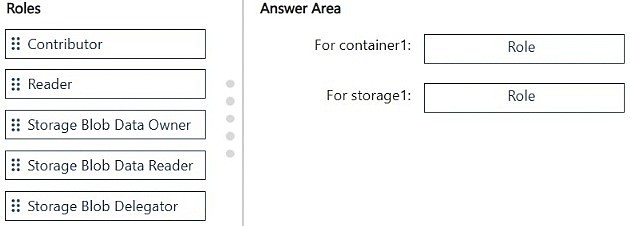
Move each item to the matching row:
- Contributor
- Reader
- Storage Blob Data Owner
- Storage Blob Data Reader
- Storage Blob Delegator
- For container1:
- For storage1:
Show answer
- For container1: Storage Blob Data Reader
- For storage1: Reader
WhyStorage Blob Data Reader scoped to container1 grants read access to its blobs and nothing else. Browsing in the Azure portal also needs a management plane role to navigate to the account, and Reader on storage1 is the least privileged role that allows this.
- You have an Azure subscription that contains the resources shown in the following table.
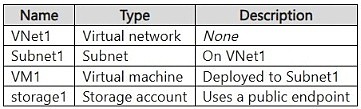
VM1 contains an application that accesses storage1. Another application accesses storage1 from a public IP address of xxx.xxx.xx.xx.
For storage1, you set Public network access to Enabled from selected virtual networks and IP addresses. You add an IP network rule for xxx.xxx.xx.xx.
After the configuration, only connections from xxx.xxx.xx.xx succeed.
You need to ensure that both VM1 and xxx.xxx.xx.xx.can access storage1 over the public endpoint, while preventing all other access.
What should you do?- ASet Public network access to Enabled from all networks.
- BEnable a private endpoint for storage1.
- CAdd a public IP address to VM1.
- DEnable the Microsoft.Storage service endpoint for Subnet1.
Show answer
Correct answer: D
WhyIP rules for storage firewalls cannot allow Azure VM private IPs in the same region. Enabling the Microsoft.Storage service endpoint on Subnet1 and adding that subnet as a virtual network rule lets VM1 in, while the IP rule keeps the external app allowed. Opening all networks removes protection.
- A
- You have an Azure subscription that contains a resource group named RG1 and has Microsoft Defender for Cloud enabled.
You connect an Amazon Web Services (AWS) account to Defender for Cloud by creating the AWS connector in RG1.
You have a Microsoft Entra group named Group1 that contains the user accounts of the security analysts at your company.
You need to ensure that the members of Group1 can view multicloud recommendations and security alerts for the connected AWS account. The solution must follow the principle of least privilege.
Which role should you assign to Group1 for RG1?- ASecurity Reader
- BReader
- COwner
- DSecurity Administrator
Show answer
Correct answer: A
WhySecurity Reader lets Group1 view recommendations and security alerts, including multicloud AWS findings, without any change rights. Reader does not include security data access, while Owner and Security Administrator exceed least privilege.
- A
- You have an Azure subscription that has the Microsoft Defender for Cloud Foundational Cloud Security Posture Management (CSPM) plan enabled.
You have an Amazon Web Services (AWS) account connected to Defender for Cloud for posture management.
In Defender for Cloud, security recommendations for the resources in Azure and AWS have a risk level of Not evaluated.
You need to ensure that Defender for Cloud assigns a risk level to the recommendations.
What should you do?- AOnboard all the virtual machines in the AWS account to Azure Arc.
- BEnable Microsoft Defender for Servers Plan 2.
- CAssign the CIS AWS Foundations v3.0.0 standard to the AWS account.
- DEnable the Defender CSPM plan.
Show answer
Correct answer: D
WhyRisk levels for recommendations are a feature of the Defender CSPM plan (risk prioritization). The Foundational CSPM plan leaves them as Not evaluated, so enable Defender CSPM. Arc onboarding, Defender for Servers and compliance standards do not assign risk levels.
- A
- You have a Microsoft Entra tenant that uses Microsoft Entra Agent ID.
You have multiple Microsoft Foundry agents that have agent identities assigned.
You discover that one of the identities is flagged as high risk due to unusual sign-in activity.
You need to ensure that agent access to resources is restricted automatically based on risk.
What should you create?- Aa Privileged Identity Management (PIM) activation policy
- Ban Access review for the identities
- Ca Conditional Access policy for the identities
- Da Microsoft Entra role assignment policy
Show answer
Correct answer: C
WhyConditional Access supports Microsoft Entra Agent ID identities, so a policy using agent identity risk as a condition can block or restrict access automatically for high-risk agents. PIM, access reviews and role assignment policies are not risk-driven and are not automatic for sign-in risk.
- A
- You have an Azure API Management instance named APIM1.
You have a partner company that accesses an API in APIM1 by using subscription keys.
A backend API key is stored in a named value in APIM1.
Microsoft Defender for Cloud generates the following recommendation: “API Management secret named values should be stored in Azure Key Vault.”
You need to address the recommendation.
What should you do first?- AEnable the Microsoft Defender for APIs plan.
- BEnable a managed identity for APIM1.
- CMark the existing named value as a secret.
- DReplace the backend API key with a subscription key.
Show answer
Correct answer: B
WhyTo use Key Vault references for named values, APIM1 needs a managed identity with access to the vault, so enabling a managed identity is the first step. Then the named value is changed to a Key Vault secret reference. Marking it secret alone does not satisfy the recommendation.
- A
- HOTSPOT
You have a Microsoft Entra tenant named contoso.com that contains the users shown in the following table.
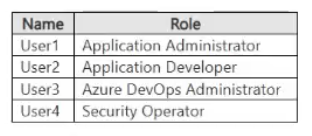
You add enterprise applications to contoso.com as shown in the following table.
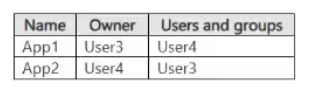
You need to identify which users can grant admin consent for App1 and App2.
Which users should you identify for each application? To answer, select the appropriate options in the answer area.
NOTE: Each correct selection is worth one point.
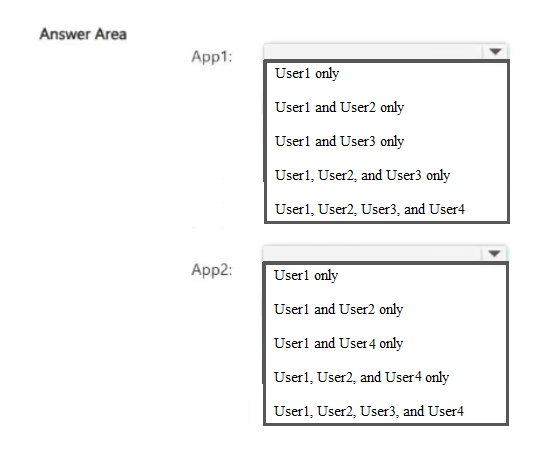
App1: User1 only / User1 and User2 only / User1 and User3 only / User1, User2, and User3 only / User1, User2, User3, and User4 App2: User1 only / User1 and User2 only / User1 and User4 only / User1, User2, and User4 only / User1, User2, User3, and User4 Show answer
- App1: User1 only
- App2: User1 only
WhyTenant-wide admin consent requires a role such as Application Administrator, Cloud Application Administrator or Privileged Role Administrator. Application Developer, Azure DevOps Administrator and Security Operator lack it, and owning an enterprise application or being assigned to it does not grant that right.