

SCS-C03 sample exam questions
15 exam-style questions for AWS SCS-C03: Security Specialty, with answers and explanations. Take them as a timed practice exam first if you want a score out of 1000.
- HOTSPOT
A company is building a web application that needs to authenticate external users across multiple microservices that the company hosts on Amazon Elastic Container Service (Amazon ECS). The solution must use temporary credentials and minimize the management overhead required to maintain user databases.
Select and order the correct steps from the following list to implement a secure authentication strategy that meets these requirements. Select each step one time or not at all.
Configure Amazon Cognito user pools for user authentication.
Set up an IAM role for each microservice. Grant each role appropriate permissions.
Implement an Amazon API Gateway HTTP API with AWS Lambda authorizers to validate tokens before forwarding requests to microservices.
Create an Amazon DynamoDB table to store user credentials for each microservice.
Create an Amazon Cognito application client to interact with the web application.
Set up AWS IAM Identity Center to give users access to the microservices.
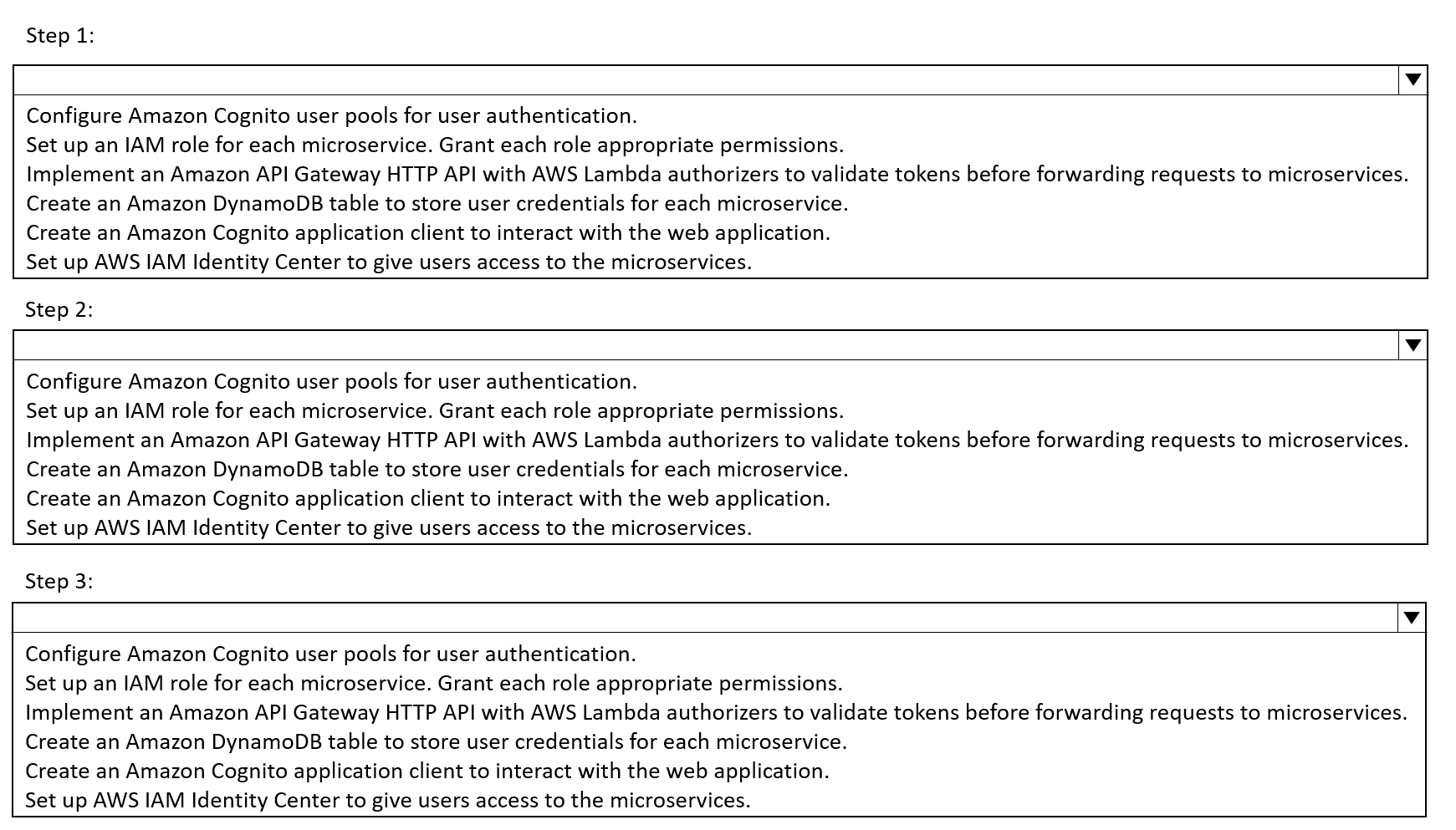
Arrange 3 of these in the correct order:
- Configure Amazon Cognito user pools for user authentication.
- Set up an IAM role for each microservice. Grant each role appropriate permissions.
- Implement an Amazon API Gateway HTTP API with AWS Lambda authorizers to validate tokens before forwarding requests to microservices.
- Create an Amazon DynamoDB table to store user credentials for each microservice.
- Create an Amazon Cognito application client to interact with the web application.
- Set up AWS IAM Identity Center to give users access to the microservices.
Show answer
- Configure Amazon Cognito user pools for user authentication.
- Create an Amazon Cognito application client to interact with the web application.
- Implement an Amazon API Gateway HTTP API with AWS Lambda authorizers to validate tokens before forwarding requests to microservices.
WhyA Cognito user pool authenticates external users without a user database to maintain, and an app client connects the web application to that pool. API Gateway with Lambda authorizers then validates the tokens before requests reach the microservices. DynamoDB would mean storing credentials yourself, and IAM Identity Center is for workforce users.
- An AWS account administrator created an IAM group and applied the following managed policy to require that each individual user authenticate using multi-factor authentication:
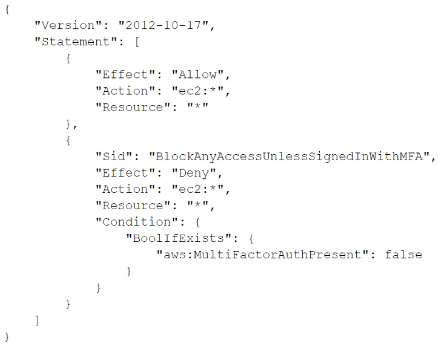
After implementing the policy, the administrator receives reports that users are unable to perform Amazon EC2 commands using the AWS CLI.
What should the administrator do to resolve this problem while still enforcing multi-factor authentication?- AChange the value of aws:MultiFactorAuthPresent to true.
- BInstruct users to run the aws sts get-session-token CLI command and pass the multi-factor authentication --serial-number and -token-code parameters. Use these resulting values to make API/CLI calls.
- CImplement federated API/CLI access using SAML 2.0, then configure the identity provider to enforce multi-factor authentication.
- DCreate a role and enforce multi-factor authentication in the role trust policy. Instruct users to run the sts assume-role CLI command and pass --serial-number and --token-code parameters. Store the resulting values in environment variables. Add sts:AssumeRole to NotAction in the policy.
Show answer
Correct answer: B
WhyLong-term access keys carry no MFA context, so the Deny applies to every CLI call. aws sts get-session-token with the MFA serial number and token code returns temporary credentials that have aws:MultiFactorAuthPresent set to true, which keeps MFA enforced and lets the EC2 calls succeed. The other options either change the policy logic or add federation or roles that the problem does not need.
- A
- HOTSPOT
A security engineer needs to implement AWS IAM Identity Center with an exlemai identity provider (IdP).
Select and order the correct steps from the following list to meet this requirement. Select each step one time or not at all.
Configure the external IdP as the identity source in IAM Identity Center.
Create an IAM role that has a trust policy that specifics the IdP's API endpoint.
Enable automatic provisioning in IAM Identity Center settings
Enable automatic provisioning in the external IdP.
Obtain the SAML metadata from IAM Identity Center.
Obtain the SAML metadata from the external IdP.
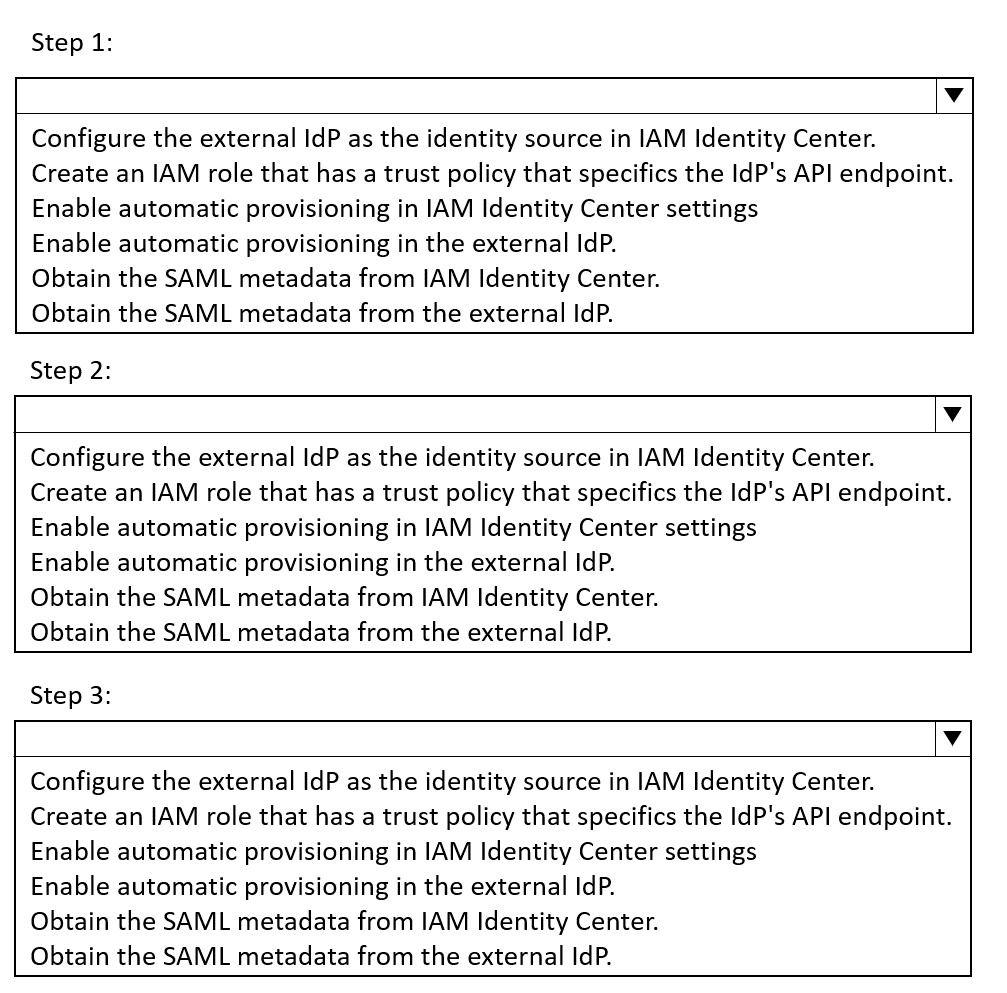
Arrange 3 of these in the correct order:
- Configure the external IdP as the identity source in IAM Identity Center.
- Create an IAM role that has a trust policy that specifics the IdP's API endpoint.
- Enable automatic provisioning in IAM Identity Center settings
- Enable automatic provisioning in the external IdP.
- Obtain the SAML metadata from IAM Identity Center.
- Obtain the SAML metadata from the external IdP.
Show answer
- Obtain the SAML metadata from the external IdP.
- Configure the external IdP as the identity source in IAM Identity Center.
- Enable automatic provisioning in IAM Identity Center settings
WhyGet the SAML metadata from the external IdP, set that IdP as the identity source in IAM Identity Center, then turn on automatic provisioning in IAM Identity Center settings. Provisioning uses SCIM, which is enabled in IAM Identity Center first, and no IAM role is needed for this setup.
- HOTSPOT
A company is designing its security monitoring strategy for an existing sensitive workload on AWS. The security team has identified several scenarios that require monitoring strategies.
Select the correct monitoring strategy from the following list for each monitoring scenario. Select each monitoring strategy one time.
Automatically isolate Amazon EC2 distances when malware detection findings are confirmed.
Correlate security findings from multiple AWS detection services to identify multi-stage attacks.
Detect when privileged users perform an unusually high volume of resource deletion operations.
Identify patterns of more than 50 failed authentication attempts from specific IP addresses in 1 hour.
Monitor network traffic patterns especially large data transfers to external IP addresses outside normal office hours.
Configure VPC Flow Logs with Amazon CloudWatch Logs Insights queries to analyze traffic volume and destination patterns during specific time windows.
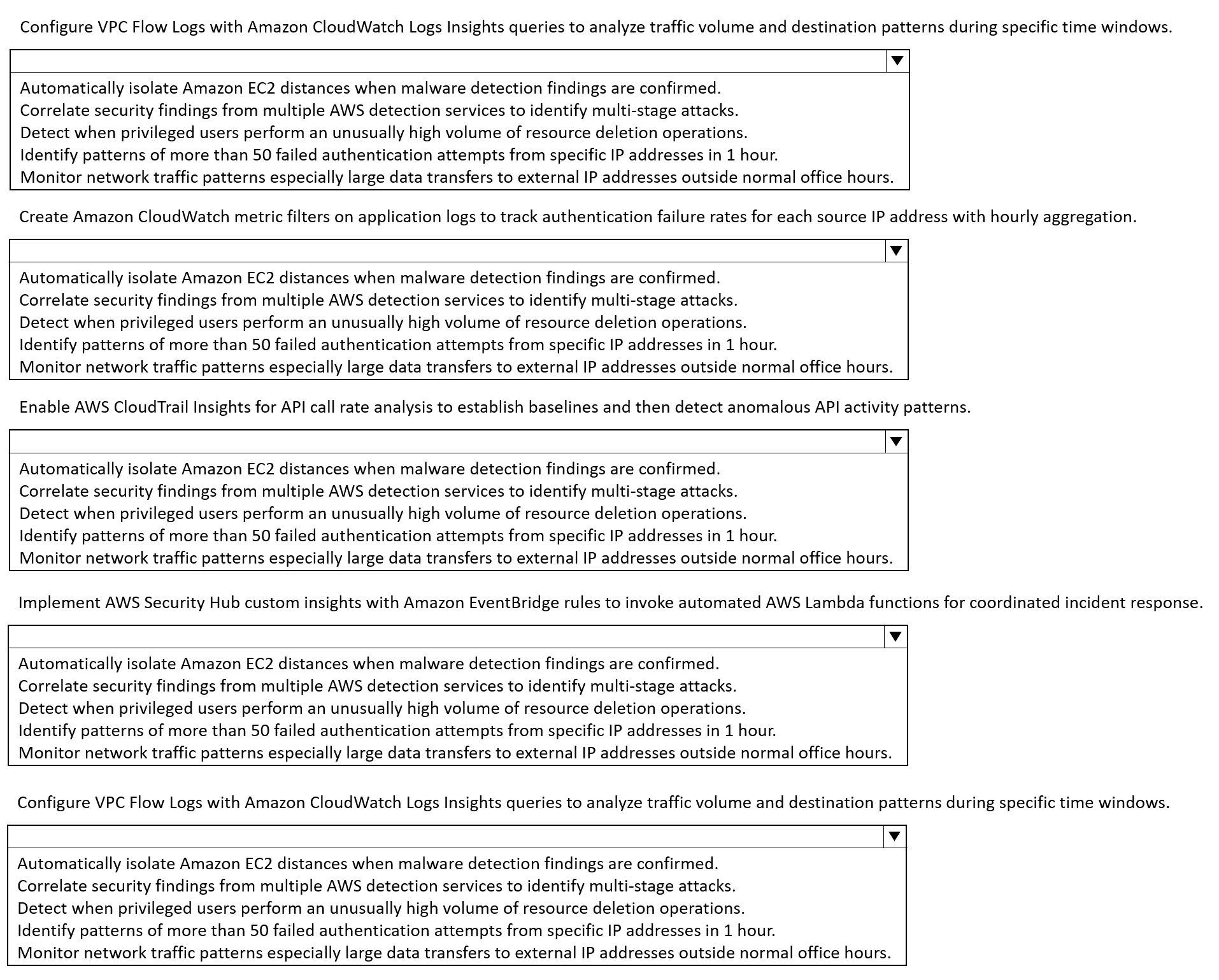
Move each item to the matching row:
- Automatically isolate Amazon EC2 distances when malware detection findings are confirmed.
- Correlate security findings from multiple AWS detection services to identify multi-stage attacks.
- Detect when privileged users perform an unusually high volume of resource deletion operations.
- Identify patterns of more than 50 failed authentication attempts from specific IP addresses in 1 hour.
- Monitor network traffic patterns especially large data transfers to external IP addresses outside normal office hours.
- Configure VPC Flow Logs with Amazon CloudWatch Logs Insights queries to analyze traffic volume and destination patterns during specific time windows.
- Create Amazon CloudWatch metric filters on application logs to track authentication failure rates for each source IP address with hourly aggregation.
- Enable AWS CloudTrail Insights for API call rate analysis to establish baselines and then detect anomalous API activity patterns.
- Implement AWS Security Hub custom insights with Amazon EventBridge rules to invoke automated AWS Lambda functions for coordinated incident response.
- Fifth strategy (the question repeats the VPC Flow Logs wording here)
Show answer
- Configure VPC Flow Logs with Amazon CloudWatch Logs Insights queries to analyze traffic volume and destination patterns during specific time windows. Monitor network traffic patterns especially large data transfers to external IP addresses outside normal office hours.
- Create Amazon CloudWatch metric filters on application logs to track authentication failure rates for each source IP address with hourly aggregation. Identify patterns of more than 50 failed authentication attempts from specific IP addresses in 1 hour.
- Enable AWS CloudTrail Insights for API call rate analysis to establish baselines and then detect anomalous API activity patterns. Detect when privileged users perform an unusually high volume of resource deletion operations.
- Implement AWS Security Hub custom insights with Amazon EventBridge rules to invoke automated AWS Lambda functions for coordinated incident response. Automatically isolate Amazon EC2 distances when malware detection findings are confirmed.
- Fifth strategy (the question repeats the VPC Flow Logs wording here) Correlate security findings from multiple AWS detection services to identify multi-stage attacks.
WhyVPC Flow Logs with Logs Insights analyze traffic volume and destinations by time window. CloudWatch metric filters count failed logins per source IP. CloudTrail Insights spots unusual API activity such as a burst of deletions. Security Hub with EventBridge and Lambda automates isolating an instance when malware is confirmed. The fifth row repeats the VPC Flow Logs wording by mistake, and it pairs with the remaining scenario, correlating findings across detection services.
- A company is running an application on Amazon EC2 instances in an Auto Scaling group. The application stores logs locally. A security engineer noticed that logs were lost after a scale-in event. The security engineer needs to recommend a solution to ensure the durability and availability of log data. All logs must be kept for a minimum of 1 year for auditing purposes.
What should the security engineer recommend?- AWithin the Auto Scaling lifecycle, add a hook to create and attach an Amazon Elastic Block Store (Amazon EBS) log volume each time an EC2 instance is created. When the instance is terminated, the EBS volume can be reattached to another instance for log review.
- BCreate an Amazon Elastic File System (Amazon EFS) file system and add a command in the user data section of the Auto Scaling launch template to mount the EFS file system during EC2 instance creation. Configure a process on the instance to copy the logs once a day from an instance Amazon Elastic Block Store (Amazon EBS) volume to a directory in the EFS file system.
- CAdd an Amazon CloudWatch agent into the AMI used in the Auto Scaling group. Configure the CloudWatch agent to send the logs to Amazon CloudWatch Logs for review.
- DWithin the Auto Scaling lifecycle, add a lifecycle hook at the terminating state transition and alert the engineering team by using a lifecycle notification to Amazon Simple Notification Service (Amazon SNS). Configure the hook to remain in the Terminating:Wait state for 1 hour to allow manual review of the security logs prior to instance termination.
Show answer
Correct answer: C
WhyThe CloudWatch agent sends logs off the instance as they are written, so a scale-in no longer loses them, and a log group retention setting of at least 1 year covers the audit requirement. Reattaching volumes, a daily copy to EFS and manual review before termination all leave gaps or depend on people.
- A
- A security engineer uses Amazon Macie to scan a company’s Amazon S3 buckets for sensitive data. The company has many S3 buckets and many objects stored in the S3 buckets. The security engineer must identify S3 buckets that contain sensitive data and must perform additional scanning on those S3 buckets.
Which solution will meet these requirements with the LEAST administrative overhead?- AConfigure S3 Cross-Region Replication (CRR) on the S3 buckets to replicate the objects to a second AWS Region. Configure Macie in the second Region to scan the replicated objects daily.
- BCreate an AWS Lambda function as an S3 event destination for the S3 buckets. Configure the Lambda function to start a Macie scan of an object when the object is uploaded to an S3 bucket.
- CConfigure Macie automated discovery to continuously sample data from the S3 buckets. Perform full scans of the S3 buckets where Macie discovers sensitive data.
- DConfigure Macie scans to run on the S3 buckets. Aggregate the results of the scans in an Amazon DynamoDB table. Use the DynamoDB table for queries.
Show answer
Correct answer: C
WhyMacie automated sensitive data discovery continuously samples S3 objects across the account and shows which buckets are likely to hold sensitive data, so full scans can target only those buckets. The other options need extra replication, custom code or scanning everything.
- A
- A company is running a new workload across accounts that are in an organization in AWS Organizations. All running resources must have a tag of CostCenter, and the tag must have one of three approved values. The company must enforce this policy and must prevent any changes of the CostCenter tag to a non-approved value.
Which solution will meet these requirements?- ACreate an AWS Config Custom Policy rule by using AWS CloudFormatlon Guard. Include the tag key of CostCenter and the approved values. Create an SCP that denies the creation of resources when the value of the aws:RequestTagCostCenter condition key is not one of the three approved values.
- BCreate an AWS CloudTrail trail. Create an Amazon EventBridge rule that includes a rule statement that matches the creation of new resources. Configure the EventBridge rule to invoke an AWS Lambda function that checks for the CostCenter tag. Program the Lambda function to block creation in case of a noncompliant value.
- CEnable tag policies for the organization. Create a tag policy that specifies a tag key of CostCenter and the approved values. Configure the policy to enforce noncompliant operations. Create an SCP that denies the creation of resources when the aws:RequestTag.CostCenter condition key has a null value.
- DEnable tag policies for the organization. Create a tag policy that specifies a tag key of CostCenter and the approved values. Create an Amazon EventBridge rule that invokes an AWS Lambda function when a noncompliant tag is created. Program the Lambda function to block changes to the tag.
Show answer
Correct answer: C
WhyA tag policy defines the allowed CostCenter values and, with enforcement on, blocks noncompliant tagging operations on supported resources. A tag policy does not require the tag to exist, so an SCP that denies creation when aws:RequestTag/CostCenter is null covers missing tags. AWS Config only detects, and Lambda reacts after the event.
- A
- A company uses AWS Organizations to manage its AWS accounts. The company has a development account and a production account. An auditor has requested evidence that the production account workloads are resilient to disruption. The company needs a solution that improves the resilience of each production account workload.
Which solution will meet these requirements?- AUse AWS Audit Manager to create a new assessment based on AWS Operational Best Practices in the production account. After the assessments are finished, provide the auditor with direct access to the reports.
- BReview the architecture by using the AWS Well-Architected Tool. Use the Well-Architected Framework and focus on the Operational Excellence, Security, and Reliability pillars. Document and implement mitigations for the identified risks. Provide the documentation to the auditor.
- CUse Amazon Inspector with a multi-account environment to assess the production account workloads for vulnerabilities. Create a CIS scan in Amazon Inspector. Configure the CIS scan as a one time scan with Benchmark Level 2. After the scan is finished, download the PDF report and provide the report to the auditor.
- DUse the AWS Fault Injection Service to create experiments in the development account for each workload. Adjust the configuration and architecture of the workloads to improve resilience. Run the experiments again. Download the PDF reports and provide the reports to the auditor.
Show answer
Correct answer: B
WhyA Well-Architected review of each production workload identifies reliability risks and leads to mitigations, and the documentation serves as the auditor's evidence. Audit Manager collects evidence without improving resilience, Inspector looks for vulnerabilities, and experiments in the development account do not show how production behaves.
- A
- A company runs an application on a fleet of Amazon EC2 instances. The company can remove instances from the fleet without risk to the application. All EC2 instances use the same security group named ProdFleet. Amazon GuardDuty and AWS Config are active in the company's AWS account.
A security engineer needs to provide a solution that will prevent an EC2 instance from sending outbound traffic if GuardDuty generates a cryptocurrency finding event. The security engineer creates a new security group named isolate that contains no outbound rules. The security engineer configures an AWS Lambda function to remove an EC2 instance from the ProdFleet security group and add it to the isolate security group.
Which additional step will meet this requirement?- AConfigure GuardDuty to directly invoke the Lambda function if GuardDuty generates a CryptoCurrency:EC2/* finding event.
- BConfigure an AWS Config rule that invokes the Lambda function if a CryptoCurroncy:EC2/* configuration change event occurs for an EC2 instance.
- CConfigure an Amazon EventBridge rule that invokes the Lambda function if GuardDuty generates a CryptoCurrency:EC2/* finding event.
- DConfigure an Amazon EventBridge rule that invokes the Lambda function if AWS Config detects a CryptoCurrency:ЕС2/* configuration change event for an EC2 instance.
Show answer
Correct answer: C
WhyGuardDuty publishes findings to EventBridge, and a rule matching CryptoCurrency:EC2/* can invoke the Lambda function that moves the instance to the isolation group. GuardDuty cannot invoke Lambda directly, and these findings are not AWS Config configuration change events.
- A
- A company finds that one of its Amazon EC2 instances suddenly has a high CPU usage. The company does not know whether the EC2 instance is compromised or whether the operating system is performing background cleanup.
Which combination of steps should a security engineer take before investigating the issue? (Choose three.)- ADisable termination protection for the EC2 instance if termination protection has not been disabled.
- BEnable termination protection for the EC2 instance if termination protection has not been enabled.
- CTake snapshots of the Amazon Elastic Block Store (Amazon EBS) data volumes that are attached to the EC2 instance.
- DRemove all snapshots of the Amazon Elastic Block Store (Amazon EBS) data volumes that are attached to the EC2 instance.
- ECapture the EC2 instance metadata, and then tag the EC2 instance as under quarantine.
- FImmediately remove any entries in the EC2 instance metadata that contain sensitive information.
Show answer
Correct answer: B, C, E
WhyPreserve evidence before investigating. Termination protection stops the instance being lost by accident, EBS snapshots keep the disk state, and capturing metadata and adding a quarantine tag records its state and warns others. Deleting snapshots or metadata destroys evidence.
- A
- A company in France uses Amazon Cognito with the Cognito Hosted UI as an identity broker for sign-in and sign-up processes. The company is marketing an application and expects that all the application's users will come from France.
When the company launches the application, the company’s security team observes fraudulent sign-ups for the application. Most of the fraudulent registrations are from users outside of France.
The security team needs a solution to perform custom validation at sign-up. Based on the results of the validation, the solution must accept or deny the registration request.
Which combination of steps will meet these requirements? (Choose two.)- ACreate a pre sign-up AWS Lambda trigger. Associate the Amazon Cognito function with the Amazon Cognito user pool.
- BUse a geographic match rule statement to configure an AWS WAF web ACL. Associate the web ACL with the Amazon Cognito user pool.
- CConfigure an app client for the application’s Amazon Cognito user pool. Use the app client ID to validate the requests in the hosted UI.
- DUpdate the application’s Amazon Cognito user pool to configure a geographic restriction setting.
- EUse Amazon Cognito to configure a social identity provider (IdP) to validate the requests on the hosted UI.
Show answer
Correct answer: A, B
WhyA pre sign-up Lambda trigger runs custom validation and can accept or reject each registration. AWS WAF can be associated with a Cognito user pool, and a geographic match rule filters requests from outside France. App client IDs and social identity providers do not validate where users come from, and user pools have no geographic restriction setting.
- A
- A company maintains both on-premises legacy systems and resources in AWS. The AWS resources include an Amazon DynamoDB table and an Amazon S3 bucket. The on-premises legacy systems need to connect to DynamoDB and Amazon S3 on a regular basis.
The company currently uses a bastion host in a public subnet in a VPC. The company connects to the bastion host by using an SSH private key that the company stores on-premises. The instance profile that is assigned to the bastion host has full access to Amazon S3 and DynamoDB.
A security team issues a new internal policy that requires all bastion hosts to be removed. The policy requires all systems to authenticate by using certificate-based authentication.
Which solution will meet these requirements?- ASet up an AWS Direct Connect connection and create a VPN connection to a VPC that has access to VPC endpoints for the required services.
- BSet up the on-premises systems to use AWS IAM Roles Anywhere to authenticate.
- CUse AWS Private Certificate Authority to issue SSL certificates to give on-premises systems access to resources on AWS.
- DCreate an IAM user that has permission to temporarily assume an IAM role and to use temporarily assumed role credentials to access the required resources.
Show answer
Correct answer: B
WhyIAM Roles Anywhere lets on-premises systems use X.509 certificates to obtain temporary AWS credentials, so they can call S3 and DynamoDB directly with no bastion host. Direct Connect provides only a network path, Private CA issues certificates but does not exchange them for AWS credentials, and an IAM user is not certificate-based.
- A
- HOTSPOT
A company is developing an incident response process to quarantine Amazon EC2 hosts that become infected by malware. The company uses an organization in AWS Organizations to manage multiple AWS accounts. The company configures AWS Security Hub in the organization to receive findings from multiple accounts that run across multiple AWS Regions. A security engineer develops an AWS Lambda function to remove all the rules from all security groups for any EC2 instance the company suspects might be infected by malware.
Select and order the correct steps from the following list to deploy and use the Lambda function as a custom action in Security Hub. Select each step one time or not at all. (Select and order THREE.)
• Create a custom action that uses the Lambda function in Security Hub.
• Create and apply a filter set to the Amazon EventBridge rule in Security Hub.
• Define a rule in Amazon EventBridge.
• Select the custom action in Security Hub for EC2 host findings.
• Select the custom action in Security Hub for security group findings.
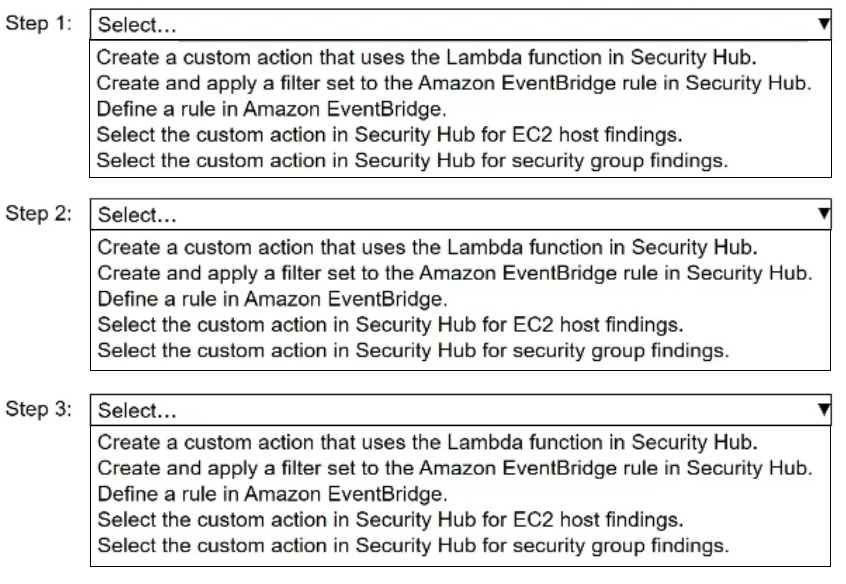
Arrange 3 of these in the correct order:
- Create a custom action that uses the Lambda function in Security Hub.
- Create and apply a filter set to the Amazon EventBridge rule in Security Hub.
- Define a rule in Amazon EventBridge.
- Select the custom action in Security Hub for EC2 host findings.
- Select the custom action in Security Hub for security group findings.
Show answer
- Create a custom action that uses the Lambda function in Security Hub.
- Define a rule in Amazon EventBridge.
- Select the custom action in Security Hub for EC2 host findings.
WhyCreate the custom action first. Then define an EventBridge rule that matches the custom action and targets the Lambda function, because Security Hub sends custom actions to EventBridge. Finally, select the action on EC2 host findings, since the function acts on instances suspected of infection.
- A security engineer needs to protect a public web application that runs in a VPC. The VPC hosts the origin for an Amazon CloudFront distribution. The application has experienced multiple layer 7 DDoS attacks. An AWS WAF web ACL is associated with the CloudFront distribution. The web ACL contains one AWS managed rule to protect against known IP addresses that have bad reputations.
The security engineer must configure an automated solution that detects and mitigates layer 7 DDoS attacks in real time with no manual effort.
Which solution will meet these requirements?- AEnable AWS Shield Advanced on the CloudFront distribution. Configure alerts in Amazon CloudWatch for DDoS indicators.
- BEnable AWS Shield Advanced and configure proactive engagement with the AWS DDoS Response Team.
- CDeploy AWS Network Firewall in the VPCreate security policies that detect DDoS indicators. Create an AWS Lambda function to automatically update the web ACL rules during an attack.
- DAdd a rate-based rule to the web ACL. Enable AWS Shield Advanced. Enable automatic application layer DDoS mitigation on the CloudFront distribution.
Show answer
Correct answer: D
WhyShield Advanced automatic application layer DDoS mitigation detects deviations from normal traffic and creates, evaluates and deploys AWS WAF rules itself, and a rate-based rule adds protection against request floods. Proactive engagement involves the AWS response team contacting you rather than automated mitigation. Since March 2026, AWS recommends the Anti-DDoS managed rule group for new deployments.
- A
- HOTSPOT
A security engineer is using the AWS Well-Architected Tool to evaluate a multi-tier web application that a company hosts on AWS. During the assessment, the security engineer identifies several resources that violate design principles of the Well-Architected Framework security pillar.
Select the security pillar design principle from the following list that each assessment finding primarily violates. Select each security pillar design principle one time.
• Configure service and application logging
• Reduce manual management and interactive access.
• Deploy software programmatically.
• Control traffic flow within your network layers.
• Protecting data in transit.
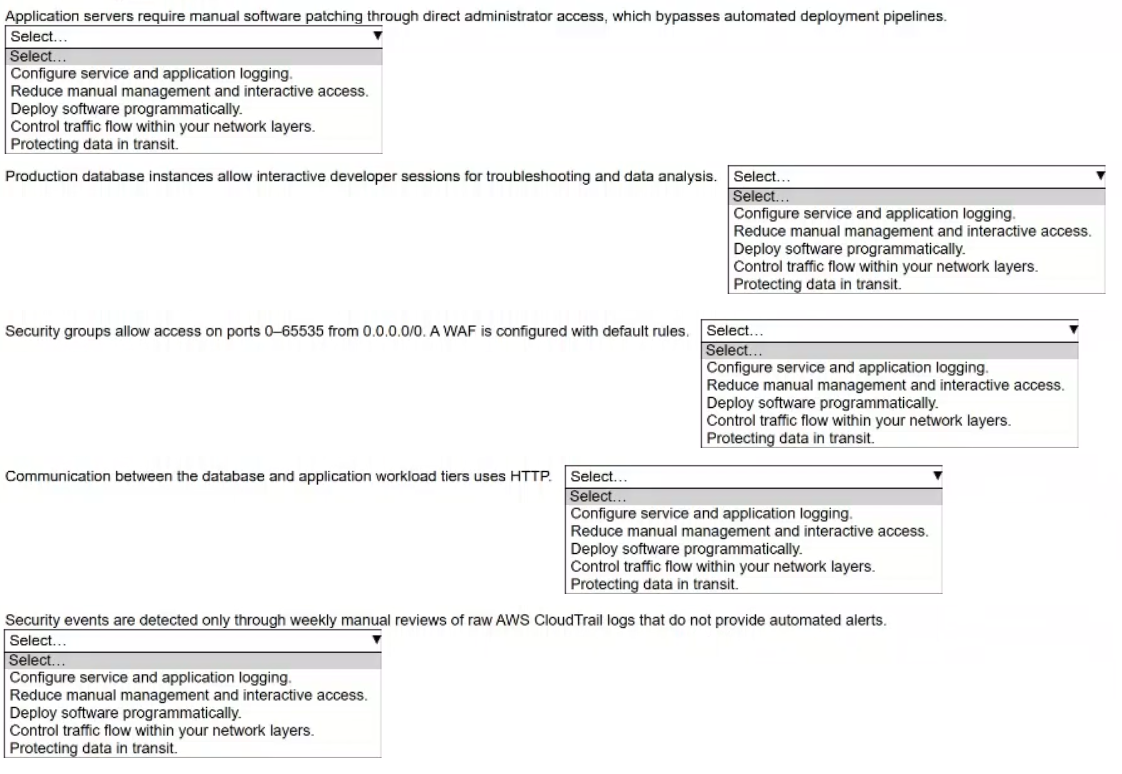
Application servers require manual software patching through direct administrator access, which bypasses automated deployment pipelines. Configure service and application logging. / Reduce manual management and interactive access. / Deploy software programmatically. / Control traffic flow within your network layers. / Protecting data in transit. Production database instances allow interactive developer sessions for troubleshooting and data analysis. Configure service and application logging. / Reduce manual management and interactive access. / Deploy software programmatically. / Control traffic flow within your network layers. / Protecting data in transit. Security groups allow access on ports 0-65535 from 0.0.0.0/0. A WAF is configured with default rules. Configure service and application logging. / Reduce manual management and interactive access. / Deploy software programmatically. / Control traffic flow within your network layers. / Protecting data in transit. Communication between the database and application workload tiers uses HTTP. Configure service and application logging. / Reduce manual management and interactive access. / Deploy software programmatically. / Control traffic flow within your network layers. / Protecting data in transit. Security events are detected only through weekly manual reviews of raw AWS CloudTrail logs that do not provide automated alerts. Configure service and application logging. / Reduce manual management and interactive access. / Deploy software programmatically. / Control traffic flow within your network layers. / Protecting data in transit. Show answer
- Application servers require manual software patching through direct administrator access, which bypasses automated deployment pipelines. Deploy software programmatically.
- Production database instances allow interactive developer sessions for troubleshooting and data analysis. Reduce manual management and interactive access.
- Security groups allow access on ports 0-65535 from 0.0.0.0/0. A WAF is configured with default rules. Control traffic flow within your network layers.
- Communication between the database and application workload tiers uses HTTP. Protecting data in transit.
- Security events are detected only through weekly manual reviews of raw AWS CloudTrail logs that do not provide automated alerts. Configure service and application logging.
WhyManual patching bypasses pipelines, which breaks deploying software programmatically. Interactive sessions on production databases break reducing manual management. Security groups open to all ports fail to control traffic flow, HTTP between tiers leaves data in transit unprotected, and weekly manual log reviews without alerts show that logging is not set up to support detection.